Showing posts with label Tomatoland. Show all posts

Sunday, December 27, 2015

What the heck is that? Kumato tomatoes


Try this experiment at home: drop a supermarket tomato off the counter and see if it gets damaged. 

I inadvertently performed this experiment on some plum tomatoes I was using for a red lentil dish. Nope, they emerged unscathed. 

We all value resilience, of course, but this is a little ridiculous – and an echo of the description in the book Tomatoland of Florida-grown supermarket tomatoes falling off the truck and remaining dent-free. (And I don't mean to imply that this is the worst attribute of supermarket tomatoes, grown in nutrient-free sand, doused in eye-popping amounts of pesticide and harvested under slavery-like conditions. But, yes, there are times when I still buy them.)

I went ahead and used these tomato-bots – I pumped up the tomato flavor with tomato paste and enjoyed the texture and slight sourness the supermarket tomatoes contributed to the dish. 

But using tomatoes in a cooked lentil dish is one thing; a fresh salad is another. Are there viable tomato options for a salad in December?

Enter the kumato.


Kumatoes have a striking appearance - their color is reminiscent of autumn leaves, encompassing various hues of green and brown in addition to their basic red.


Typically when you see a tomato with an exotic appearance, it's hanging out at the farmers' market.


You might have mistaken the kumato for an heirloom variety, had you first seen it in a farmers' market rather than encased in plastic. Kumatoes are actually cultivated (but not genetically modified) tomato variety. They were first bred in Spain; now their patent is held by a Swiss company, Syngenta. Kumatoes have a higher sugar content than most tomatoes (yum) balanced out with some tang, and thicker skins, which make them hardier than regular tomatoes. To help kumatoes stand out even more in shoppers' minds, Sunset, the North American representative for the kumato brand, trademarked the phrase "Simply Unique Brown Tomato" and put the catchphrase on the kumato packaging. 

The kumato tomatoes were delicious in a chopped garden salad, and earned a lot of "How did you manage to pull off a decent salad with winter tomatoes?" compliments. The green and brown hues of the tomatoes got lost in the normal exuberance of a salad. I give the kumato high grades for taste.


But of course it's hard to be unique - even if you're trademarked as such.


Sacher tomatoes, seen here at a farmer's market, are probably mistaken for heirlooms by most shoppers, simply because of their context. But like kumato tomatoes, sachers are carefully cultivated hybrids. Even their name is carefully selected: "Sacher" is intended to connote the chocolately deliciousness of a sacher torte.  As we saw with apple breeding, taste is just one part of the package - the most successful products are also hardy and memorable in the marketplace.


Kumato tomatoes can cope with their farmers' market rivals (and so far, I haven't seen sachers make the leap out of the farmers' market). In fact, the better-because-they're-odd farmers' market varieties help give kumato tomatoes their street cred. But the success of one supermarket "European brown gourmet tomato" can't help but spawn imitators. 

Watch out kumato - brunetta's right behind you.


Tuesday, October 1, 2013

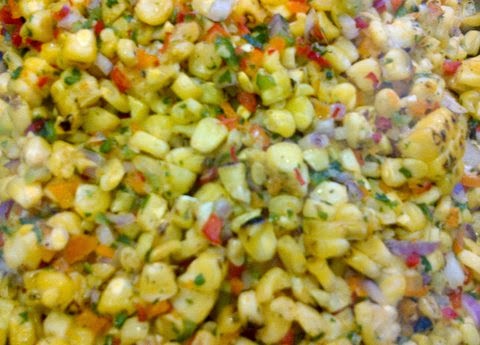
Grilled Corn Salad

Let me be clear from the get-go: corn salad isn't meant to solve an "excess corn" problem. There is no excess corn problem.


This time of year it's common to find ideas and recipes for extra tomatoes, eggplant, squash, etc. I wish I had an excessively fertile garden and over-productive vines! Instead, I had the need for a good picnic salad - the kind that doesn't need refrigeration; has no delicate components to bruise or wilt; and benefits from some knocking around in transit to mix up the ingredients.

I could have made a grain or bean salad, but I had loaded up on ears of corn earlier in the day. When I moved several ears to make way for my salad, I had an epiphany: they could be the basis of my salad!

I quickly assembled the fixings: corn, red pepper, tomatoes, wild scallion from my sister-in-law's garden and some red onion (I had both on hand, but either one would have been fine) and a little parsley from our own windowsill garden. 

Here's the quick-and-dirty recipe:

1) Cook two ears of corn. I stovetop-grilled them in my beloved cast iron skillet for about 7 minutes (turning regularly), but you could steam the corn or even microwave them (2 squares of paper towels to absorb moisture + 2 ears of corn (husks kept in place) + 5-7 minutes = cooked corn.) The grilling gives a nice smoky effect, but any method will work. Once the corn is cooked, set it aside to cool off. 

2) Chop everything else. I used approximately one small beefsteak tomato, 1/4 of a red pepper, one scallion, a leftover bit of red onion and a handful of parsley. I chopped everything finely.

3) Using a sharp knife, cut the corn kernels from the cob, making sure not to cut into the cob itself. Kernels are tasty in a salad but bits of cob are not. (If you're determined to use the cob, save them for soup stock or corn cob jelly.)

3) Make the dressing: mostly vinaigrette  with a splash or two of soy sauce and a splash or two of hot sauce (or a pinch of ground chipotle or one finely chopped chipotle pepper). Mix thoroughly.

4) Dump everything in a large bowl and mix thoroughly.


Enjoy! The salad is good warm, at room temperature or chilled. It's good as a relish or sneaked into sandwiches, green salads or soups.

Come wintertime, you could probably recreate the salad with frozen corn and imported peppers and herbs. (I would try to hold the line against the undentable pink tomatoes described so vividly in Barry Estabrook's book Tomatoland, but I might lack resolve by January.) But for now, this salad tastes like the juicy last harvest of summer.