Showing posts with label guest blog. Show all posts

Sunday, May 7, 2017

Greetings from Cuba!

My friend Bethanne recently took a week-long trip to Cuba. In the past, travel from the US to Cuba required considerable planning and justification for the trip, but the normalization of relations in 2015 has made the impulse of regular tourism - tourism for the curious, not just the credentialed or blood-related - possible.

Being a good friend and Produce Savant guest blogger superstar, she took note of the produce markets.


"Everything looked fresh and good," she said. The picture above, with sensible cabbage, peppers, onions and carrots, two kinds of starchy tubers and actually ripe pineapple. reminded me of the fruit stands in El Barrio, aka Spanish Harlem. 


A wide range of bananas.


Bethanne noted, "I learned that Cubans are on ration books and fresh produce isn't covered by the ration books, which makes the fresh stuff a bit of a luxury."


Political issues always touch produce, even if we don't always discuss it. Trade policies, agricultural policies, environmental policies, labor policies, and so on. What's grown? What's sold? At what price? Who's selling? Who's buying? What isn't sold? What's exported? I'm curious about it all. 


Given the historically fraught relations between theUS and Cuba, the political implications of produce seem more central. But perhaps I'll explore these topics more fully in future posts. But for now, I'll just promise to write about the mysterious fruits in the photo. Look forward to "What the heck is that? Mamey sapote" in the near future.

Monday, August 5, 2013

Watermelon Tourism (Guest blog post from Korea and Hong Kong)

Summer vacations! The time to hit the road and check out far away lands, reunite with family and friends and visit tourist attractions. And the time for me to engage in some vicarious produce tourism.

My friend Thom has been visiting Hong Kong and Korea this summer, and - of course - our email exchanges have a certain focus to them: the food.

And even within our niche topic I've noticed a little sub-niche: watermelon. 


Large & in charge!


Back in New York Thom and I debated the relative merits of seedless (so convenient) versus seeded (usually more flavorful) watermelon. While I mulled over my weekend purchase of a disappointing whole seedless watermelon, Thom continued her exploration of this topic from Hong Kong and Korea.

Here are some of her comments:

We're in Korea! We went to an ocean park today, and I thought it was interesting one of the snacks that was offered was mini watermelon.  They cut it open and served both halves with a with a spoon! It was very refreshing! I normally hate small mini watermelon, but this one was was surprisingly sweet - and seedless too! 


(Here's Thom's daughter Heidi enjoying some of the mini-watermelon.)


Why are you taking my picture, Mom?


Thom's watermelon commentary continued in Hong Kong. 


The photo of the giant watermelon [photo at the beginning of this post]  was taken inside a Japanese supermarket in Hong Kong that sells a lot of beautiful greenhouse fruit. They sold a pretty looking cantaloupe for $240 HK -- about $35 US! There was also a pretty peach -- for $20!

This long, mini-melon [photo immediately above] is known as a "Blacklady," maybe because of the seeds. You can see the name on the price label.


These Malaysian Melon are about half-way between our typical watermelons' size and that of the super mini-melon size. (Mini stuff is big: they have mini-pineapple too.)

In Hong Kong, people still prefer to go shop in the market in they have household help, a stay-at-home mom, etc. old style. People still prefer to hand pick their produce, but the best quality stuff gets picked early in the AM well before lunch. Unless you get there early, by the time you get to the market, the most popular stalls are usually closed since they are sold out. Working people usually go to the supermarket, which will sell everything. I noticed the market is getting smaller and smaller as Hong Kong land is getting more and more expensive, and it's more regulated since the initial outbreaks of SARS and bird flu.

In Hong Kong, people definitely eat very seasonally. In a restaurant, for example, instead of ordering a plate of broccoli, you would ask the waiter, "What vegetables do you have today?" Now in the summer there is something called "yean choi," that is available. It's like spinach except with more texture and less of a minerally taste - like a big, crunchy watercress. You might get that. Once you select your vegetable, you tell the waiter exactly the way you want it done. [Editor's note: Cover your eyes, vegetarians!] Poached in fish stock, steamed with chicken broth, stir fried with shrimp paste with chili, etc. The vegetable dish is more of a main dish than a side dish; it's the same size as an entree.

Thom sent another interesting picture, this time from Korea. (With nary a watermelon in sight! See, we are complex people with many varied interests - vegetables, for example.)


It's alive!

The Lotte Mart is a 3 story supermarket in Seoul that sells everything from shampoo to stationery to pots to frozen, fresh and preserved vegetables. They also sell lettuces that are still growing - here they are in their little nursery.

Given that Korea is kimchi world, they have a whole section, easily a 2000 square foot space, just for preserved and pickled vegetables, fish, etc. Every customer seems to buy leeks and scallions in this market.

The weather has been rainy, otherwise I'd be visiting the market we passed on a taxi ride. It's huge - Vietnamese, Hong Kong style. The vendors sell stuff from woven baskets, just grabbing and weighing. Like Chinatown but on a massive scale. Sorry to miss out on those pictures.

Wednesday, April 24, 2013

The ramps are here!


They're coming. The signs are in place.


Wait - they're here!


In my experience, no other item of seasonal produce, however delectable - not corn, not cherries, not berries, not tomatoes - generates as much anticipation and fanfare at the Union Square Farmers' Market as ramps do.

Ramps, also known as wild leeks are certainly a lovely sign of spring.


Even their roots are cool.

My hair looks like this sometimes

And the city of Chicago supposedly got its name from "shikaakwa" or "chicagou," an American Indian word for ramps. But never mind all that. 


Ramp enthusiasts stage annual ramp festivals out of love for this short-lived vegetable. April (take that, T.S. Eliot) is ramp season, and for once this blog will salute a vegetable in its heyday rather than hailing it farewell when its season ends.


My friend Thom, hot off her guest blogging effort about mango agar dessert has returned to write this ode/recipe for her beloved ramps. Take it away, Thom!


I love ramps and you can put them in anything, quiche, pasta, omelets, etc.

Ramps are only available in Spring, 2 - 3  weeks window max, and then they are gone! So eat them while you can!


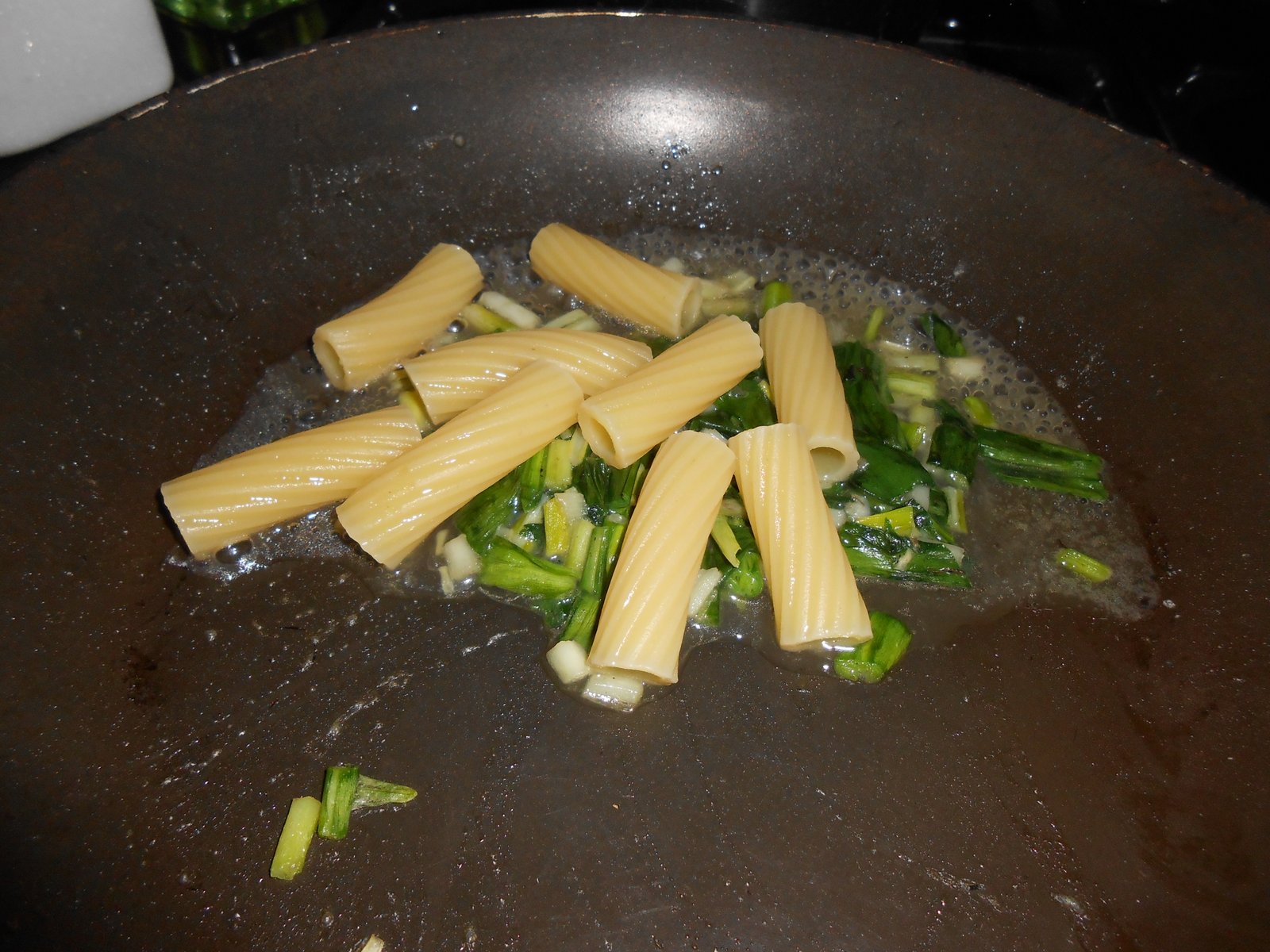
I like to serve ramps with pasta. I cook the pasta - I use rigatoni in this recipe - separately and don't cook the ramps until the pasta is done because the ramps have a very short cooking time. Drain the pasta for ease of use but keep some of the pasta's cooking water since you'll need it for the finished dish. 

Instructions:

There is nothing I hate more than sandy vegetables, and ramps are sandy. Make sure you untie the rubber band that is generally used to tie the bunch of ramps and soak them in cold water.  By doing that, all the sand/soil/dirt will loosen, which makes it easier to rinse later. 

Rub a dub dub, some ramps in a tub

Once you have rinsed them WELL, you can cut off the root and very tip top part.  I like to pull out the first outer layer skin off too, because normally that's where all the dirt hides.  Once you do that, it's nice and pretty and ready to use.


You can eat the ENTIRE ramp (other than the root part). Chop the white part in smaller pieces since it takes longer to cook.  As you can see from my picture, the bottom of the ramps are cut into small pieces and the top parts, which cook more quickly, are left in relatively large pieces.


Heat a saute pan with either olive oil or butter (depending upon how healthy you want to be). Saute the white part of the ramp in medium heat, add a sprinkle of salt, then add the rest of the leafy part and add a little bit more salt. 


Once the white part is translucent, about 3 -4 minutes, add the cooked pasta into the saute pan along with a ladle of the pasta's cooking water. Mix well, and you are done.


For extra flavor, sprinkle a tablespoon of Parmesan cheese on top and freshly grounded pepper. Enjoy!