Showing posts with label my friend Karen. Show all posts

Friday, September 4, 2015

How to Pick a Good Cantaloupe

Yes, once again I'm taking a break from showcasing the oddball and  curious side of produce to offer, as my friend Karen said, "something useful, for a change." My only regret, of course, is that I can't offer this particular blog post in Odorama.


You might recall Odorama from the John Water's film Polyester.  The movie was enhanced by Smell-o-Vision cards that audience members were supposed to sniff at various times in story, to give them a deeper understanding of the movie. (This being a John Waters movie, unlike later family-friendly copycats like Spy Kids, which used "Aromavision," the scents included dirty sneakers and airplane glue.)

A Smell-0-Vision card would be useful to demonstrate the most important criterion in selecting a good cantaloupe: aroma.

A sweet, ripe cantaloupe will have a very pleasant, tropical, floral scent. Your nose can help you weed out cantaloupes with rot and mold - distinctive and unpleasant smells.

In the absence of Odorama, I suggest that you get into the habit of smelling cantaloupes that were sweet and luscious, and committing the smell to memory. Likewise, remember the smell of melon mold and remember it when you next hold your cantaloupe auditions.

You can also find visual clues to the cantaloupe's taste.

First, avoid cantaloupes with signs of withering, moldy patches or rot.


Next, look at the cantaloupe's underlying color below its netting. A creamy or orange color is good; greenish casts, especially if they are dark green, suggest underripeness.

Finally, check out the melon's stem end. An "innie" indentation means that the cantaloupe was ripe enough at the time of harvest to be pulled off its vine.


If the melon still has a bit of stem attached, it means that it had to be cut off before it was fully ripened.


As always, a fruit that is heavy for its side is likely to be ripe and juicy.

Choose a cantaloupe that is heavy for its size and has a floral aroma, creamy color, and an innie stem end, and you're likely to nab a good one!


After dealing with the mystery of the plum, my status as the Produce Savant needs this reassurance.

Friday, December 26, 2014

Forget the Can: How to Choose and Cut Fresh Pineapples


My friend Karen has a suggestion.

"Hey, how about taking a break from writing about weirdo fruits and bizarre vegetables and write instead about something practical, like how to choose a good melon or cut up a pineapple? You know, something useful?"

Hey, I'm all about useful and practical. Was not this blog's very first entry Make It Pretty about making attractive fruit platters?

But Karen is right that I have digressed from time to time from this Useful 'n' Practical path, so I will try to heed her advice. December isn't the best time for melon tips, but it's always pineapple importing season in New York.


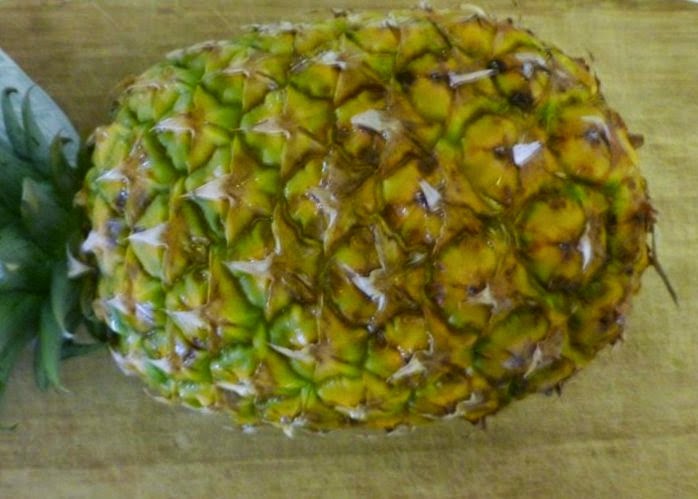
What should you look for in a fresh pineapple? First, you want a nice, tropical scent. Avoid pineapples with no scent, which are likely to be under-ripe and flavorless, or with fermented or rotten scents. Also avoid pineapples that are predominantly green. A bit of brown may be okay - it was in the pineapple shown above - provided the brown areas aren't spongy, soft or bruised. I personally haven't found the pull-out-a-leaf method (if the leaf releases easily, the pineapple is ripe - or overripe) helpful in determining flavor, but it is kind of fun. Just make sure you leave some leaves on for the next tester.

Now you're ready to cut up your pineapple. For about $20 you could buy a gadget that cores and slices the pineapple. Like leaf-pulling, using this tool is kind of fun. If it takes the intimidation factor out of enjoying fresh pineapple, great. On the other hand, the corer does waste a fair amount of the pineapple, and it's one more item to buy and maintain. It's not hard to cut up a pineapple using one of those nice sharp knives that you ideally already have on hand. I use my my trusty chef's knife.

1) Cut the bottom of the pineapple off. Some people cut off the crown at this stage, but I like to keep the crown as a handle.


2) Stand the pineapple up and begin cutting off the peel. Don't worry if you leave some peel or "eye" in place. You'll be going back and correcting your work.


3) Find the diagonal line on which a collection of eyes fall. Make a cut to the right of this line.


4) Then make an angled cut to the left of the eyes and remove a V shaped chunk of eyes.  


5) Repeat throughout the pineapple.


6) Vive la Revolution! It's time to cut off the crown.


7) Interestingly, the V cuts end up being a bit decorative.


8) Cut the pineapple in half, then quarters.


9) Remove the woody core. Frugalistas can use the core to make fruit vinegar, stock  and skin treatments.


10) And after that, it's off to the fruit platter. Note the decorative fins your V cuts have given your pineapple slices!


A nice change of pace from the lifesaver ring shape.