Showing posts with label pickles. Show all posts

Wednesday, April 30, 2014

The Slime Factor

Is okra the new "it" vegetable?


For the first time, okra is making frequent appearances on New York's produce carts - following the star-making trail of fuyu persimmon, lychees and other mainstream crossover successes.


I know I have limited ability to divinate The Next Big Produce Thing, okra's popularity is surprising for an excellent reason: okra doesn't get a lot of love.

Some responses I've heard over the years: "Eww!" "Are you really gonna eat that?" and "Okra? Aren't they like slugs for vegetarians?"

My friend Maryann is an okra enthusiast, though she mainly enjoys okra in its New Orleans omnivore incarnations - gumbo (literally okra in Bantu), and jambalaya. Of course, it helps that she doesn't mind what others find objectionable about okra: the slime factor. "I like it all," she says.

I'm not as unambivalently pro-okra. I like okra pickles (hmm...I sense a potential blog entry!), which are crispy and non-slimy, but I'm put off by the slug-like texture that I associate with overcooked okra.

To learn more about okra's potential, I turned to Indian cuisine. I love Indian vegetarian food - could half a billion people be wrong? - but I admit that two decades of enjoying Indian food hasn't prompted me to order bhindi masala. (Okra vs. potatoes, lentils and flatbread? Nice try. Hard to find anyone to go halvsies, either.) But simply knowing that okras had a fan base for dishes beyond gumbo and deep-fried hush puppies (deep-fried anything has a fan base, so the that can't count for much) helped make the case to try some okra for myself.

But what to do about the slime factor?

There were several schools of thought: Don't cut the stem. No, don't cut the okra anywhere. An intact okra is a slime-free okra.

No, the enemy is water. Never add water to okra. Dry the okra diligently - and dry it again when you think you're done - after washing it. 

High heat! High heat will keep your okra nice and slimeless. High heat and quick cooking.

No, choose youth! Small, tender okra would naturally have fewer seeds and less developed mucilage - i.e., less slime.

I decided to cherry-pick some ideas from the varying philosophies. After perusing some recipes, I decided to cook okra with some onion and Indian spices.

Most bhindi masala recipes call for the okra to be split lengthwise. That seemed to be an invitation to slimeville. I liked the idea of quick cooking at a high heat. I also liked the idea of small, tender okra, ideally warmed by the August sun in my own ripening garden, but as a young friend likes to say, you get what you get and you don't get upset. 

My stance on slicing was part devil-may-care (I'd slice most of them), part scientific researcher (I'd keep a few okra whole and see if this control group was substantively different than the cut sample).

Finally, I would wash those babies and pat them Sahara Desert dry.What else are paper towels for?


Indian Spiced Okra

1 lb. okra
1 medium onion, finely diced
2 cloves garlic, finely diced
1 tablespoon ginger-garlic paste
1 teaspoon ground cumin 
1 teaspoon cumin seeds (what can I say? I love cumin!)
1 teaspoon ground coriander
1/2 teaspoon turmeric
1/2 teaspoon asafetida, optional 
1/2 teaspoon red pepper flakes (or less, to taste) or other hot pepper
Oil spray


Directions: 

Wash and dry the okra. Slice in half or keep whole as you wish. Or do both, for comparison.

Spray a large saute pan or cast iron skillet with oil spray or a thin film of olive oil. Saute the onion over a medium flame, adding the garlic after a few minutes, until golden (about 5 minutes). 

Add the ginger-garlic paste and then the spices, stirring vigorously to coat the onion mixture, and saute for a minute. 

Add the okra, continuing to stir. Add another bit of oil or oil spray to prevent scorching. Cover the pan, lower the heat and cook for an additional 3 - 4 minutes.


Variation: I added 2 chopped tomatoes with the okra, since bhindi masala does include tomatoes. 


This time the okra did come out a bit slimy. Was it the tomatoes? Did I simply overcook the dish? My mode of scientific inquiry has its limits: I plan to return to the tomato-free version rather than test all the permutations of the dish. Besides, I'll need those okras for my pickling experiments.

Good thing the produce carts seem so well stocked.


Saturday, October 12, 2013

Waste Not, Want Not

I hate waste, but I have my limits.

I pickled watermelon rinds - once - before I concluded that it was fine to toss them into the compost pile. I think soy sauce makes a better vegetarian soup base than a dubious collection of peels, so my enormous pile of scraps generally go to the compost pile as well, not the stock-in-progress pile.

But if root-to-frond eating, the vegetarian equivalent of snout-to tail -  makes sense, I'm all for it.

My new chum (if not best friend), radish, offers such a package deal.  


The radish's roots are what we think of as "radish," but typically they come attached to some greens. Often those greens look as appealing as as any garden lettuce. And there they are, convenient attached to the vegetable you're already purchasing! 

So if your produce seller asks, "Want me to cut off the tops?" don't absent-mindedly nod yes. It might even be worthwhile to inquire about the greens that your fellow customers requesting be chopped off and discarded. 

But what can you do with the green part of your package deal?

While you ponder your options, give the greens a good clean-up soak. Root vegetables and their attached greens live in soil, and often bring the soil with them wherever they go. Fill a large bowl with water, cut the radish tops off and give them a good soak. Dump out the mud and do it again. Drain and hose them down when you're through. You might be astonished by how much mud is left behind.

Yes, feel free to waste the soil

After you spin or pat the radish greens dry, consider some possibilities:

1) The simplest: Use the greens as you would watercress or arugula. Add them to a salad; bring some brightness to a sandwich; toss them into a soup; or place them as a base underneath a hot, protein-rich food.

2) Be inspired by namul, the marinated vegetable dishes that are part of the banchan often served as appetizers at Korean restaurants. Coat the greens with one or two teaspoons of toasted sesame oil and one tablespoon of soy sauce (feel free to dribble the liquids from their respective bottles and use your well-scrubbed hands to mix). When the marinade is evenly distributed, add one teaspoon of toasted sesame seeds, and if you like, a splash of mirin.

3) Wilt the greens in a very lightly oiled skillet for few minutes. If you're like me, you think a splash of soy sauce makes everything better, so go ahead and add that splash. This is a great use of vegetarian ponzu (citrus) soy sauce.


And what about the radish "bottoms" - you know, radishes?

Start out by making sure the radishes are rid of soil. 

I like to give radishes a haircut - I cut off their rat-tail roots.


Then give them a nice pat-down.


Of course you could use the radish for salads or for lovely garnishes, as I used to do. Lately I've been enjoying the caramelized, salty snack goodness of sauteed radishes. Sauteing the radishes brings out their sweetness - great if you've avoided radishes because you find their raw taste too harsh. I cut the radishes in half and cook them, cut side down, for a relatively long time - 20 minutes or even more - in my trusty cast-iron skillet.


I cover the skillet and keep the flame medium-low. After a while the radishes turn a rosy pink. Keep them there 20 minutes or so and they'll get brown. 


I like to sprinkle them with sea salt right in the pan. There have been times when a friend and I have eaten them directly from the pan, with no pesky, needs-to-be-washed plates getting in the way. Yes, "salty snack goodness" is no misnomer.

Of course, the combo platter - radish tops and bottoms - is another option, a tasty and attractive option.


Radishes are not only dirty, but dirt cheap. A bunch goes for about $1.50 at the Union Square Greenmarket. Many vendors charge just $1 - and with good timing and the slightest interest, you typically can get extra radish greens for free. Pretty astounding.

Yes, I am indeed thinking about the radish.


Sunday, August 25, 2013

A Day at the Beach

What does a beach have to do with produce? Everything - if the beach is Brighton Beach!

Brighton Beach is a Brooklyn neighborhood adjacent to the more famous Coney Island. In addition to its lovely and gorgeous mosaic beach (yes, the same South Shore of Long Island beaches that celebrities enjoy in The Hamptons), Brighton offers what New York Magazine called "arguably the most fascinating ethnic enclave in New York," an area in which several waves of Russian immigrants, initially Russian Jews in the 1970s and more recently a mix of Russian Jews and gentiles after the collapse of the Soviet Union, call home.

These are some of New York's most produce-loving people, as a stroll down the neighborhood's main drag, Brighton Beach Avenue, will reveal.


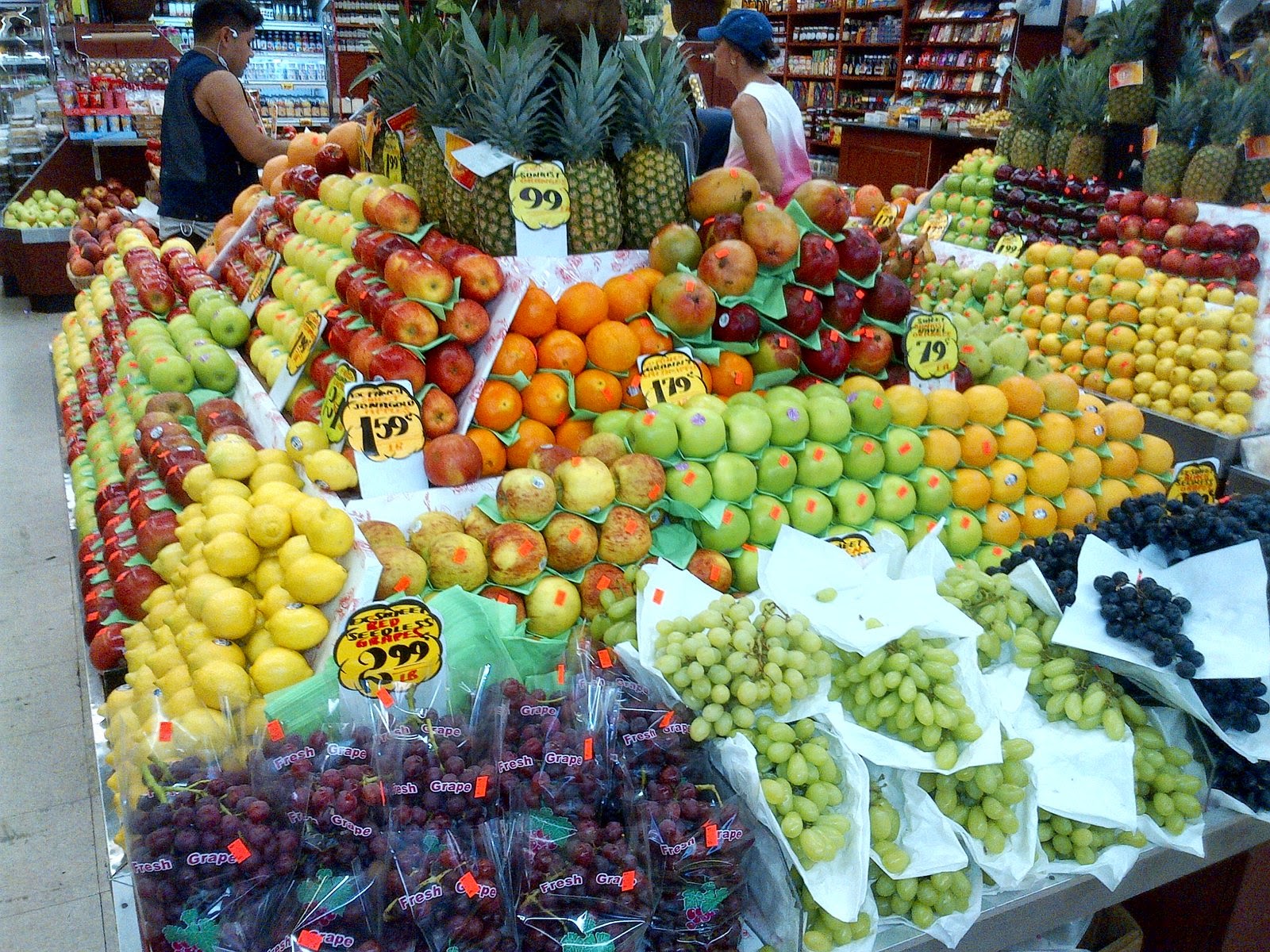
Some fruit vendors, particularly Fancy Farm (across the street from the Brighton Beach branch of the Brooklyn Public Library) are as fancy and beautifully arranged as any gourmet store.


Don't be surprised to see a sea of options, especially for produce items particularly beloved in the Russian community - three kinds of sour cherries, for example.


Does the number 99 contain mystical properties? Nah, these demanding shoppers just enjoy a good value.


Of course, the long Russian winter gives an appreciation for the need to preserve that bounty. Or maybe it's just that pickles are so tasty! Expect your vendor to carry a selection - pickled cucumbers, cabbage, tomatoes, etc.


Every now and then you'll see a sign that shows an appreciation for other produce items that wouldn't necessarily get as much love in another community.


Of course, Brighton Beach is still a beach! Not everyone is focusing on the produce. (And to be honest, once I'm on the beach, neither am I.)


Amazingly, this journey is readily accessible via the same subway lines that might take you to Central Park or Rockefeller Center. Or, in my case, home.