Showing posts with label weeds. Show all posts

Thursday, September 19, 2013

What the heck is that? Purslane


One of the fun things you can do in the Union Square Greenmarket is snoop in chef’s shopping carts. Today I snooped in this cart. Sure enough - this seems like the norm this time of year - there was some purslane on top.


Let's go for the close-up:


Purslane is a chef’s darling, but to many folks it’s a weed. As horticulturalist Sandra Mason  writes, "Purslane, Portulaca oleracea, is probably in your garden right now, but not because you invited it to dinner."

Once you know what to look for, you'll find it, as I did, in a green patch around an urban traffic light and in a mall parking lot.


And don't think these purslane patches aren't here to stay! Purslane has made its way all over the world - not surprising, given purslane's legendary hardiness. As Mason notes,

Seeds of purslane have been known to stay viable for 40 years in the soil. You may find that fact either depressing or exciting... Purslane grows just about anywhere from fertile garden soil to the poorest arid soils. A rock driveway is nirvana to purslane... Again depressing or exciting. Running a tiller through purslane is called purslane multiplication.


I first encountered purslane as a desirable vegetable in Turkey, where it is prized in a variety of dishes - stews , meze appetizers, and salads. In New York, I frequently see it sold in the East Harlem vegetable stalls that cater to Mexican shoppers. And it's sold at many farmers' markets, where it is snapped up by chefs and a small but cultish following of laypeople. (And, occasionally, curious shoppers who interact with both groups.) This stand at a farmers' market is hoping to entice the uninitiated. 


So what's purslane's appeal? Of course, if you have a lot of it growing in your garden, by all means forage away. Purslane is extremely nutritious - in addition to being a good source of fiber, Vitamins A, B and C and several minerals and anti-oxidants, purslane has more Omega 3 fatty acids than any other leafy plant source. Chefs like it because it is a juicy succulent with an unusual tangy, almost lemony taste. Whenever I've seen someone buying purslane, I've asked them what they planned to do with it. Here are some of the responses: 

  • Mixed green salad
  • "Hide it in a sandwich for extra nutrition"
  • Chopped salad with tomatoes, cucumbers and onions
  • Salad with watermelon
  • Wilted, like spinach or other greens, underneath a hunk of protein
  • In a soup
  • "I'm Turkish, so with yogurt or with lamb"

Purslane does indeed go well with tomatoes - juiciness meets juiciness - and I was intrigued by the watermelon suggestion. Another juicy idea!


This combination was a winner! As it happened, this particular watermelon wasn't that impressive on its own, but as a salad ingredient it was aces. (As an aside, I'm always on the lookout for ideas for disappointing produce (check out some entries in the When Bad Produce Happens to Good People series on this blog), and treating a fruit as a salad vegetable often lowers the bar satisfactorily.)  A good addition to this salad would be something salty - olives, capers - or just some salt itself. 


The other idea that appealed to me was wilting the purslane. Purslane can get a little slimy if it's overcooked, so a light hand and quick cooking time are in order. You could saute some chopped garlic in oil first or proceed without it.


Sometimes I like to eat the tangled web of purslane with chopsticks.


One final tip: Purslane stems may be sold without their roots or with them.


If the roots are intact, expect clumps of sod too.


Give the purslane a soak and thorough hosing.

Give them a haircut too - no need for rat-tails here!


A couple of times I've pinched tip of what I assume is a purslane stem's seed head and planted it in one of my flower pots. The success of this plant plan is by no means guaranteed: I've killed a few "weeds" in my time - this year, a lovely pot of spearmint - so I don't know if this ever-propagating plant will visit me next year. If not, no big deal. That's what farmers' markets are for.

Saturday, April 20, 2013

What the heck is that? Cardoons

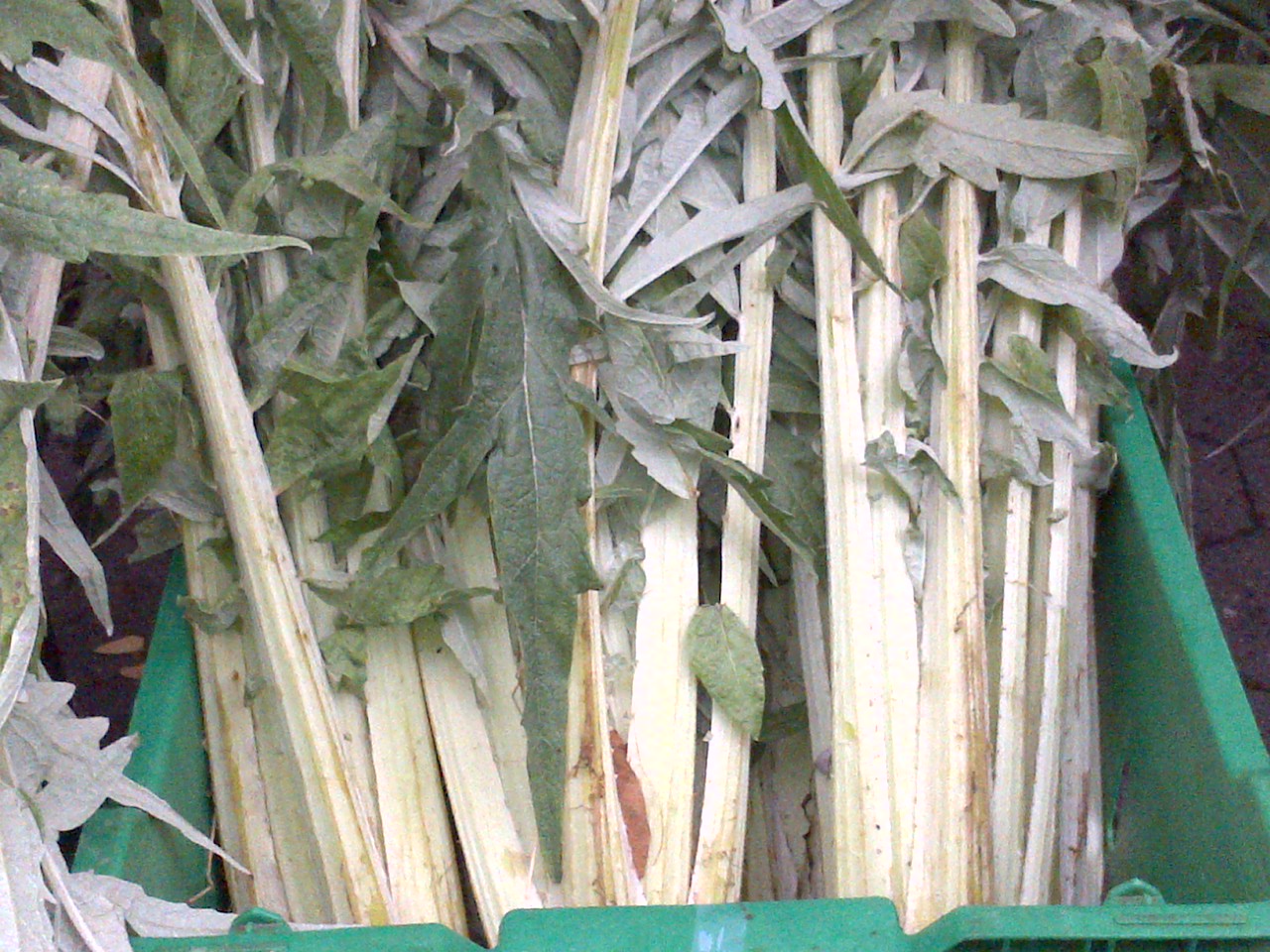
Stalks that looked a bit like celery, leaves that would not have been out of place overhead on a tree, and the overall impression of a lovely greenish-silver that could be next year's fashion must-have color. 

What the heck was this vegetable?

If I had seen the plant growing out of the ground I might not have even assumed it was edible, but it was in a bin at the Union Square Farmers Market, so I asked the farmer.

Really, what the heck is that?

Cardoons, he said.

I had never heard of cardoons. I liked the sound of the word. I could easily imagine it in the history books: "The king was overthrown in the Cardoon Revolution of 1658." The farmer told me that cardoons tasted a bit like artichokes and grow like crazy.

I consulted my well-thumbed copy of The Oxford Companion to Food.


A book that I gave as a gift, but I ended up using all the time

I learned that the cardoon was


a member of the thistle family, with a flower head intermediate in size and appearance between artichoke and common thistle. Long before the artichoke was developed, the ancient Greeks and Romans regarded the cardoon as a great delicacy.

So far so good. The book went on to advise,
The flowering heads, stems and midribs of the main leaves are eaten.The flavor is complex. bitter and sweet, with limits of artichoke hearts, celery and oyster plants...Still popular in Spain and Italy, [cardoons are regarded as] a troublesome weed in South America, Australia and California. 

I sometimes ponder the old vegetable-or-weed conundrum, especially when I buy dandelion greens or purslane (hmm....perhaps a blog entry is in order, or maybe trademarking this great party game), but cardoons looked much more substantial than the weeds I know. Their root systems looked like they could get pretty entrenched. I could easily imagine one saying, "I SAID, this is my garden now." Eating them seemed like basic self-defense.

I brought the cardoons home, washed them thoroughly and put them on the chopping block.


Some of the outer stalks needed some trimming. I enjoyed the feathery appearance of some of the leaves.


I pondered what to do with my cardoons. A quick internet search revealed that in the wild, cardoons have a beautiful flower head and massive spikes. Cardoons are known as cardone (make that "car-doh-nay") in Italy, where both their stalks and flower buds are popular. Cardone are made into soups and stews; battered and fried; and used in risotto. They are featured prominently in  bagna cauda, a fondue-like dish in which raw and boiled vegetables get dipped in a hot bath of garlicky olive oil or melted butter. In the US, they're apparently snapped up by those in the know - folks who come from Mediterrean countries in which cardoons are popular - and totally ignored by everyone else.

Since this was my first adventure, I thought I'd saute/steam the cardoons in a skillet, and consider whipping up a kind of vegetarian (anchovy-free) bagna cauda if I felt motivated. 


I had read some recipes that suggested braising the cardoons for an hour, but I declared the cardoons ready for consumption after about 15 minutes.

The verdict: Okay. Kind of tasty. Quicker to cook than artichokes but with a smaller payoff.  The taste was as The Oxford Companion said, artichoke + celery hearts. 

The food writer Deborah Madison called the vegetable "the difficult cardoon" and suggested "rich embellishments" like cream, eggs and cheese. She noted that her guests liked a cardoon salad she served well enough, but "didn't feel that it warranted the effort involved." Her response - "feature cardoons in a course devoted only to them" - made me laugh. You brat! You're an overpriced non-entity, but if I devote enough attention to you my guests will understand that you're worth my considerable investment of money (as Madison also notes, "cardoons are expensive") and time.

Reading between the lines, I would have concluded that cardoons are on the "forgotten vegetables" list for good reason, and that I was unlikely to encounter them, at least in New York, except as a farmers' market curiosity.

But once again I failed as a Produce Trend Spotter. Soon after my cardoon experiment, I spied them on a supermarket shelf, looking right at home, occupying their space with no particular fanfare. No introductory signs, no testimonials, no ingratiating recipe suggestions to entice the unfamiliar to take a risk on an mystery product. 


And even more amazingly, they were wearing jaunty produce code rubber bands that suggested that they were here to stay.