Wednesday, April 24, 2013

The ramps are here!


They're coming. The signs are in place.


Wait - they're here!


In my experience, no other item of seasonal produce, however delectable - not corn, not cherries, not berries, not tomatoes - generates as much anticipation and fanfare at the Union Square Farmers' Market as ramps do.

Ramps, also known as wild leeks are certainly a lovely sign of spring.


Even their roots are cool.

My hair looks like this sometimes

And the city of Chicago supposedly got its name from "shikaakwa" or "chicagou," an American Indian word for ramps. But never mind all that. 


Ramp enthusiasts stage annual ramp festivals out of love for this short-lived vegetable. April (take that, T.S. Eliot) is ramp season, and for once this blog will salute a vegetable in its heyday rather than hailing it farewell when its season ends.


My friend Thom, hot off her guest blogging effort about mango agar dessert has returned to write this ode/recipe for her beloved ramps. Take it away, Thom!


I love ramps and you can put them in anything, quiche, pasta, omelets, etc.

Ramps are only available in Spring, 2 - 3  weeks window max, and then they are gone! So eat them while you can!


I like to serve ramps with pasta. I cook the pasta - I use rigatoni in this recipe - separately and don't cook the ramps until the pasta is done because the ramps have a very short cooking time. Drain the pasta for ease of use but keep some of the pasta's cooking water since you'll need it for the finished dish. 

Instructions:

There is nothing I hate more than sandy vegetables, and ramps are sandy. Make sure you untie the rubber band that is generally used to tie the bunch of ramps and soak them in cold water.  By doing that, all the sand/soil/dirt will loosen, which makes it easier to rinse later. 

Rub a dub dub, some ramps in a tub

Once you have rinsed them WELL, you can cut off the root and very tip top part.  I like to pull out the first outer layer skin off too, because normally that's where all the dirt hides.  Once you do that, it's nice and pretty and ready to use.


You can eat the ENTIRE ramp (other than the root part). Chop the white part in smaller pieces since it takes longer to cook.  As you can see from my picture, the bottom of the ramps are cut into small pieces and the top parts, which cook more quickly, are left in relatively large pieces.


Heat a saute pan with either olive oil or butter (depending upon how healthy you want to be). Saute the white part of the ramp in medium heat, add a sprinkle of salt, then add the rest of the leafy part and add a little bit more salt. 


Once the white part is translucent, about 3 -4 minutes, add the cooked pasta into the saute pan along with a ladle of the pasta's cooking water. Mix well, and you are done.
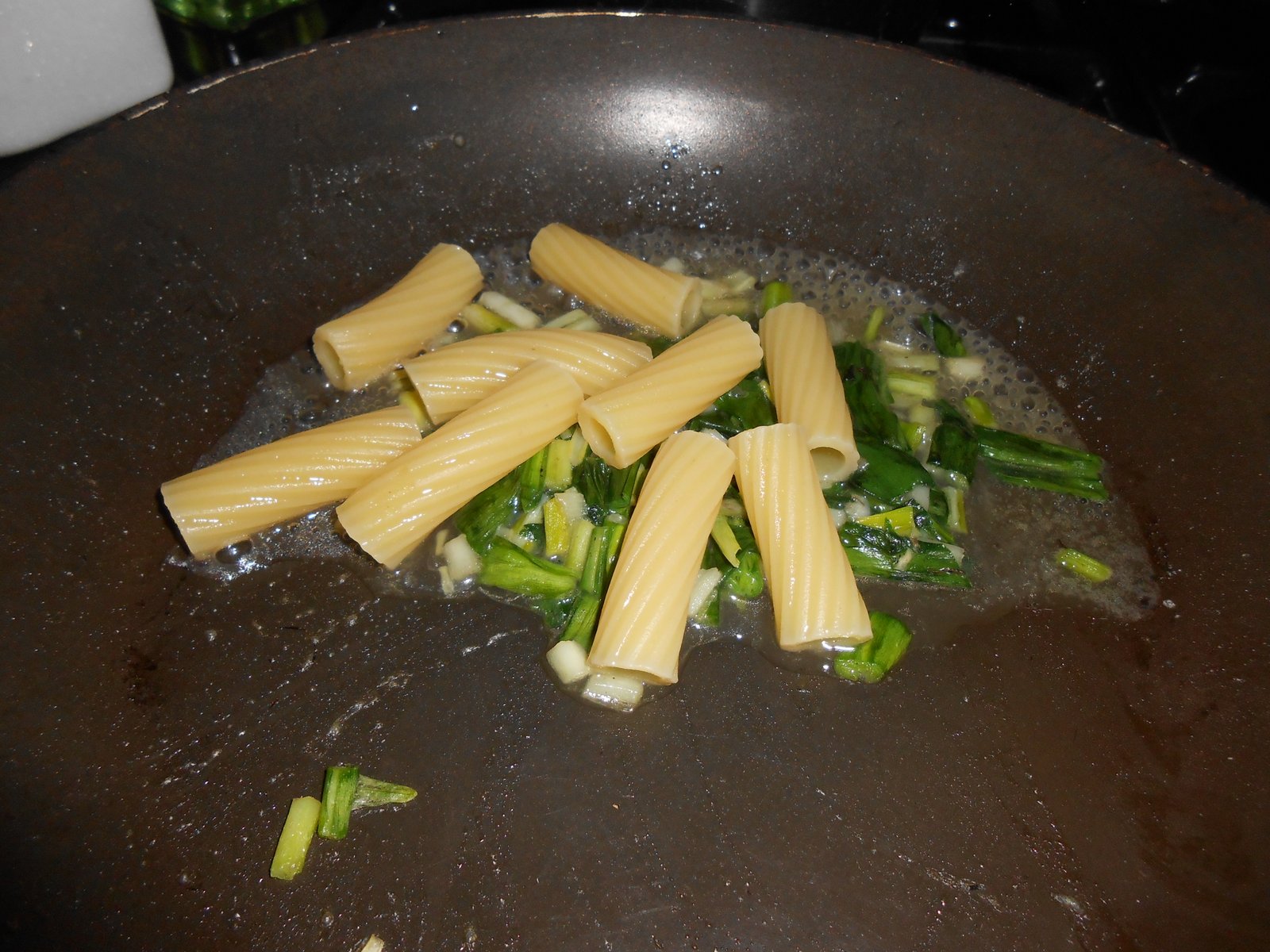


For extra flavor, sprinkle a tablespoon of Parmesan cheese on top and freshly grounded pepper. Enjoy!


Saturday, April 20, 2013

What the heck is that? Cardoons

Stalks that looked a bit like celery, leaves that would not have been out of place overhead on a tree, and the overall impression of a lovely greenish-silver that could be next year's fashion must-have color. 

What the heck was this vegetable?

If I had seen the plant growing out of the ground I might not have even assumed it was edible, but it was in a bin at the Union Square Farmers Market, so I asked the farmer.

Really, what the heck is that?

Cardoons, he said.

I had never heard of cardoons. I liked the sound of the word. I could easily imagine it in the history books: "The king was overthrown in the Cardoon Revolution of 1658." The farmer told me that cardoons tasted a bit like artichokes and grow like crazy.

I consulted my well-thumbed copy of The Oxford Companion to Food.


A book that I gave as a gift, but I ended up using all the time

I learned that the cardoon was


a member of the thistle family, with a flower head intermediate in size and appearance between artichoke and common thistle. Long before the artichoke was developed, the ancient Greeks and Romans regarded the cardoon as a great delicacy.

So far so good. The book went on to advise,
The flowering heads, stems and midribs of the main leaves are eaten.The flavor is complex. bitter and sweet, with limits of artichoke hearts, celery and oyster plants...Still popular in Spain and Italy, [cardoons are regarded as] a troublesome weed in South America, Australia and California. 

I sometimes ponder the old vegetable-or-weed conundrum, especially when I buy dandelion greens or purslane (hmm....perhaps a blog entry is in order, or maybe trademarking this great party game), but cardoons looked much more substantial than the weeds I know. Their root systems looked like they could get pretty entrenched. I could easily imagine one saying, "I SAID, this is my garden now." Eating them seemed like basic self-defense.

I brought the cardoons home, washed them thoroughly and put them on the chopping block.


Some of the outer stalks needed some trimming. I enjoyed the feathery appearance of some of the leaves.


I pondered what to do with my cardoons. A quick internet search revealed that in the wild, cardoons have a beautiful flower head and massive spikes. Cardoons are known as cardone (make that "car-doh-nay") in Italy, where both their stalks and flower buds are popular. Cardone are made into soups and stews; battered and fried; and used in risotto. They are featured prominently in  bagna cauda, a fondue-like dish in which raw and boiled vegetables get dipped in a hot bath of garlicky olive oil or melted butter. In the US, they're apparently snapped up by those in the know - folks who come from Mediterrean countries in which cardoons are popular - and totally ignored by everyone else.

Since this was my first adventure, I thought I'd saute/steam the cardoons in a skillet, and consider whipping up a kind of vegetarian (anchovy-free) bagna cauda if I felt motivated. 


I had read some recipes that suggested braising the cardoons for an hour, but I declared the cardoons ready for consumption after about 15 minutes.

The verdict: Okay. Kind of tasty. Quicker to cook than artichokes but with a smaller payoff.  The taste was as The Oxford Companion said, artichoke + celery hearts. 

The food writer Deborah Madison called the vegetable "the difficult cardoon" and suggested "rich embellishments" like cream, eggs and cheese. She noted that her guests liked a cardoon salad she served well enough, but "didn't feel that it warranted the effort involved." Her response - "feature cardoons in a course devoted only to them" - made me laugh. You brat! You're an overpriced non-entity, but if I devote enough attention to you my guests will understand that you're worth my considerable investment of money (as Madison also notes, "cardoons are expensive") and time.

Reading between the lines, I would have concluded that cardoons are on the "forgotten vegetables" list for good reason, and that I was unlikely to encounter them, at least in New York, except as a farmers' market curiosity.

But once again I failed as a Produce Trend Spotter. Soon after my cardoon experiment, I spied them on a supermarket shelf, looking right at home, occupying their space with no particular fanfare. No introductory signs, no testimonials, no ingratiating recipe suggestions to entice the unfamiliar to take a risk on an mystery product. 


And even more amazingly, they were wearing jaunty produce code rubber bands that suggested that they were here to stay.


Wednesday, April 17, 2013

In Praise of the Simple Baked Potato

So you know what to do with bad produce.

Now let's take a moment to talk about good produce. Really good produce.


I bought some beautiful carola potatoes at the Union Square Green Market over the weekend. I pricked a few holes in the potatoes with a fork, set them directly on the oven racks and baked them for about an hour and a half at what might have been 400 degrees in my somewhat iffy oven.

They were just heavenly.

My family enjoyed the potatoes with salt and pepper, but of course you could add butter, creme fraiche, yogurt, sour cream, chives, parsley, etc.

Some basic tips:

1) Choose great potatoes. The wrinkled, eye-sprouting spud at the bottom of the 5 lb. sack might not be a good candidate for this minimalist treatment.

2) Look beyond the "Idaho" or russet potato for baking options. Carolas are a very creamy, thin-skinned potato variety, which for many people suggests boiling and only boiling. Your loss!

2) Fer god's sake, do not confuse microwaving with baking.They are not the same operation. A microwaved potato is a shrunken, wizened potato. No delectable crackling skin (yes, another shout-out to the potato skin), no sweetened flesh. A big mistake.

3) Don't stint on the baking time. 20 minutes of unwatched, undemanding baking time could mean the difference between a fully realized baked potato and an inedible horror. Don't even bother checking on the potato for doneness until at least an hour has passed.

Buy good stuff when you can. Cook it long enough. Eat the peel. Yum. 

Tuesday, April 16, 2013

Mango Agar Dessert

I am feeling very lucky! Not only did my friend Hiroko write a great guest blog, but her friend Thom, who is becoming my friend too, volunteered to share her recipe for a favorite dessert, Mango Agar, via a guest blog post.


Mangos, pre-agar bath


Thom and I recently ran into each other at - where else? – a produce stand and we got to talking about our shared love of produce.  Thom is originally from Hong Kong, which I hope means some joint shopping trips to Chinatown soon! 

Mangoes, of course, are very popular in Asia, and so is agar, a plant-based (algae-based, to be more specific) alternative to gelatin. Agar can be used to clarify stocks or as a substitute for pectin in jams, and more recently it's been used in diet studies, since its high fiber content gives a feeling of satiety. But it's mainly used in chilled Asian desserts - jellies, custards and puddings - that are understandably appealing in warm, humid climates. Thom describes her mango agar as a hybrid of Malaysia agar and the Chinese mango pudding that is often served on dim sum menus. 


Here is Thom's recipe:


1) Melt about a handful of agar strands in 5 quarts of boiling water. I use the non-processed agar form, which looks like dry and clear grass, long and stringy. Agar also comes in powdered form. If you want to use that kind, check the label for usage. Every brand is different and varies in the quantities of powdered agar you'll need (probably between 1 and 2 tablespoons).
<!--[if !supportLineBreakNewLine]-->
<!--[endif]-->


Agar strands out in force

2) Let the pot simmer for 10 - 15 minutes, stirring occasionally to make sure all the agar is dissolved.  Let the agar cool, then pour it through a sieve into a large mixing bowl. 


3) Peel and dice 5 ripe mangoes. I like to use fresh mango and I like using Ataulfo mangos best because they have less fiber and are much sweeter than other varieties.


Mango fest


4) Pour in 7 oz. of condensed milk into the mixing bowl and mix in well. You can also use soy milk and agave nectar as a lactose-free/vegan alternative. If you've pureed the mango, mix it well with the condensed milk. 


The milk-agar combo


5) Pour the milk mixture into individual containers. If you're using diced mango, distribute equal amounts of mango into each container. 
6) Refrigerate for 2 hours and serve. Enjoy!


Just chillin'


Thursday, April 4, 2013

Guest Post from Japan

My friend Hiroko returned to Japan last year after several years in New York. Since then, I’ve been pestering her for her take on produce in Japan.


Are the fruits really presented like jewels?

Does everything cost a fortune?

Do they have fruits and vegetables that we’d be hard-pressed to identify?

I know that Hiroko misses shopping at the Union Square Market but evidently doesn’t miss some of our grown-to-be-shipped tasteless fruit. 

Here is Hiroko’s guest blog entry:

Japanese can be very picky about their berries. In Japan, you'll find these red strawberries neatly lined up in a container as if they are something really precious.


Oooh, comfy!


Do you see how "pampered" these strawberries are? They're sitting on a fluffy foam bed.

I saw a Japanese strawberry farmer on TV the other day -- he dedicates his life to "Strawberry Breed Improvements" -- and finally created "Skyberry," big, tart, sweet and juicy kind that costs $20 for 600 grams!

I remember strawberries I found in the supermarkets in the US were usually very big but practically had no flavor -- they had no sweetness, no tartness, no smell, just kind of cold, dry "something look red outside.”

The only good thing about them was that I could find them throughout a year, and were totally different from what we saw in Green Market in spring time -- farm strawberries were small, sweet, juicy, but their season was really short!

I found that Japanese strawberries are like hybrid of those two strawberries. They are medium sized, nice and ripe, have lots of flavor -- but rather expensive. I would say one container -- bit less than that one pound container of Driscoll's -- can cost 4 dollars (regular kind) to 10 dollars (premium kind). I can find probably 4 to 6 different kind of strawberries in one store -- because some like it small and tart and  some like it big and sweet.

The strawberries in my photo are called "Tochi Otome" (Belle of Tochigi). They were a gift from my dinner guest. They were very sweet and had a great aroma that filled the room immediately.

How is the Green Market at Union Square doing? Is it still too cold for berries?

Hiroko also provided this information about this springtime delicacy. (And I will try to ignore the mention of mayonnaise, which I know is extremely popular in Japan, much to my chagrin.)

"Nano Hana" (field mustard) is a delicacy of springtime.


I like the way they are wrapped, in old fashioned paper and rubber band!


If you go to countryside out of Tokyo in early spring, you'll see field of this plant blooming -- thousands of yellow flowers swaying in the wind -- some poet described it as "Mustard green field, scrambled eggs for a million people.” It is kind of rustic scenery of springtime in Japan.

I guess the seeds are used to make Canola oil, but some make it to our table before they start to bloom! [Note: I googled "Nano hana" and learned that yes, it is indeed the same as rapeseed, whose seed's oil was the original basis of "Canadian oil, low acid," or Canola.]


The Nano Hana tastes a bit bitter -- like broccolini or broccoli rabe, but much more tender than them. It cooks rather quickly, so you've have to be watchful not to overcook!

We usually boil it crisp-tender, and season lightly with dressing of your choice, such as a mixture of dashi-broth and soy sauce, mustard and soy sauce, etc. My favorite is a mixture of mayo, roasted sesame paste (like tahini) and soy sauce. The key is not to overpower the green with too much dressing, as we need to feel that slight bitterness. The flavor says "Spring!!!" to us. Soon, the season for Nano Hana will be over :(.


Thursday, March 28, 2013

Velvety Roasted Pears

I could have just as easily called this entry "Ridiculously Simple Roasted Pears" or "When Bad Produce Happens to Good People - Pears." All titles would be fair and accurate. The pears are velvety; the method of preparation is time consuming, but is embarrassingly simple; and roasting is a great answer for the problem of under-ripe, mealy and withered pears - the kind of pears you might already possess.


For eating out of hand, my favorite varieties of pear are  seckel and comice, though I find forellle the most beautiful. Over the years I've tried almost every kind of pear I could find, including yellow and red bartletts (by far the most popular varieties in the US), bosc, and others. For roasting, however, my favorite pear variety is the anjou (or d'Anjou). 

I seldom buy anjou for any purpose other than roasting because typically anjou pears are simply not as juicy and tasty and comices, seckels and (next tier in my personal pear Olympics), boscs. 

Often the anjous - and other pears - are sold rock hard. Unlike other fruit, pears ripen after being picked from the tree. You can hasten ripening by putting them in a bag with a ripe banana or apple, which will give off ethylene gas and promote the pears' own ripening process.

Sometimes, of course, pears pass from rock hard/under-ripe to withered/mealy without passing through the Zone of Lusciousness. Have no fear! Roasting will make pears at either end of the ripeness spectrum as lush and sweet as you might hope. Perfect for the pears that feel like baseballs and for the bag you forgot in the back of the fridge.

Here's what you'll need for the Ridiculously Simple ingredient list: Pears, raisins, cinnamon and water.

Even more Ridiculously Simple is what you won't need: butter, sugar, wine or a peeler.

You will, however, need lots of this: baking time.

Specifics:

1) Preheat your oven to 400 degrees

2) Select a baking dish. I like to use glass baking dishes, but you could also use rimmed metal baking trays. The pears will give off syrup, so think in advance of clean-up and scrubbing. You could line the trays with aluminum foil, but I caution you that things could get a bit sticky. Choose a dish large enough to fit the pears you intend to use, or use the number of pears for which you have a dish. For example, I fit 8 pear halves (4 pears, I hope I don't need to say) on the oblong 4 qt. baking dish in the photo below. Any shape of dish - square, rectangular, oval, etc. - is potentially fine to use. You could also use a combination of dishes as I typically do.

3) Sprinkle your baking dish with ground cinnamon. I loooooove cinnamon (to quote a friend from Yorkshire), so I use a heavy hand - maybe "shovel" would be a better word choice than "sprinkle."


Enough cinnamon?


4) Slice the pears in half. Using a small spoon - a demitasse spoon is good if you hail from a more genteel era and have one - dig out the pear's seed pod.

5) Stuff the cavity with 4-5 raisins, or as many fit comfortably.


What manner of jewel have I in my navel?


6) Place the pears raisin-side down on the cinnamony dish. Pour about a half inch of water on the whole shebang. 


A relaxing cinnamon bath

7) Here's the hard part: believing how long you need to keep the pears in the oven. The baking time is well over an hour, closer to 2 hours. Every 20 minutes or so you'll need to add some water to the roasting pan. Your goal is to keep the pears from scorching. You do, however, want to get them good and roasted! This is the key to the velvety texture mentioned in the title. I've mentioned elsewhere about the unreliability of my oven temperature. Perhaps my 400 is really 375. No matter. Keep an eye on both the clock and the water level.

8) You think they're done now? Go back and give them another 20 minutes.

Here's what you're looking for. Burnt? Overdone? No way. Think deep, caramelized flavors.


What you're looking for - even if you don't know it


.
9) Remove the pan from the oven and let it cool a bit. Carefully remove the pears using a spatula. Add a small amount of water to loosen the pears if necessary. After cooling, pears can be frozen if you're not going to use them right away.


Just chillin'


Wasn’t that Ridiculously Simple? No hassle of peeling the pairs. No need for sugar, wine, butter, etc. to replace the flavor that you never took away. On the contrary, you intensified and enriched the flavor! No worries that your peeled pears look a little lopsided or some of the pears got more of a flavor injection (from the wine-sugar) than did the other side, and now you have to come up with a way to balance the flavors.

Here they are in all their velvety glory. 


I like them just as is, but feel free to add ice cream, crème fraiche or Greek yogurt or use the pears as a topping for pound cake or sliced over pancakes or French toast. As one friend’s child marveled, “This really counts as a fruit, and not as a yummy dessert? Really?”

Really. And only you need to know how Ridiculously Simple these velvety roasted pears were to make.


Friday, March 15, 2013

What the heck is that? Durian fruit

You can't say it doesn't warn you.

First, there's its appearance. Heavy, armored and spiky.


I dare you


I double dare you

We've seen some armored fruit before - guanabana and jackfruit  (aka in Brazil as graviola and jaca, respectively), for example. But those fruit are not as, well, mean-looking.This fruit looks positively belligerent in comparison.

And then there's the smell. Oh Lord, the smell.


Looking weird but deceptively cute here

I first heard about durian fruit when I went to Asia over a decade ago. I ended up flying with Cathay Pacific, which uses Hong Kong as its hub, but nearly took Sinapore Airlines. As an inveterate gum chewer, I was somewhat alarmed to learn that gum chewing was prohibited in Singapore and figured it would behoove me to learn what else was on the no-no list. Some sources said that a large and distinctive fruit called durian was banned in Singapore because of what Wikipedia called "its stomach churning odor...described variously as almonds, rotten onions, turpentine, raw sewage and gym socks."

I was, of course, intrigued.

When I arrived in Asia, I made sure to seek out the durian fruit. They're not hard to find: durians are very popular, and their scent announces their presence. Even in their mighty shells, durians manage to convey their scent.  I've only smelled durian outdoors and in someone's very well ventilated home (every window and the front door opened for the occasion) and my knees still nearly buckled. I could only imagine how overpowering the smell could be in tight quarters.

If you are expecting An Experience, durian fruit do not disappoint. Many vendors will sell you a chunk of the fruit if you'd like. 


A scary gill slit?

Or two.


The removed flesh looks a bit like a lobe of an internal organ. An organ you might need.


The durian's texture is firm-creamy, kind of like avocado - not surprising given the fruit's high-for-produce fat content. Nevertheless the overall impression is eerie.

Back to the smell. One of the wildest aspects of the durian's scent is its overpowering nature. It's as if someone came in and coated the inside of your nostrils with Essence of Durian. You simply can't shake the scent.

The durian's taste is like that too. It is an astounding mixture of sweet custard and fetid onions, and it will positively coat your tongue - and linger. Here's a description from Cami Oger of Le Manger 


Once you have clearly identified this smell, after a few encounters with the durian, you cannot go wrong. You know exactly what is it is. Then, when you have a taste of it for the first time, you’re not surprised. Its taste is the solid expression of this stink...The powerful taste is followed by an even more powerful after-taste. Don’t even think about getting rid of it. Oh yeah, you can eat all you want to cover it. But you will only get a weird mix of the taste of what you’re eating and the after-taste of the fruit that won’t let go. Even worse : when you think you have finally beaten the taste, after brushing your teeth 4 times, 2 hours later, you will have a strong tendency to burp. Yes, durian is sneaky. It is not easy to digest. And with the burping, hop, you get the taste all over again.

Simply reading this description is almost enough to evoke the smell and taste for me -- and to give me my fill. But some people can't get enough! Most Southeast Asian countries have deep appreciation for durian fruit and a great number of recipes - durian cheesecakes and durian pastries, ice creams and custards, rice dishes, curries - that feature it. Care for a chocolate with a durian center? I've enjoyed the expressions on the faces of people who bit into bread topped by vegemite thinking it was chocolate. The unsuspecting eater of a durian-centered chocolate (presumably attributing That Smell to something else) is bound to top that one.

Go ahead, add chowing down some of the "king of fruits" to your bucket list. You might love it! You might be inspired to host Durian Fest (and conclude that the Fest merely whets your appetite for more durian.) You might even use it as a means of exploring Southeast Asia, as the bloggers behind Year of the Durian do. Or one taste might be enough. After all, that taste might hang around for a while.