Showing posts with label pears. Show all posts

Friday, December 2, 2016

What the heck is that? Apple pear

Apple pears: the first step in a project to breed interesting hybrids of popular fruit? A project that could include the easy-peel, not-too-acidic banana pineapple (not to be confused with banana potatoes ) and one-step-ratatouille tomato eggplant?


The truth is a bit less exciting.

Apple pears are a type of pear, as some of the fruit's other names, Asian pear (and its geographic subsets, Chinese pear, Korean pear, Taiwanese pear, Japanese pear, etc.) and nashi (Japanese for "pear") indicate. Apple pears have been enjoyed in Asia for thousands of years and in California since the Gold Rush days, when Chinese immigrant miners planted trees. 

The "apple" part of "apple pear" refers to the fruit's appearance and texture - round and crisp like an apple. In other ways, the apple pear definitely tows the pear line. Apple pears ripen on the tree, not the kitchen counter. They are sweet, with a flavor in the pear family. Apple pears' skins can range from golden yellow to greenish yellow to paper bag brown, with a corresponding texture than can range from delicate to a bosc pear level of coarseness.


Here you can see the outward similarity of the two apple pears to the apple on the left. The apple pears' grainy texture, not quite revealed in the photo, differs from the apple's. Unlike a regular pear, the seed pod is dead center, rather than located in the lower portion of the fruit. 


The more delicate apple pears sometimes earn dog in a winter vest protective gear. 
th -- they're both members of the rose family, or pomes -- but the "apple pear," or Asian pear, blurs the line between the two fruits. Their flavor packs the unmistakeable honeyed sweetness of a pear, but Asian pears have the crisp texture, size and roundness of a superlative eating apple. To scientists they're unquestionably pears, but they're a distinctive and quirky branch of the family. You can use them in tarts, pies and other baked confections, but aficionados recommend eating them out of hand.

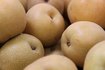


Distinctive Characteristics

  • Apple pears differ significantly from the familiar Eurasian varieties that fill your grocer's produce section. Ordinary pears don't ripen on the tree, but must be harvested while still hard and encouraged to ripen in storage. Asian pears, like apples, can be left on the tree and picked while ripe. Conventional pears have textures ranging from meltingly soft to grainy and sand-like, but always relatively dense. Apple pears have a distinctively crisp texture, apple-like but even lighter and juicier than most apples.

Pick a Good One

  • Asian pears are packaged carefully to minimize bruising, their major flaw from the retailer's perspective. Avoid fruit with visible bruising or other damage. Apple pears range from pale yellow to russet to green in color, but this is a question of cultivar rather than ripeness. Rather than color, use your nose to judge the ripest fruit. The best-tasting pears have the sweetest fragrance.


Read more : http://www.ehow.com/facts_5769226_apple-pear_.html?ref=Track2&utm_source=ask


But they are surprisingly hardy in other important ways: they don't turn brown or mealy when exposed to air, making them a good choice for salads and cheese platters, and their shelf life is noticeably longer than that of either apples or regular pears.                                                                                                          
My friend Thom sent me a picture from a Japanese supermarket in Hong Kong of this gift box of giant apple pears grown in a greenhouse in Japan. 


The price (using the conversion of Hong Kong dollars to U.S. dollars at the time of the picture) is over $22 per apple pear. Yes, $22 each! A box of six makes a nice gift for the right person. 

How can you do justice to a fruit this expensive? Chomping down wouldn't seem right. Perhaps you could only cut it thinly and curate on a platter with some equally fancy tidbit.

Fortunately, when I buy apple pears, whether at the Union Square Greenmarket, a fruit stand or in Chinatown, I don't have such constraints. At $1 each, and sometimes half that cost, apple pears are free to be simply enjoyed.

Thursday, March 28, 2013

Velvety Roasted Pears

I could have just as easily called this entry "Ridiculously Simple Roasted Pears" or "When Bad Produce Happens to Good People - Pears." All titles would be fair and accurate. The pears are velvety; the method of preparation is time consuming, but is embarrassingly simple; and roasting is a great answer for the problem of under-ripe, mealy and withered pears - the kind of pears you might already possess.


For eating out of hand, my favorite varieties of pear are  seckel and comice, though I find forellle the most beautiful. Over the years I've tried almost every kind of pear I could find, including yellow and red bartletts (by far the most popular varieties in the US), bosc, and others. For roasting, however, my favorite pear variety is the anjou (or d'Anjou). 

I seldom buy anjou for any purpose other than roasting because typically anjou pears are simply not as juicy and tasty and comices, seckels and (next tier in my personal pear Olympics), boscs. 

Often the anjous - and other pears - are sold rock hard. Unlike other fruit, pears ripen after being picked from the tree. You can hasten ripening by putting them in a bag with a ripe banana or apple, which will give off ethylene gas and promote the pears' own ripening process.

Sometimes, of course, pears pass from rock hard/under-ripe to withered/mealy without passing through the Zone of Lusciousness. Have no fear! Roasting will make pears at either end of the ripeness spectrum as lush and sweet as you might hope. Perfect for the pears that feel like baseballs and for the bag you forgot in the back of the fridge.

Here's what you'll need for the Ridiculously Simple ingredient list: Pears, raisins, cinnamon and water.

Even more Ridiculously Simple is what you won't need: butter, sugar, wine or a peeler.

You will, however, need lots of this: baking time.

Specifics:

1) Preheat your oven to 400 degrees

2) Select a baking dish. I like to use glass baking dishes, but you could also use rimmed metal baking trays. The pears will give off syrup, so think in advance of clean-up and scrubbing. You could line the trays with aluminum foil, but I caution you that things could get a bit sticky. Choose a dish large enough to fit the pears you intend to use, or use the number of pears for which you have a dish. For example, I fit 8 pear halves (4 pears, I hope I don't need to say) on the oblong 4 qt. baking dish in the photo below. Any shape of dish - square, rectangular, oval, etc. - is potentially fine to use. You could also use a combination of dishes as I typically do.

3) Sprinkle your baking dish with ground cinnamon. I loooooove cinnamon (to quote a friend from Yorkshire), so I use a heavy hand - maybe "shovel" would be a better word choice than "sprinkle."


Enough cinnamon?


4) Slice the pears in half. Using a small spoon - a demitasse spoon is good if you hail from a more genteel era and have one - dig out the pear's seed pod.

5) Stuff the cavity with 4-5 raisins, or as many fit comfortably.


What manner of jewel have I in my navel?


6) Place the pears raisin-side down on the cinnamony dish. Pour about a half inch of water on the whole shebang. 


A relaxing cinnamon bath

7) Here's the hard part: believing how long you need to keep the pears in the oven. The baking time is well over an hour, closer to 2 hours. Every 20 minutes or so you'll need to add some water to the roasting pan. Your goal is to keep the pears from scorching. You do, however, want to get them good and roasted! This is the key to the velvety texture mentioned in the title. I've mentioned elsewhere about the unreliability of my oven temperature. Perhaps my 400 is really 375. No matter. Keep an eye on both the clock and the water level.

8) You think they're done now? Go back and give them another 20 minutes.

Here's what you're looking for. Burnt? Overdone? No way. Think deep, caramelized flavors.


What you're looking for - even if you don't know it


.
9) Remove the pan from the oven and let it cool a bit. Carefully remove the pears using a spatula. Add a small amount of water to loosen the pears if necessary. After cooling, pears can be frozen if you're not going to use them right away.


Just chillin'


Wasn’t that Ridiculously Simple? No hassle of peeling the pairs. No need for sugar, wine, butter, etc. to replace the flavor that you never took away. On the contrary, you intensified and enriched the flavor! No worries that your peeled pears look a little lopsided or some of the pears got more of a flavor injection (from the wine-sugar) than did the other side, and now you have to come up with a way to balance the flavors.

Here they are in all their velvety glory. 


I like them just as is, but feel free to add ice cream, crème fraiche or Greek yogurt or use the pears as a topping for pound cake or sliced over pancakes or French toast. As one friend’s child marveled, “This really counts as a fruit, and not as a yummy dessert? Really?”

Really. And only you need to know how Ridiculously Simple these velvety roasted pears were to make.