Tuesday, May 28, 2013

What the heck is that? Cherimoya


Beneath the tough, scaly, lizardy exterior lies a tender interior. A smooth, sweet and creamy interior, to be exact. I'm writing, of course, of armored tropical fruits.

I'm thinking of guanabana, which I passed up in Brooklyn when I had empty pockets and some sticker shock. I'm thinking also of Brazilian beauties like the pinha that I am determined to see in person. Ah, someday.

So when I encountered these scaly, lumpy fruits in Chinatown over this past weekend, I was powerfully motivated to buy them. My old pal, the cherimoya.


My interest in what you could call the lizardy fruits basically began with the cherimoya I first had at the fabled La Marqueta, a market built under the elevated Metro-North Railroad tracks in East Harlem. I had specifically gone to La Marqueta to discover unknown, delicious produce. I was not disappointed. The cherimoyas I purchased were magically custardy, as befitted another name by which they are known, custard apple. They tasted like a combination of several tropical fruits - banana + pineapple, most prominently, with hints of other fruits (maybe a very ripe Comice pear?) rounding out the flavor.

It's been years since I've had one. It was time.

The cherimoya in Chinatown looked considerably further along the ripeness continuum than, say, the photo in the Wikipedia entry.


Photo courtesy of Hannes Grobe, Wikipedia

Still, I was game. The Chinatown cherimoyas were a little riper than I would have liked, but I asked for one "for tomorrow, not today," and got one of the firmer ones. (Cherimoya can be a little grainy if not ripe and even a little astringent if far from ripe. I've been told to aim for the feeling of a banana at the degree of ripeness you like.)

I knew I needed to treat the cherimoya, especially if it was very ripe, extremely gently. This fruit stand wasn't going to provide padded sleeves for their high-strung fruit as some gourmet stores do. That was fine with me - I love the range, immediacy and price of the Chinatown produce experience, so  I am willing to forego some niceties. I wrapped my new cherimoya in a T shirt. 


When I got home, I dumped my bags and practically ran into the kitchen.

Here's what the Wikipedia photo of a cut cherimoya looks like: 


Photo courtesy Hannes Grobe, Wikipedia


And here's what mine looked like:


That is, until it looked like this:


Wow, that was good. 

Friday, May 24, 2013

The Rules of Attraction

On a recent walk through the Union Square Green Market, I saw several items of produce that I suspected I would dislike. Despite my misgivings, I ended up giving them a try. Why? They were so pretty! My head was turned by their beauty. Was my mind changed as well? Let's take a look.

Head Turner #1: Kale Flowers


Spring has sprung!


Selling point: Beautiful, bountiful and just $3 for a huge bunch. And they must be extremely nutritious - we are, after all, talking about kale here.

Voice in my head says: "Edible flowers" usually taste like sodden tissues. (Slight exception: I do like nasturtium well enough in small doses.)

Verdict: A great purchase for a caterer! The kale flowers would look great on a spring salad at a ritzy event, and one of these big bunches could to a whole lot of salad duty (especially considering the portion size at most ritzy, edible flower type events). As for the taste, well, the flowering kale tasted a bit better than sodden tissues but not enough to inspire me to compose a prissy salad. 


Head Turner #2: Red Mustard


Mustard greens are like escarole and chicory. Okay enough, but why would I buy or eat them when I had better options, such as collard, kale or broccoli rabe?  So I've mostly ignored ignored them. These bunches, however, were real lookers.


I feel a rosy glow!

Selling points: I loved the color! They'd be easy to prepare - just saute with some diced onion. Besides, I needed a vegetable for dinner. 

Voice in my head says: Yeah, it's worth making - once.

I made an all red (purple) dish: I sauteed some finely diced red onion until they became translucent and added the mustard greens.

First some onions


I love my cast iron skillet

I stirred the greens and allowed them for a few minutes. I plated them and added a dash of (red/purple) balsamic vinegar.


I know I've seen these mats before


The red mustard greens lost their reddish color in the cooking, as often happens with red/purple vegetables, but overall the dish retained enough Purple Majesty to please even Prince.

Verdict: Quick and easy to make. The greens retained a bit of their bite.Still, I probably won't rush to make the dish again - I sincerely like a lot of leafy green vegetables more than I enjoyed this one. 


Head turner #3: Radishes


When I was growing up, paprika was a kind of tasteless red dust you used to add some color to beige food and radishes were a food garnish, typically in the form of a radish rose, that wouldn't cause harm if eaten. My husband's family, on the other hand, uses zesty Hungarian paprika as an essential spice, and considers radishes a necessary component of any salad. I no longer push radish slices uneaten around my plate, but I don't typically think of purchasing them either. But could I really say no to these beauties?


Wow


Selling points: Gorgeous. Inexpensive. If I didn't eat them, maybe I could use them as some kind of centerpiece.

Voice in my head says: Youtube probably has some how-to videos about garnishes if the actually-eating-them plan doesn't work out. 

I made a quick salad by thin-slicing the radishes with a mandoline, adding some salt and a handful of chopped dill and garlic chives that I had on hand. 


Verdict: Finally! A dish I thoroughly enjoyed and would make again. In fact, I already have. The radish salad would be a great addition to a sandwich, too.

Overarching conclusion: Well, beauty may lure me in, but it's not enough for a lasting relationship.  But as the song nearly says, One out of Three Ain't Bad. 

Thursday, May 9, 2013

Oh, fiddleheads!


With the Great Power of being a savant comes Great Responsibility. *

(* I just found out that  Voltaire said this first, not Peter Parker's Uncle Ben! )

No longer can I pass by a cute little container of some springtime vegetable and think, Yeah, fiddleheads. Whatever.


Instead, I now think, Look at those veggies in those little boxes! Wow, it's probably been about 20 years since I tried them. Look at their tiny, ferny fronds! They look like the curled top of a violin - no wonder they're called fiddlehead ferns!

How do they taste? Will they be a burst of springtime goodness, or will I consign them to the unsung-for-a-good-reason produce pile?


Look at the tiny ferny fronds

Perhaps inspired by the Market's signs for ramps, a fiddlehead announcement appeared. (Just the one, though.)


I saw no evidence of ramps-style mania, but the farmer of the sole booth that was selling fiddleheads was subtly persuasive. He told me that fiddleheads have an extremely short season - on his farm, just about 2 weeks. Like many of the Union Square farmers, he was a very effective produce proselytizer. I seized the moment and bought a box and brought them home.

En route I suddenly recalled reading somewhere that fiddleheads must be cooked thoroughly...because they're poisonous! Perhaps the sign's full message was, "Fiddleheads are here! Eat them, and you may not be!"

I headed to the computer. In Fine Gardening magazine, Ruth Lively, an editor of Kitchen Gardener magazine, had words praise ("Fiddleheads offer a fresh flavor reminiscent of asparagus and a pleasantly crunch, tender-firm texture") tempered by some cautionary advice:


Throughout the world, several types of fiddleheads are eaten, though most contain toxic compounds. The most commonly eaten and most esteemed fiddlehead is that of the ostrich fern, often simply called fiddlehead fern. The ostrich fern is the safest fern to eat, even though it, too, can contain toxins. The fiddleheads of cinnamon fern, lady fern, and bracken fern can also be eaten, but all are at least mildly toxic and can cause nausea, dizziness, and headache, so it’s probably best to avoid them. The safest way to eat fiddleheads is to stick to ostrich ferns and to eat them in small quantities.


Nausea, dizziness and headaches - bon appetit! That about ensured that I was unlikely to sample any quantity in excess of the contents of the little box in my hand. 

The farmer had recommended steaming the fiddleheads for a few minutes then sauteing them, so I followed his suggestion. I opted not to dunk them in an ice bath between steaming and sauteing. I often say, "Eh" to blanching, admirable though it might be. Now that I knew the fiddleheads' toxic secret - unmentioned by the farmer - ganging up on them with two methods of cooking seemed wise.

I dumped the fiddleheads in a bowl of water and rubbed off the bits of dried brown skin.


Next was a few minutes in a steam bath.


I'm shvitzing!


And then a few minutes in the cast iron skillet.


Fiddleheads are quick to cook, and striking to look at.


But what about the taste? They have their fans - one food blogger happily plunked down $19.99/lb at a West Coast gourmet market for his fiddleheads - but others are less enthusiastic about fiddleheads. In response to the query "What do fiddleheads taste like?" some suggested asparagus (albeit in a "weird, dirty way"), but others suggested "dirt" and "grass," and - in one memorable, Gee-how-would-they-have-this-reference-point? answer - "like boiled mouse." 

The middle of the road may indeed be for yellow lines and dead armdillos, as noted activist Jim Hightower used to say, but in this case that's where my opinion ended up. (As an aside, I usually try to encourage vegetarianism through the preparation of delicious, meat-free meals, but all these mentions of dead and/or boiled varmints has me wondering if I have been subliminally trying a different route here - inspiring some visceral disgust. Sorry.)

To me, the fiddleheads tasted more like spinach than asparagus. They had a certain freshness that I could imagine would inspire some enthusiasm. I thought I detected a bit of cynarin, the acid in artichokes that makes food eaten thereafter taste sweeter, but my exhaustive research (i.e., a few minutes with my pal Google) didn't yield any connections.

The Verdict: Forced to pay a premium price for fiddleheads? Skip 'em. If they're growing wild in your backyard, I understand why the annual forage would be springtime delight. Except for the inevitable excessive consumption/ dizziness/ nausea/ headaches/ death thing.

And if you missed them, well, there's always next year.


Wednesday, April 24, 2013

The ramps are here!


They're coming. The signs are in place.


Wait - they're here!


In my experience, no other item of seasonal produce, however delectable - not corn, not cherries, not berries, not tomatoes - generates as much anticipation and fanfare at the Union Square Farmers' Market as ramps do.

Ramps, also known as wild leeks are certainly a lovely sign of spring.


Even their roots are cool.

My hair looks like this sometimes

And the city of Chicago supposedly got its name from "shikaakwa" or "chicagou," an American Indian word for ramps. But never mind all that. 


Ramp enthusiasts stage annual ramp festivals out of love for this short-lived vegetable. April (take that, T.S. Eliot) is ramp season, and for once this blog will salute a vegetable in its heyday rather than hailing it farewell when its season ends.


My friend Thom, hot off her guest blogging effort about mango agar dessert has returned to write this ode/recipe for her beloved ramps. Take it away, Thom!


I love ramps and you can put them in anything, quiche, pasta, omelets, etc.

Ramps are only available in Spring, 2 - 3  weeks window max, and then they are gone! So eat them while you can!


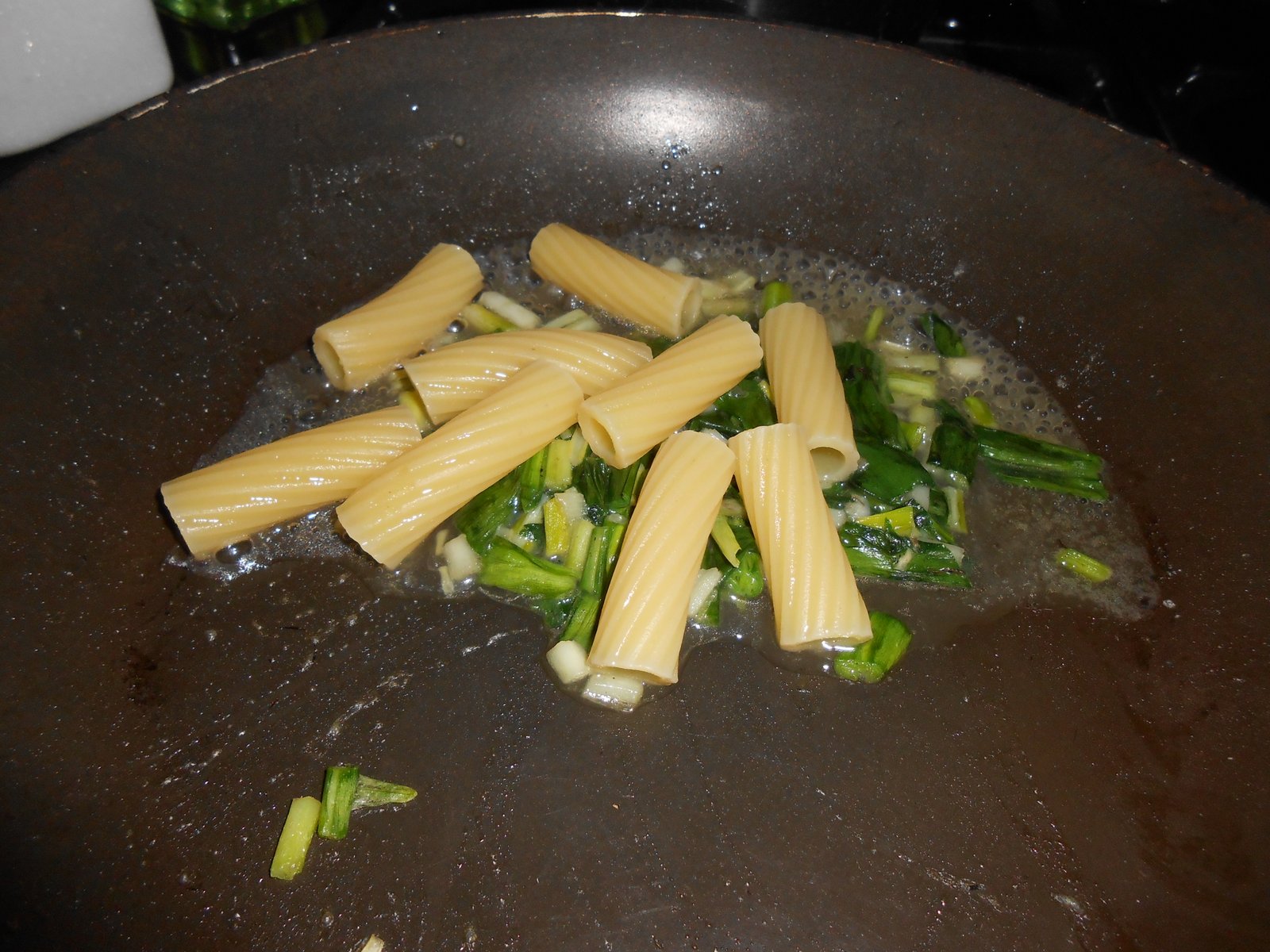
I like to serve ramps with pasta. I cook the pasta - I use rigatoni in this recipe - separately and don't cook the ramps until the pasta is done because the ramps have a very short cooking time. Drain the pasta for ease of use but keep some of the pasta's cooking water since you'll need it for the finished dish. 

Instructions:

There is nothing I hate more than sandy vegetables, and ramps are sandy. Make sure you untie the rubber band that is generally used to tie the bunch of ramps and soak them in cold water.  By doing that, all the sand/soil/dirt will loosen, which makes it easier to rinse later. 

Rub a dub dub, some ramps in a tub

Once you have rinsed them WELL, you can cut off the root and very tip top part.  I like to pull out the first outer layer skin off too, because normally that's where all the dirt hides.  Once you do that, it's nice and pretty and ready to use.


You can eat the ENTIRE ramp (other than the root part). Chop the white part in smaller pieces since it takes longer to cook.  As you can see from my picture, the bottom of the ramps are cut into small pieces and the top parts, which cook more quickly, are left in relatively large pieces.


Heat a saute pan with either olive oil or butter (depending upon how healthy you want to be). Saute the white part of the ramp in medium heat, add a sprinkle of salt, then add the rest of the leafy part and add a little bit more salt. 


Once the white part is translucent, about 3 -4 minutes, add the cooked pasta into the saute pan along with a ladle of the pasta's cooking water. Mix well, and you are done.


For extra flavor, sprinkle a tablespoon of Parmesan cheese on top and freshly grounded pepper. Enjoy!


Saturday, April 20, 2013

What the heck is that? Cardoons

Stalks that looked a bit like celery, leaves that would not have been out of place overhead on a tree, and the overall impression of a lovely greenish-silver that could be next year's fashion must-have color. 

What the heck was this vegetable?

If I had seen the plant growing out of the ground I might not have even assumed it was edible, but it was in a bin at the Union Square Farmers Market, so I asked the farmer.

Really, what the heck is that?

Cardoons, he said.

I had never heard of cardoons. I liked the sound of the word. I could easily imagine it in the history books: "The king was overthrown in the Cardoon Revolution of 1658." The farmer told me that cardoons tasted a bit like artichokes and grow like crazy.

I consulted my well-thumbed copy of The Oxford Companion to Food.


A book that I gave as a gift, but I ended up using all the time

I learned that the cardoon was


a member of the thistle family, with a flower head intermediate in size and appearance between artichoke and common thistle. Long before the artichoke was developed, the ancient Greeks and Romans regarded the cardoon as a great delicacy.

So far so good. The book went on to advise,
The flowering heads, stems and midribs of the main leaves are eaten.The flavor is complex. bitter and sweet, with limits of artichoke hearts, celery and oyster plants...Still popular in Spain and Italy, [cardoons are regarded as] a troublesome weed in South America, Australia and California. 

I sometimes ponder the old vegetable-or-weed conundrum, especially when I buy dandelion greens or purslane (hmm....perhaps a blog entry is in order, or maybe trademarking this great party game), but cardoons looked much more substantial than the weeds I know. Their root systems looked like they could get pretty entrenched. I could easily imagine one saying, "I SAID, this is my garden now." Eating them seemed like basic self-defense.

I brought the cardoons home, washed them thoroughly and put them on the chopping block.


Some of the outer stalks needed some trimming. I enjoyed the feathery appearance of some of the leaves.


I pondered what to do with my cardoons. A quick internet search revealed that in the wild, cardoons have a beautiful flower head and massive spikes. Cardoons are known as cardone (make that "car-doh-nay") in Italy, where both their stalks and flower buds are popular. Cardone are made into soups and stews; battered and fried; and used in risotto. They are featured prominently in  bagna cauda, a fondue-like dish in which raw and boiled vegetables get dipped in a hot bath of garlicky olive oil or melted butter. In the US, they're apparently snapped up by those in the know - folks who come from Mediterrean countries in which cardoons are popular - and totally ignored by everyone else.

Since this was my first adventure, I thought I'd saute/steam the cardoons in a skillet, and consider whipping up a kind of vegetarian (anchovy-free) bagna cauda if I felt motivated. 


I had read some recipes that suggested braising the cardoons for an hour, but I declared the cardoons ready for consumption after about 15 minutes.

The verdict: Okay. Kind of tasty. Quicker to cook than artichokes but with a smaller payoff.  The taste was as The Oxford Companion said, artichoke + celery hearts. 

The food writer Deborah Madison called the vegetable "the difficult cardoon" and suggested "rich embellishments" like cream, eggs and cheese. She noted that her guests liked a cardoon salad she served well enough, but "didn't feel that it warranted the effort involved." Her response - "feature cardoons in a course devoted only to them" - made me laugh. You brat! You're an overpriced non-entity, but if I devote enough attention to you my guests will understand that you're worth my considerable investment of money (as Madison also notes, "cardoons are expensive") and time.

Reading between the lines, I would have concluded that cardoons are on the "forgotten vegetables" list for good reason, and that I was unlikely to encounter them, at least in New York, except as a farmers' market curiosity.

But once again I failed as a Produce Trend Spotter. Soon after my cardoon experiment, I spied them on a supermarket shelf, looking right at home, occupying their space with no particular fanfare. No introductory signs, no testimonials, no ingratiating recipe suggestions to entice the unfamiliar to take a risk on an mystery product. 


And even more amazingly, they were wearing jaunty produce code rubber bands that suggested that they were here to stay.


Wednesday, April 17, 2013

In Praise of the Simple Baked Potato

So you know what to do with bad produce.

Now let's take a moment to talk about good produce. Really good produce.


I bought some beautiful carola potatoes at the Union Square Green Market over the weekend. I pricked a few holes in the potatoes with a fork, set them directly on the oven racks and baked them for about an hour and a half at what might have been 400 degrees in my somewhat iffy oven.

They were just heavenly.

My family enjoyed the potatoes with salt and pepper, but of course you could add butter, creme fraiche, yogurt, sour cream, chives, parsley, etc.

Some basic tips:

1) Choose great potatoes. The wrinkled, eye-sprouting spud at the bottom of the 5 lb. sack might not be a good candidate for this minimalist treatment.

2) Look beyond the "Idaho" or russet potato for baking options. Carolas are a very creamy, thin-skinned potato variety, which for many people suggests boiling and only boiling. Your loss!

2) Fer god's sake, do not confuse microwaving with baking.They are not the same operation. A microwaved potato is a shrunken, wizened potato. No delectable crackling skin (yes, another shout-out to the potato skin), no sweetened flesh. A big mistake.

3) Don't stint on the baking time. 20 minutes of unwatched, undemanding baking time could mean the difference between a fully realized baked potato and an inedible horror. Don't even bother checking on the potato for doneness until at least an hour has passed.

Buy good stuff when you can. Cook it long enough. Eat the peel. Yum. 

Tuesday, April 16, 2013

Mango Agar Dessert

I am feeling very lucky! Not only did my friend Hiroko write a great guest blog, but her friend Thom, who is becoming my friend too, volunteered to share her recipe for a favorite dessert, Mango Agar, via a guest blog post.


Mangos, pre-agar bath


Thom and I recently ran into each other at - where else? – a produce stand and we got to talking about our shared love of produce.  Thom is originally from Hong Kong, which I hope means some joint shopping trips to Chinatown soon! 

Mangoes, of course, are very popular in Asia, and so is agar, a plant-based (algae-based, to be more specific) alternative to gelatin. Agar can be used to clarify stocks or as a substitute for pectin in jams, and more recently it's been used in diet studies, since its high fiber content gives a feeling of satiety. But it's mainly used in chilled Asian desserts - jellies, custards and puddings - that are understandably appealing in warm, humid climates. Thom describes her mango agar as a hybrid of Malaysia agar and the Chinese mango pudding that is often served on dim sum menus. 


Here is Thom's recipe:


1) Melt about a handful of agar strands in 5 quarts of boiling water. I use the non-processed agar form, which looks like dry and clear grass, long and stringy. Agar also comes in powdered form. If you want to use that kind, check the label for usage. Every brand is different and varies in the quantities of powdered agar you'll need (probably between 1 and 2 tablespoons).
<!--[if !supportLineBreakNewLine]-->
<!--[endif]-->


Agar strands out in force

2) Let the pot simmer for 10 - 15 minutes, stirring occasionally to make sure all the agar is dissolved.  Let the agar cool, then pour it through a sieve into a large mixing bowl. 


3) Peel and dice 5 ripe mangoes. I like to use fresh mango and I like using Ataulfo mangos best because they have less fiber and are much sweeter than other varieties.


Mango fest


4) Pour in 7 oz. of condensed milk into the mixing bowl and mix in well. You can also use soy milk and agave nectar as a lactose-free/vegan alternative. If you've pureed the mango, mix it well with the condensed milk. 


The milk-agar combo


5) Pour the milk mixture into individual containers. If you're using diced mango, distribute equal amounts of mango into each container. 
6) Refrigerate for 2 hours and serve. Enjoy!


Just chillin'


Thursday, April 4, 2013

Guest Post from Japan

My friend Hiroko returned to Japan last year after several years in New York. Since then, I’ve been pestering her for her take on produce in Japan.


Are the fruits really presented like jewels?

Does everything cost a fortune?

Do they have fruits and vegetables that we’d be hard-pressed to identify?

I know that Hiroko misses shopping at the Union Square Market but evidently doesn’t miss some of our grown-to-be-shipped tasteless fruit. 

Here is Hiroko’s guest blog entry:

Japanese can be very picky about their berries. In Japan, you'll find these red strawberries neatly lined up in a container as if they are something really precious.


Oooh, comfy!


Do you see how "pampered" these strawberries are? They're sitting on a fluffy foam bed.

I saw a Japanese strawberry farmer on TV the other day -- he dedicates his life to "Strawberry Breed Improvements" -- and finally created "Skyberry," big, tart, sweet and juicy kind that costs $20 for 600 grams!

I remember strawberries I found in the supermarkets in the US were usually very big but practically had no flavor -- they had no sweetness, no tartness, no smell, just kind of cold, dry "something look red outside.”

The only good thing about them was that I could find them throughout a year, and were totally different from what we saw in Green Market in spring time -- farm strawberries were small, sweet, juicy, but their season was really short!

I found that Japanese strawberries are like hybrid of those two strawberries. They are medium sized, nice and ripe, have lots of flavor -- but rather expensive. I would say one container -- bit less than that one pound container of Driscoll's -- can cost 4 dollars (regular kind) to 10 dollars (premium kind). I can find probably 4 to 6 different kind of strawberries in one store -- because some like it small and tart and  some like it big and sweet.

The strawberries in my photo are called "Tochi Otome" (Belle of Tochigi). They were a gift from my dinner guest. They were very sweet and had a great aroma that filled the room immediately.

How is the Green Market at Union Square doing? Is it still too cold for berries?

Hiroko also provided this information about this springtime delicacy. (And I will try to ignore the mention of mayonnaise, which I know is extremely popular in Japan, much to my chagrin.)

"Nano Hana" (field mustard) is a delicacy of springtime.


I like the way they are wrapped, in old fashioned paper and rubber band!


If you go to countryside out of Tokyo in early spring, you'll see field of this plant blooming -- thousands of yellow flowers swaying in the wind -- some poet described it as "Mustard green field, scrambled eggs for a million people.” It is kind of rustic scenery of springtime in Japan.

I guess the seeds are used to make Canola oil, but some make it to our table before they start to bloom! [Note: I googled "Nano hana" and learned that yes, it is indeed the same as rapeseed, whose seed's oil was the original basis of "Canadian oil, low acid," or Canola.]


The Nano Hana tastes a bit bitter -- like broccolini or broccoli rabe, but much more tender than them. It cooks rather quickly, so you've have to be watchful not to overcook!

We usually boil it crisp-tender, and season lightly with dressing of your choice, such as a mixture of dashi-broth and soy sauce, mustard and soy sauce, etc. My favorite is a mixture of mayo, roasted sesame paste (like tahini) and soy sauce. The key is not to overpower the green with too much dressing, as we need to feel that slight bitterness. The flavor says "Spring!!!" to us. Soon, the season for Nano Hana will be over :(.