Showing posts with label Chinatown. Show all posts

Tuesday, September 29, 2015

What the heck is that? Muscadine

Suddenly they are everywhere.  Well, maybe not everywhere, but at a lot of places.  

Could muscadines, aka swamp grapes, be the Next Big Produce Thing?


Here are some muscadines at a produce stand in the South Bronx. 


Surrounded by fruit stand mainstays like bananas, strawberries and oranges, and Latino neighborhood mainstays like papayas, plantains and two kinds of avocados (one of which, the large tasteless green kind, labeled "Domin" for Dominican, perhaps a slander) were the muscadines: small purplish fruit, a bit smaller and rounder than Damson or Italian Prune plums in the primo real estate of the center square. 

I have also been seeing muscadines all over Chinatown. Here they are at one stand in Chinatown, next to longans, grapes and starfruit.


 And here they are at Sarah's Fruit Stand in Union Square.


I have a poor track record of produce prognostication - that is, guessing which obscure produce items will cross over. I wouldn't have plucked muscadines off the chorus line.

Muscadines are grapes that are native to the United States, specifically its hot, swampy South, where most grape varieties would plead uncle. They are a fruit with many nicknames, including "America's first grape." Sir Walter Raleigh described muscadines in glowing terms way back in 1584 when he encountered them growing along the Outer Banks in 1584. Southerners have been making jellies, sauces and - most importantly - wine, ever since.

Muscadines grow in clusters, but the clusters are much looser than the tight bunches of other grapes. 


They are harvested one by one, not in bunches. And they are big by grape standards, so it's easy to mistake them for small plums, as you would for the fruit in the opening photo.

Photo credit: grapeseedextract.com
Muscadines, like most deeply colored fruit, have impressive antioxidant levels, and are especially high in resveratrol and ellagic acid. M.D. Journals (special Carolinas edition, natch) says, "A single 1 cup serving of muscadine grapes would more than double the average person's antioxidant intake." This could explain some of the fruit's newfound popularity. In the South, there is also a certain folk celebration of the fruit in the South, especially for old-time muscadine hull pies and wine.

On the "con" side, however, are two inescapable attributes: seeds and thick skins. In this country, seeds are generally considered a nuisance by most fruit consumers (and the corporations that predict and shape consumers' behavior). When was the last time you saw watermelon with seeds, for example?

Thick skin is a different matter: even though I have no quarrel with baked potato and kabocha peels, I am annoyed by the muscadines' thick skins. (I'm pretty tolerant of seeds). But muscadine lovers work around the problem.

Ozzy of Sarah's fruit stand is one enthusiast. "I love them!" he said. His technique is to bite into the muscadine and suck out the pulp, which he then discards. He doesn't mind the seeds, but as he says, "I'm Turkish, so I don't think fruit shouldn't have seeds."


He throws out the skins, but as muscadines grow in popularity, I imagine a secondary market for the discarded skins. Added to smoothies for the nutritional power? Harnessed for agricultural disease resistance? Organic clothing dye? Touted addition to makeup and shampoos?

Or maybe it's just time to bake up some extra muscadine hull pie.

Saturday, February 21, 2015

What the heck is that? Tamarind

When my friends Anna and Rabi took a trip to the U.S. Virgin Islands, I said the same thing I say to all my traveling friends: "Send me some pictures of the produce! Send me some pictures of the produce markets!"

Anna said that the town she visited was too small to have an interesting market. Instead, she took a picture of something else that I found interesting: a tamarind tree.


Anna’s husband Rabi is originally from Sri Lanka, where tamarind is extremely popular. Actually, tamarind is popular all over the world. The word “tamarind” comes from the Arabic words “tamar hind,” or ”Indian date,” but tamarind’s popularity extends far beyond just South Asia. The tree is indigenous to Africa, but now grown in warm spots everywhere. In Mexico, tamarind is a big star, showing up in Jarrittos sodas, agua fresca beverages and ices. Just about every tropical country has some candy or jam that features tamarind, and many cuisines, such as Thai and Indian, use tamarind to give recipes  dishes a certain sweet-sour piquancy. Evidently English colonists couldn't get enough either: tamarind is a key ingredient of Worcestershire sauce.

Here are some highlights from the extensive tamarind foodstuff collection at Kalustyan's, the wonderful international spice store: juice, two kinds of candy, chutney, paste, concentrate, etc.


More recently, however, I’ve started to see something even more interesting for sale: fresh tamarind. I've found it in Chinatown, naturally - all interesting produce sooner or later shows up in Chinatown - and East Harlem, which has many groceries catering to Mexican shoppers. 

I had to try it.


The picture on the tamarind box was pretty accurate: brown pods with a crackly shell and a sticky interior. A twiglike vein ran the length of the pod, and seeds hid underneath the sticky fruit.


The tamarind pulp was certainly tropical fruit-sweet, like dates or dried bananas, with the puckery tang that has made tamarind popular in cooking.


I got into a bit of a groove: Crack off a bit of the shell, peel off the rest. Loosen the twig-vein, which I found somewhat repulsive. Bite off a section of tamarind. Spit out the shiny seed. Chew the tamarind pulp.

Contemplate whether in fact I liked tamarind. Decide I wasn't sure. Reflect on the flavor's similarity to fruits I don't particularly like - bananas, dates - but acknowledge that this sticky sweetness is offset by the tamarind's tang, which I did enjoy. Consider the need for for more experience of that flavor. Bite off another section. 

When there was no more tamarind pulp left to chew, I was forced to acknowledge that I did like tamarind, won over, as millions or even billions of people have, by its sweet-sour charms.


It's hard to argue with a pile of seeds, twig-veins and shell bits.

Saturday, November 1, 2014

What the heck is that? Concord grapes


On a recent visit to the Union Square Greenmarket, I noticed that farm stands with super-fragrant, thick-skinned and deeply purple Concord grapes attracted almost as many bees as the beekeeper who brought a huge honeycomb.


Bees aren't the only fans of the grapes. "Concord grapes make your taste buds sing!" my friend Jen says.


Concord grapes, distinguished by a complex, winy flavor and "slip skins" that separate easily from the grapes' flesh, get their name from Concord, Massachusetts. In the 19th century, Concord was home to intellectuals and free-thinkers, including Louisa May Alcott, Ralph Waldo Emerson, Nathaniel Hawthorne, Henry David Thoreau, and their grape-growing neighbor Ephraim Wales Bull, who cultivated and cross-bred species of the native grape vitis labrusca into Concord grapes. Two interesting articles about Concord grapes, He Sowed, Others Reaped: Ephraim Bull's Concord Grapes and The Syrupy Tale of How Jews Invented Kedem and Modern America, note Thoreau's August 28, 1853 journal entry about the fragrant grape crop:

I detect my neighbor’s ripening grapes by the scent twenty rods off, though they are concealed behind his house. Every passer knows of them. Perhaps he takes me to his back door a week afterward and shows me with an air of mystery his clusters concealed under the leaves, which he thinks will be ripe in a day or two—as if it were a secret. He little thinks that I smelled them before he did.

Ephraim Bull's Concord grape became very popular but - unlike today's fruit breeders and propagators, who can patent an agricultural product - Bull made little or no money from the nurseries all over the country who grew and sold Concord grapes, nor from the "Dr. Welch's Unfermented Wine" that Thomas Welch, a dentist/ Methodist minister, sold as non-alcoholic communion wine. (Thomas Welch's son, Charles Welch, transformed this Concord grape juice into Welch's Grape Juice and marketed it to wild success at the 1893 Chicago World's Fair.)

Nowadays Concord grapes are best known for their presence in Welch's Grape Juice and the jelly in a peanut butter and jelly sandwich. But why aren't they also in lunchboxes?

"Americans hate seeds, regardless of how the fruit tastes," my fruit vendor buddy Osman, frequently observes. Concord grapes' thick skins are also considered a turnoff for mass marketing.  But we're lucky in New York - at least Concord grapes on our radar, especially this time of year. New York State's Finger Lakes region, about a 5 hour drive north of Manhattan, is a major producer of Concord grapes, mostly for wine production, and consequently, Concord grapes and New York City have a vivid history together that includes basement winemaking by both Italian immigrants in Williamsburg and Red Hook and Jews on the Lower East Side. (Not to mention backyards throughout the City, from my childhood next-door-neighbors' to my my sister's garden, that feature grapevines no one remembers planting.) 


And Concord grapes are not the only hardy, thick-skinned, super-fragrant grape game in town. The Greenmarket market had a variety of blue, magenta and white grapes, both seeded - Concord-style grapes have larger seeds than European varieties do - and "seedless" (i.e., containing tiny vestigial seeds).


Here's my score card:


Concord: the original and the baseline. How far can you spit the seeds?


Mars: What's not to love? Just like Concord - but seedless!


Jupiter: Seedless and more oval than Concord and Mars. Perhaps my favorite of the Concord-y family.


Caco. Red-magenta rather than purple-blue. Seeds. Good flavor.


Canadice. Basically looks like Caco only with slightly smaller grapes in slightly denser clusters. Seedless. Very tasty!


Delaware. Seedless and tasty. Could I really tell the difference between Canadice and Delaware? Yes, but only because I took careful notes!

There's another seedless red variety, Vanessa, that looks just like Delaware and Canadice. I haven't seen it this year (yet). 


And the green grapes:


Niagra. They are indeed known as "White Concord" and are the most popular of the green Concord-type grapes. Some of the wine sellers, for example, sell Niagras.  They have thick skins and seeds but a lighter scent and taste than Concords.


Marquis. Seedless, but eh. Underwhelming.


Lakemont. Seedless. My favorite of the greenies!

Himrod, another green variety, made a blink-and-you'll-miss-them appearance at the Greenmarket this year. To be honest I don't remember much about them other than that they were (1) green (2) seedless and (3) good.

Our old buddy, the Cornell University agricultural program lists many other varieties.

As you can see from the picture of the Marquis grapes, these grapes are not always picture perfect. The dense clusters sometimes promote mold and rot. There is considerable variety even within the vine, with some grapes sweeter and more flavorful than others.

I think of Concord grapes as a Northeast greenmarket kind of produce, but that's naive. Everything is grown in California -- and almost every kind of produce ends up in Chinatown.  So I shouldn't have been surprised to find a package of "Concord-Niabell Grapes" for sale at a Chinatown vendor. Wilson Brand's packaging featured Chinese writing and enthusiastic health claims about Resveratrol and Polyphenols and antioxidants.


But "Niabell"? What the heck is that? As it turns out, basically California's version of Concord grapes. So even this most seasonal - and to me, New York-centered - of grapes can be part of the Endless Summer.

Wednesday, January 1, 2014

Winter Melon One Pot Wonder

I'll admit it - even after years of shopping for produce in Chinatown, I still encounter mysterious vegetables that intimidate me. Winter melon is a good example. 


I guessed from its looks that winter melon was a kind of summer squash, but I was at a loss thereafter. Good thing my friend Thom, a Hong Kong native, is there to break it down for me!

She said, "Winter melon is like a cross-bred hairy cucumber and zucchini. The seeds inside are edible, so you don't have to pick them out. Winter melon is heartier than a cucumber, and it's popular in many Chinese stews and soups."


Thom likes to feature winter melon in this recipe. As she notes, it can be a side dish, or with the simple addition of mung bean vermicelli (aka cellophane noodles), a main course. Best of all, "It's a one pot wonder!"

Ingredients:

  • 1 winter melon
  • 1 tablespoon oil
  • 2 cloves garlic, crushed, or 2-3 slices of ginger
  • 1/2 cup broth (Note: since this is a vegetarian blog, I will suggest vegetable broth)
  • Dash of soy sauce
  • Optional: mung bean vermicelli, softened for 1 minute in boiling water then immediately drained
Directions:

1) Cut off both ends of the winter melon and peel off the skin to get rid of the fuzz.

2) Cut the winter melon in sections, then cut it into wedges. Keep the size of the wedges consistent so that the winter melon will cook evenly.


3) Heat a tablespoon of oil in a large pot. Add the garlic and let it infuse the oil, making sure that the garlic does not burn. If you do not like garlic, you may use a few slices of ginger as a substitute.

4) Add the wedges of winter melon and a pinch of salt, stirring to ensure that all of the winter  melon is coated with the seasoned oil.


5) Add 1/2 cup broth and let simmer for about 5-7 minutes. Note: If you plan to add vermicelli to your dish, add extra broth at this point. The noodles, which you will add after the winter melon is cooked, will soak up any excess liquid in the pot. Cook until the winter melon turns translucent. 


6) Add soy sauce, perhaps adding a bit more to taste. If you're cooking winter melon as a side dish, you're done! 

7) If you're making the winter melon with noodles, add the drained vermicelli to the winter melon, turn off the fire and keep the lid on for 2 minutes. Try to keep the noodles on one side of the pot.

Enjoy! A great start for winter and the new year!


Friday, December 27, 2013

What the heck is that? Water Chestnuts


As an inveterate Chinatown produce shopper, I frequently see vegetables for sale that are totally mysterious to me. For years I noticed displays of mud-encrusted brown bulbs, but had no idea what they were. Since I had plenty of other items available to amuse me, I paid the bulbs little attention and busied myself with many other produce delights.


But when I was recently shopping at a favorite Chinatown stand (making a typical purchase of broccoli, mushrooms and kabocha), I overheard another customer asking for a pound of water chestnuts.  The vendor obliged by scooping up some of the papery bulbs. This long-term mystery was solved!

Water chestnuts? Sure, intellectually I understood that water chestnuts were not born boiled and canned, but I never realized they were were so readily available fresh.


I hadn't actually given them much thought at all. I had only had water chestnuts in Chinese dishes such as stir-fries, in which they distinguished themselves as the crunchy-but-otherwise-bland element. I assumed they also showed up in pot stickers and other finely chopped vegetable conglomerations, mainly because no vegetable escapes such associations.

But I was curious enough to buy a pound of water chestnuts myself and begin exploring this familiar yet strange new vegetable.


I learned that water chestnuts aren't actually bulbs; they're corms, similar to bulbs, but made up of solid tissue, whereas bulbs are made up of layers of quasi-leaves. Water chestnuts grow in marshes, and - as I had seen over the years - they're generally sold covered with a layer of dirt. They resemble tree chestnuts (actual nuts, not vegetables) somewhat, hence the name, but the two are entirely unrelated.

I gave my water chestnuts a good soak and scrubbing.


The next step: removal of the papery skin. Forget the vegetable peeler:  water chestnuts are small, round and tricky, so you'll need a sharp paring knife. Cut off both ends, then pare off the skin. 


 You'll be left with a lot of debris and small white nubs. 


What to do with these nubs?


One obvious idea was to use the fresh water chestnuts in the manner of canned: sliced in a stir-fry;  chopped finely for pot stickers; or wrapped with smoky tempeh in a vegetarian version of the only non-Chinese water chestnut recipe I know, bacon wrapped around water chestnuts, covered in a ketchup sauce and baked.

But all of them seemed a waste after the hassle of peeling them. Besides, I was curious about how fresh water chestnuts differed from their canned cousins, and sauces would obscure the distinctions.

I decided to try the water chestnuts as is. First bite: crunchy! Sweet, with a mild apple + coconut taste, then a hint of something more vegetal, maybe broccoli stem. After seeing my prep work, my friend Charlotte was sufficiently game to try one. She said, "The taste is changing a little while I eat it. It tastes a little like an apple, but then it tastes different, maybe more like a vegetable by the time you swallow." I thought so too.

It wasn't love at first bite, but I kept eating these little nubs, partly to figure out their elusive taste, partly to figure out if I liked them, and partly because they made a satisfying crunch. I had thought, "Good for crudites," and "Try it with a dip," but before I knew it, there weren't any water chestnuts left to try.

Perhaps another trip to Chinatown is in order...

Monday, August 19, 2013

What the heck is that? Garlic scapes

Here’s another way to love garlic.


I first saw garlic scapes a few years ago. I was in Chinatown, and they were crowded among a whole heap of unknown and intriguing items. I was a little intimidated, so I kept to my shopping list and left them untouched. 

Flash forward a year or two, and I noticed them at the Union Square Greenmarket. This time the scapes were surrounded by familiar herbs, making them much more approachable. I decided to buy a bunch.

And so it began.  I was soon hooked.

What are garlic scapes? How do they fit into the scheme of what we typically consider "garlic"?

Garlic scapes are the leafless stems of hardneck garlic. From what I've been told, farmers traditionally cut back the stems in order to get the garlic plants to focus their energy on the garlic bulbs. One enterprising (or hungry) farmer must have grabbed some scapes off the compost pile and decided to cook with them. Viola! A cult was born. 

Or more likely, folks in the US noted that in Garlic Central, aka China, the world's leading producer and exporter of garlic, pretty much every bit of garlic is used. The blog Red Cook, which focuses on Chinese home cooking, tried to help out a reader confused by garlic scape nomenclature, since garlic scapes are sometimes called "garlic sprouts" or "garlic greens," noting,

There are many different parts of garlic available in Chinatown and they should all be labeled accordingly. Even in Chinese there are many different names. In northern China the name suan tai (蒜薹) is used most commonly for garlic scapes. But in the south suan xin (蒜芯) is used. But sometime suan miao (蒜苗) also refers to garlic scapes in spite of the fact that suan miao often refers to garlic greens, or the leaves. So I’m as confused as you are. I’m afraid you’ll have to look at the item itself. Garlic scapes are round solid stalks and usually have flower buds attached. Garlic greens are usually just the leaves with white parts at the bottom.

I hasten to add: Don't get discouraged! Work your way past the confusion! There are many great aspects to garlic scapes that will justify your investment of brain power and derring-do. Here are a few:


1) They are are beautiful singly and a little crazy looking when bunched into a bouquet, a Medusa-head, roller-coaster ride of flower bud and stalk. 

2) They taste like garlic, only a subtle and even herbal version of garlic. This makes them appealing to both garlic fanciers and more reticent fans.

3) They're really versatile! One idea: I've used my scapes, diced finely, in a cucumber salads, mixed green salads and bean salads - anywhere I might use scallions. But wait, there's more!


4) The number one use among shoppers at the Union Square Greenmarket (and not just because of the suggestion below): garlic scape pesto. One shopper said she freezes several containers' worth.


5) Scapes are a nice addition to stir fries.

6) Soups, dips, sandwich enhancers - just let your imagination run wild.

7)  My favorite way: pop a few on a skillet and grill for a few minutes. Sprinkle lightly with salt. Totally addictive. 


But do not tarry! The season is short. Before too long your request for scapes will get you only a sorrowful look and a tip to try again next year.

Tuesday, May 28, 2013

What the heck is that? Cherimoya


Beneath the tough, scaly, lizardy exterior lies a tender interior. A smooth, sweet and creamy interior, to be exact. I'm writing, of course, of armored tropical fruits.

I'm thinking of guanabana, which I passed up in Brooklyn when I had empty pockets and some sticker shock. I'm thinking also of Brazilian beauties like the pinha that I am determined to see in person. Ah, someday.

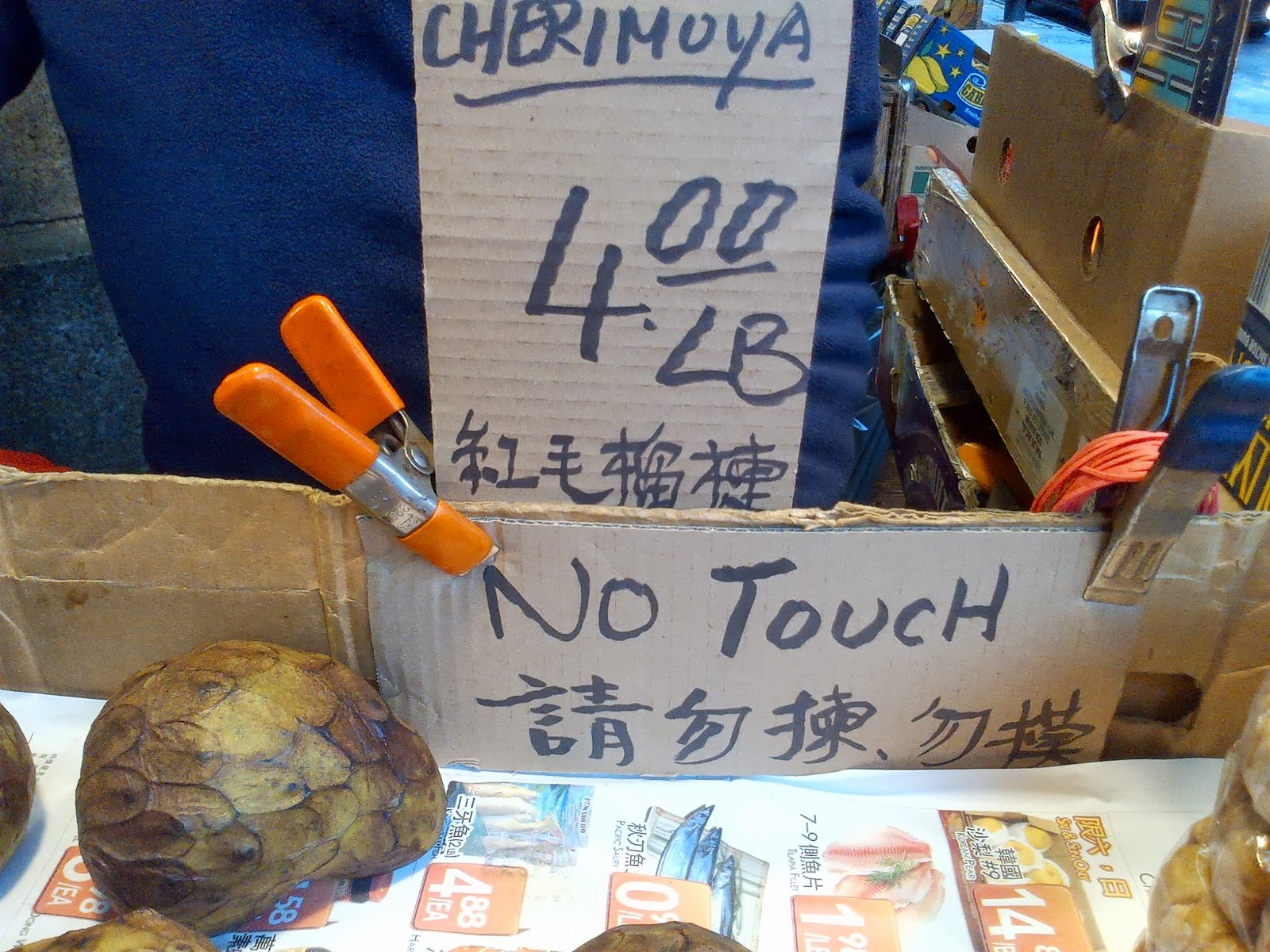
So when I encountered these scaly, lumpy fruits in Chinatown over this past weekend, I was powerfully motivated to buy them. My old pal, the cherimoya.


My interest in what you could call the lizardy fruits basically began with the cherimoya I first had at the fabled La Marqueta, a market built under the elevated Metro-North Railroad tracks in East Harlem. I had specifically gone to La Marqueta to discover unknown, delicious produce. I was not disappointed. The cherimoyas I purchased were magically custardy, as befitted another name by which they are known, custard apple. They tasted like a combination of several tropical fruits - banana + pineapple, most prominently, with hints of other fruits (maybe a very ripe Comice pear?) rounding out the flavor.

It's been years since I've had one. It was time.

The cherimoya in Chinatown looked considerably further along the ripeness continuum than, say, the photo in the Wikipedia entry.


Photo courtesy of Hannes Grobe, Wikipedia

Still, I was game. The Chinatown cherimoyas were a little riper than I would have liked, but I asked for one "for tomorrow, not today," and got one of the firmer ones. (Cherimoya can be a little grainy if not ripe and even a little astringent if far from ripe. I've been told to aim for the feeling of a banana at the degree of ripeness you like.)

I knew I needed to treat the cherimoya, especially if it was very ripe, extremely gently. This fruit stand wasn't going to provide padded sleeves for their high-strung fruit as some gourmet stores do. That was fine with me - I love the range, immediacy and price of the Chinatown produce experience, so  I am willing to forego some niceties. I wrapped my new cherimoya in a T shirt. 


When I got home, I dumped my bags and practically ran into the kitchen.

Here's what the Wikipedia photo of a cut cherimoya looks like: 


Photo courtesy Hannes Grobe, Wikipedia


And here's what mine looked like:


That is, until it looked like this:


Wow, that was good.