Showing posts sorted by relevance for query apple. Sort by date Show all posts

Friday, December 2, 2016

What the heck is that? Apple pear

Apple pears: the first step in a project to breed interesting hybrids of popular fruit? A project that could include the easy-peel, not-too-acidic banana pineapple (not to be confused with banana potatoes ) and one-step-ratatouille tomato eggplant?


The truth is a bit less exciting.

Apple pears are a type of pear, as some of the fruit's other names, Asian pear (and its geographic subsets, Chinese pear, Korean pear, Taiwanese pear, Japanese pear, etc.) and nashi (Japanese for "pear") indicate. Apple pears have been enjoyed in Asia for thousands of years and in California since the Gold Rush days, when Chinese immigrant miners planted trees. 

The "apple" part of "apple pear" refers to the fruit's appearance and texture - round and crisp like an apple. In other ways, the apple pear definitely tows the pear line. Apple pears ripen on the tree, not the kitchen counter. They are sweet, with a flavor in the pear family. Apple pears' skins can range from golden yellow to greenish yellow to paper bag brown, with a corresponding texture than can range from delicate to a bosc pear level of coarseness.


Here you can see the outward similarity of the two apple pears to the apple on the left. The apple pears' grainy texture, not quite revealed in the photo, differs from the apple's. Unlike a regular pear, the seed pod is dead center, rather than located in the lower portion of the fruit. 


The more delicate apple pears sometimes earn dog in a winter vest protective gear. 
th -- they're both members of the rose family, or pomes -- but the "apple pear," or Asian pear, blurs the line between the two fruits. Their flavor packs the unmistakeable honeyed sweetness of a pear, but Asian pears have the crisp texture, size and roundness of a superlative eating apple. To scientists they're unquestionably pears, but they're a distinctive and quirky branch of the family. You can use them in tarts, pies and other baked confections, but aficionados recommend eating them out of hand.

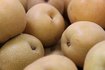


Distinctive Characteristics

  • Apple pears differ significantly from the familiar Eurasian varieties that fill your grocer's produce section. Ordinary pears don't ripen on the tree, but must be harvested while still hard and encouraged to ripen in storage. Asian pears, like apples, can be left on the tree and picked while ripe. Conventional pears have textures ranging from meltingly soft to grainy and sand-like, but always relatively dense. Apple pears have a distinctively crisp texture, apple-like but even lighter and juicier than most apples.

Pick a Good One

  • Asian pears are packaged carefully to minimize bruising, their major flaw from the retailer's perspective. Avoid fruit with visible bruising or other damage. Apple pears range from pale yellow to russet to green in color, but this is a question of cultivar rather than ripeness. Rather than color, use your nose to judge the ripest fruit. The best-tasting pears have the sweetest fragrance.


Read more : http://www.ehow.com/facts_5769226_apple-pear_.html?ref=Track2&utm_source=ask


But they are surprisingly hardy in other important ways: they don't turn brown or mealy when exposed to air, making them a good choice for salads and cheese platters, and their shelf life is noticeably longer than that of either apples or regular pears.                                                                                                          
My friend Thom sent me a picture from a Japanese supermarket in Hong Kong of this gift box of giant apple pears grown in a greenhouse in Japan. 


The price (using the conversion of Hong Kong dollars to U.S. dollars at the time of the picture) is over $22 per apple pear. Yes, $22 each! A box of six makes a nice gift for the right person. 

How can you do justice to a fruit this expensive? Chomping down wouldn't seem right. Perhaps you could only cut it thinly and curate on a platter with some equally fancy tidbit.

Fortunately, when I buy apple pears, whether at the Union Square Greenmarket, a fruit stand or in Chinatown, I don't have such constraints. At $1 each, and sometimes half that cost, apple pears are free to be simply enjoyed.

Saturday, January 14, 2017

A Midwestern Visitor to the Big Apple

Enough with the New York apple-centrism! Time to give the Midwest some love.

Recently I noticed Samascott Orchards  selling a new apple at the Union Square Greenmarket. The apple was a rosy red beauty with a focus-grouped name, EverCrisp. A handwritten sign claimed a parentage of Fuji and Honeycrisp. Was this new apple destined for greatness? Despite my dubious record of produce prognistication, I had to investigate.


The EverCrisp is a strikingly attractive apple, but apples can't get by on looks alone. (The Red Delicious apple, for example, the prototypical childhood illustration of an apple, isn't spared ridicule because of its looks; one apple preservationist denounced "this disgusting, red, beautiful fruit" in an article celebrating the end of its "evil reign.") The name "EverCrisp" suggested a commitment to marketing that some apples haven't earned yet. Samascott, for example, sells plenty of apples with names like NY 428, NY 460, NY 543 and NY 652, but it's hard to cross over into the big time with a New York State Agricultural Experiment Station robo-name.

The "Crisp" in EverCrisp's name not only piggybacks off of Honeycrisp apple - an extremely popular and profitable apple variety - but also emphasizes the attribute that makes the Honeycrisp so popular: its texture. Crispness is king! The goal is to have cells that shatter, noisily and juicily. As a New Yorker article called Building a Better Apple noted,
Although a crisp texture is the single most prized quality in an apple - even more desirable than taste, according to one study - crispness is more a matter of acoustics than of mouthfeel. Vibrations pass along the lower jaw and set the cochlea trembling. Biting into a really crisp apple, one feels, in the words of Edward Bunyard, the author of "The Anatomy of Dessert," "a certain joy in crashing through living tissue, a memory of Neanderthal days."

Some additional research helped me understand the appeal of the "Ever" portion of the name. As one Midwestern seller touts, "Sweet and ultra-firm EverCrisp can sit on your counter for weeks without losing crispness!"


Hardiness is the foundation of EverCrisp, which was developed by a fairly unlikely breeder, the Midwest Apple Improvement Association, a collective of apple growers grappling with the unique climate challenges of their region, whose late frosts kill off apples. [Washington and New York, the "powerhouse apple states" have breeding programs that focus on late blooming apples that benefit from proximity to large bodies of water (the Pacific Ocean and Lake Ontario and the Finger Lakes) that warm up slowly in the spring; ditto New Jersey, which similarly benefits from the Atlantic Ocean. The University of Minnesota's apple breeding program, creator of Honeycrisp and other successful apples like the Zestar! and SweeTango, was designed to address brutal winter weather. The Ohio State agricultural program that developed the Melrose apple no longer develops apples.] With no formal university program for landlocked Ohio/Indiana apple farmers, the growers dedicated themselves to breeding and promoting disease-resistant, late blooming apples that, in their own words, "naturally escape fire blight, scab, powdery mildew, cedar apple rust and late spring freezes thus reducing the use of fungicides, antibiotics, and orchard heating."

I appreciated the irony of this modest Midwesterner, bred to overcome the obstacle of not having New York's maritime apple advantage, being grown in New York. So far I've only seen EverCrisps at Samascott's stand, but if all goes well other farmers will follow, as will Whole Foods and other grocers. 

EverCrisp is a very welcome addition to Samscott's arsenal, especially this winter, when some of my other favorites (Macoun, Ashmead's Kernel, Golden Russet) seem to be having a difficult or truncated season. The EverCrisp is as crisp and juicy as billed, with a good apple flavor (for those of us, however unusually, prize flavor over texture), reminiscent of Fuji but without Fuji's occasional powdery and metallic notes. Its attendance at the Samascott stand has been very iffy, showing up sporadically. Twice I've been told the EverCrisp season was over, then been pleasantly surprised by a repeat appearance.

Nevertheless, Samascott demonstrated its commitment to the EverCrisp by investing in a new, formal sign.


Can the EverCrisp "remain crisp for many months"? I'm not planning any testing at my house. That's not the fate of produce (not even longevity champs like red cabbage) in my clutches. But I am encouraged by the sentiment.

Equally encouraging: EverCrisp's modest price. For fans of the notoriously expensive Honeycrisp, and similarly expensive (albeit less popular) SweeTango, EverCrisp offers a similarly tasty, crunchy apple but without the price bite.

That's another Midwestern approach that is always welcome in the Big Apple.

Wednesday, February 5, 2014

The Big Apple


My beloved Union Square Greenmarket may be my muse, but I have eyes for other other cities' markets as well. I recently wrote about Washington DC's markets, and perhaps I'll write about Philadelphia's, especially the historic Reading Terminal Market (although, let's be honest, it's the pretzels, not the produce, that make Reading Terminal one of my favorite destinations in Philadelphia). But none of these East Coast cities had farmers' markets with the Wow Factor of San Francisco's.

Yes, I'll admit it. San Francisco's markets were better than anything New York had to offer. Hard to argue with California soil. One item of produce, however, helped me hang on to my New York chauvinism: the apples. San Francisco's markets had neither the quality nor the range of New York's. Even as I oohed and ah'd about dozens of other fruits and vegetables, I actually felt a little homesick - for The Big Apple.


We New Yorkers certainly take our apples seriously here. But - as I found out when researching the nickname for this blog post - the term "The Big Apple" has nothing to do with apples. Instead, the name dates from the 1920's, and derives from the slang use of the word "apple" to mean racetracks and their prizes. NYC, as a big city, had a Big Apple. The term was later popularized by jazz musicians and made official by a New York City tourism campaign.

Of course, the tourism wouldn't have been very effective if the apples weren't so good!


My father-in-law, who hails from area of Vynohradiv in Eastern Europe, has spoken longingly of the range of apples he recalls from his youth. "You'd go to the market and you'd see 16, 20 types!" he recalled. This inspired me to conduct my own census of the apples I've seen over the past couple of months at the Union Square Market, from early ripening varieties like Ginger Gold to still-lookin'-good-in-winter stalwarts like Granny Smith. The count to date: 60. Yes, 60 varieties! (Take that, Heinz!)


Not only is the list long, it turns out that the apples' family trees are the stuff of soap operas or long Russian novels. The supermarket staple Golden Delicious (perhaps my least favorite apple on this list), for example, is  descended from the Grimes Golden and is a parent, along with the York Imperial, of the Nittany apple. (Not surprisingly, botanists at Penn State University, home of the Nittany Lions football team and many other Nittany-named associations, were the midwives of this variety.) This one offspring was plainly not enough: Golden Delicious is also a parent of Jonagold, Cameo, Pinova, Arlet, Mutsu, Pink Lady and Elstar (just to name varieties that were available at the Greenmarket).

Other varieties have intriguing histories. 


Newtown Pippins grew along Newtown Creek, an estuary between Queens and Brooklyn, in the early 1700s (well before - nearly 300 years - the area was designated a Superfund site). Later the variety was exported to Great Britain, where it gained a fan in Queen Victoria. Nowadays Martinelli's boasts of using Newtown Pippin apples in its juice. 

Wikipedia's entry for Newtown Pippin identify it as a parent of Ginger Gold, a late summer apple (that might be the official apple of Brighton Beach); but the Wikipedia entry for Ginger Gold, meanwhile, identifies its parents as "Golden Delicious, Albemarle Pippin and some other unknown variety," with no mention of good ol' Newtown. Oooh, intrigue!


The range of apples sold at the Greenmarket includes both traditional "heirloom" varieties - basically, varieties like McIntosh that were discovered a long time ago as seedlings, then cultivated - and hybrids that are the result of formal apple breeding programs, such as the one run by New York's Agricultural Experiment Station (AES), an affiliate of Cornell University.


When you go to the market and see a new variety like the AES's Ruby Frost, it's easy to assume that breeding programs are a recent invention, but the AES was established in the 19th century! One of its apples, Cortland, was was introduced 100 years ago. My beloved Macoun, a cross of McIntosh and Jersey Black (an otherwise little-known variety), is another AES product, as is Empire, a McIntosh/Red Delicious hybrid.

Nowadays one of the big breeding success stories is Honeycrisp. produced at the University of Minnesota. I had already known that Honeycrisps are usually the most expensive apples in the market, and that they have their own dedicated website; in the course of writing this blog entry, I also learned the very relevant fact that the University of Minnesota patented the Honeycrisp and reaped $10 million in royalties from the apple.   Honeycrisp's parents are Macoun and Honeygold, itself a hybrid of Golden Delicious and Haralson, a notably hardy variety named after the former head of the University of Minnesota apple breeding program.


What's the point of all this tinkering?

We're a country that loves new 'n' improved, so perhaps it's a self-explanatory phenomenon. 

From this fascinating - at least to a fruit nut like me -presentation about apple breeding, I learned that breeders especially fiddle with sweetness, hardiness, crunch, vitamin content, disease and insect resistance, and marketability. A crisper, hardier version of a Macoun would be a commercial success - especially if it could be shipped all over the place.  As the reviewers on this apple info site note, folks who live outside of Macoun territory bemoan their loss! But for me, Honeycrisp isn't an improvement over Macoun. It certainly tastes sweeter - the great restaurant critic Robert Sietsema claims that Honeycrisps have been bred to "have a sugar level way higher than other apples" - in keeping with the modern tendency to manipulate fruits to make them sweeter. A British zoo, for example, recently banned feeding monkeys bananas bred for human consumption, likening them to cake - a far cry from bananas found in the wild. 

But to be fair, the manipulation of the sweetness levels of apples has always been an integral part of the crop's history. Apples, a portrait of the fruit by Frank Browning, describes apples' transformation from super-sour "spitters" (fruit so sour you'd spit them out), to the contemporary sweet stuff. The apples we enjoy in New York and throughout the US have their origins in Eurasia and made their way to the US via the notoriously underskilled European settler-farmers. Or, in other words, "The earliest [European] settlers came ill-equipped in almost all aspects of agriculture, save for apples."

These apples were used for cider and medicinal purposes, but increasingly for food as well, which meant cultivating an ever-sweetened apple. As Michael Pollan writes in The Botany of Desire.

The quest to sweeten the typically bitter fruit ignited a grower's frenzy in the 19th century, bringing fame to hundreds of quintessentially American personalities such as the Red Delicious, the Baldwin and the Jonathan. Each iteration of the apple reflected the young country's understanding of itself as a diverse nation of transplants, a new breed of individuals digging new roots into their adoptive soil.


What about heirlooms? Here's how Robert Sietsema described one heirloom variety, Golden Russets, in this ode: 
While modern botanists seek to make apples sweeter, shapelier, and more beautifully colored, heirlooms stand in sharp contrast. They're often gnarled and brown, and have hard textures, with flavors that run more to nuts and hard liquor than table sugar and mass-produced perfumes. 
The Golden Russet is a good example. Bite into it and pecans and maple syrup fill your mouth, and even, if you concentrate really hard, maybe the soil that the apple grew in on a sunny hillside near Rome, New York, or somewhere in the Hudson Valley. "Russet" refers to the brown splotches on the apple, producing a certain leatheriness to the skin. The flesh is hard; and hence it takes some chewing to eat, and resounds with a sharp "crack" when you bite into it. The flavor is delicate, too, the opposite of the newfangled Honeycrisp, which is a current farmers' market favorite that displays the modern objectives of hybridization.


Dunno if I'd go that far. I happen to love Golden Russets. Of all the heirlooms I've sampled, they are no doubt the most exotic, the apples that have the least in common with the big, juicy sudsy Washington apples that dominate supermarket shelves. (Washington State is the US's big producer. New York is a distant second. Sour grapes (apples?) on my part? No, my bad experiences with Washington apples is no doubt based upon the combination of varieties I'm not crazy about in the first place (Golden and Red Delicious) and their selection for cross-continental shipping. Maybe I need to taste some apples at Seattle's Pike Place Market to end my grumbling.) 

Golden Russets are noticeably light for their size. Normally I choose fruit that are heavy for their size, but that's not really an option for this apple. They're drier and harder than most apples. Their skin is rough and leathery. Perhaps my powers of concentration are less than Sietsema's, but I've never tasted pecan or maple or terroir when eating a Golden Russet. I have, on the other hand, enjoyed a rich apple flavor, tarter and more complex than that of most apples.  


After all this apple research and tasting, what did I learn?


  • There is sometimes more variety within an apple type than outside it -not a great shocker when you realize how closely related some varieties are.
  • Not all heirlooms are great, and not all hybrids are bad news. Prime examples: Golden Delicious is considered an heirloom and Macouns are the results of manipulated breeding. The flip side, of course, is true as well. "Building a better apple" might result in an apple that's better for shipping or resisting blight, not for better taste.
  • If you don't like the parents (apple), there's a good chance you won't like the kid (apple) much either. Likewise, if you don't like the kid (apple), you probably won't like the parent (apple) either. For me, not liking Grimes Golden wasn't a shocker since I dislike Golden Delicious. Likewise, since I'm no fan of Golden Delicious nor of Jonathan, it was no surprised to be unimpressed by their offspring, Jonagold. Ditto for the Red Delicious/Jonathan hybrid Melrose, a product of the Ohio State horticulture program. Some vendors thoughtfully mention the parentage in their signs, which saves on having to carry around genealogy index cards. But be open to possibilities. For example, I like Fuji, whose parentage includes Red Delicious (with Ralls Genet), one of my thumbs-down varieties, and I like Cripps Pink (aka Pink Lady), although Golden Delicious is one of its parents. Maybe you need two disliked parents to really strike out.
  • Don't judge an apple by its name. Spigold, Honeygold, etc. have Golden Delicious as a parent; Ginger Gold and Golden Russet do not. Ask, read up or throw caution to the wind and simply sample.
  • Beware of any apple described as having a "subtle" or "pear-like" taste. While I like actual pears just fine, "pearlike" and "subtle" are code words for "no taste" and "lacks flavor." (See: CandyCrisp, with its sign above.) 
  • I prefer apple slices to biting into a whole apple. Best of all: quartered with the seeds and encasement removed.
  • Taste tests are fun! Apples not only have different skin colors, they have different flesh colors, too. Also, different scents and different textures. Explore, and enjoy! 60 varieties can keep you busy for a good long time.


Were there really 60 varieties? Yes, indeed!

1.   Macoun  
2.   McIntosh 
3.   Pinova (aka Sonata)
4.   Red Delicious 
5.   Golden Delicious (aka Yellow Delicious)
6.   Gold Rush
7.   Mutsu (aka Crispin)
8.   Ida Red
9.   Cripps Pink aka Pink Lady
10.  Granny Smith 
11.  Fuji
12.  Golden Russet
13.  Calville Blanc
14.  Ruby Frost
15.  Cox's Orange Pippin
16.  Winesap 
17.  Stayman's Winesap 
18.  Arlet
19.  Cortland 
20.  Rome
21.  Jonathan
22.  Jonagold
23.  Northern Spy
24.  Redspy
25.  Ginger gold
26.  Gala
27.  Braeburn
28.  Spartan
29.  Empire 
30.  Chippers


31.  Monroe
32.  Pendu Plat
33.  Melrose 
34.  Ambrosia
35.  Honeycrisp 
36.  Nittany York
37.  Keepsake
38.  Candy Crisp
39.  Black Twig
40.  Winter Banana
41.  Eve's Delight
42. Suncrisp
42. Golden Supreme
43. Cameo
44. Spencer
45. Smokehouse
46. Grimes Golden 
47. Molly Delicious
48. York
49. Snow Sweet
50. Greening 
51. Lady
52. Akane 
53. Ashmead's Kernel 
54. Fortune 
55. Elstar 
56. Newtown Pippin
57. Baldwin
58. Spigold
59. NY 428
60. NY 460


Tuesday, October 13, 2015

Apple picking in friends' backyard

Apples! The pride of the Union Square Greenmarket, where you can buy over 60 varieties (and counting).

But what the heck are they doing growing in my friends' backyard?


I surprised myself by acting like an urban hayseed. It's not like I don't grow produce myself. I covet the sour cherry tree on 19th Street near 2nd Avenue! And I fondly recall the crab apple trees that were common in my childhood home in Queens. But I betray my urban sensibilities when I encounter real apple trees in a backyard, full of fruit ripe for the picking.

My friends Joan and Frank have a house in Stony Brook, a college town on Long Island. They planted two apple trees in honor of their young grandsons, Tyler and Cameron.


Joan and Frank described the apple trees as McIntosh and Red Delicious, probably the two most popular varieties in New York. The McIntosh tree, bearing round red fruit, was indeed a McIntosh, but I had my doubts about the Red Delicious. "They're not ripe yet," Joan said of the still-green fruit. But they looked full-sized and ripe to me, despite its green color.

Feeling curious, I picked one of the green apples - you can do that with a tree in your backyard - examined it. The apple looked like it was as big as it was going to be; all of the apples on the tree did. I washed the mystery apple and cut it up. This was not a Red Delicious at all, but rather some variety of green, semi-tart apple. 

I reviewed the inventory of greenish apples I had in my head. Too small and tart for Mutsu. Too sweet for Rhode Island Greening. Didn't really look nor taste like Granny Smith. What was this apple?

I took a couple of apples, thinking I would ask one of the Union Square apple farmers. I ended up eating them instead. That happens a lot with fruit and me.
So I described the green apples to some farmers, and we played the "Who Am I?" game. The most compelling guesses were two heirloom varieties I had never heard of: Briggs Auburn, a variety so obscure it doesn't even get a mention on the comprehensive fruit fetish site Orange Pippin, and Chehalis. Could this simple Red Delicious apple tree really be an obscure heirloom variety instead? Apple trees grown from seed can cross-pollinate to become a different variety than expected. Maybe that's what happened here.

I decided not to get too hung up on the green apple's mysterious identity, which left plenty of room to mull over the pleasure of having an apple tree in the first place. There were apples to eat and apples to squish and throw into the brook behind the house.


There were apples to observe as science experiments, as in this one, Bugs Like Apples.


And of course humans, ants and worms aren't the only animals to admire apple trees. Deer and rabbits love them too, as Joan noted ruefully. But there is enough to share, and enough to continue to engage Tyler and Cameron for years to come - hanging out in the shade of the trees, playing with the fruit, and sustained by its flavor and nutrition.


Friday, November 28, 2014

Pink-a-boo! I can see you! (Or, The Big Apple, Continued)

Evidently 60 varieties of apples are not enough.

Last apple season, I counted 60 varieties of apples sold at the Union Square Greenmarket and wrote about it in a blog entry, "The Big Apple." 
(Of course 60 varieties are but specks of sand on the beach: the forthcoming seven-volume encyclopedia, The Illustrated History of Apples in North America,  identifies 17,000 apple varieties grown between 1623 and 2000.)

This season, I've seen four new varieties: the bland and crisp SnapDragon, an offspring of Honeycrisp created by Cornell University's apple breeding program; the very decent (and remarkably blight-resistant) Crimson Topaz; and  - let's cut to the case - much more interesting Pink-A-Boo and Pink Delight. 


Don't confuse either of these Pinks with Pink Lady, a fairly random Golden Delicious offspring also known as Cripps Pink.  They are far more intriguing.

From the outside, Pink-a-Boo looks nice enough. The photo above could be of Granny Smiths or another green apple that sometimes has a rosy cast. But it's the insides that count here.

Cut open a Pink-a-Boo and discover its Cherry Vanilla surprise!


Our other fascinating newcomer, Pink Delight, looks like many other reddish apples from the outside, distinguished mainly by being a bit less photogenic than usual (even for low-spray apples).


 But inside, Pink Delight had the same marvelous surprise!


I had never heard of red-fleshed apples until this season, but the eccentric British website suttonelms.org.uk lists many varieties, mostly with charmingly lurid names - Red Love, Red Moon, Scarlet Surprise, Purple Passion, Purple Wave, Vampire, Firecracker and Red Devil. A red-fleshed apples few go the Disney route, with names like Pink Sparkle, Pink Beauty and Pink Princess. Here's the site's description of Pink Pearl: 

Rich flavor..the flesh is an attractive light pink and white. The apple is to my taste but if it was put in a child's lunch box it would probably be half eaten.

A comment about the plan for Tesco, a major British supermarket chain to carry red-fleshed apples (yes, I'm envious) included this pithy description of the apples: 


They look pretty damn insane yet wonderful.

Most red-fleshed apples are believed to be descended from malus niedzwetzkyana or Niedzwetzky's apple, a wild apple native to the Caucasus with red leaves, flowers and flesh. Beginning in the 1920s, Albert Etter, a California horticulturalist, used the Niedzwetzky offspring Surprise (sometimes called Surprize) to breed around two dozen red-fleshed apples. In case you were wondering, the red color of red-fleshed apples are caused by our good buddy anthocyanins, the antioxidants also present in a variety of deeply-pigmented produce, including purple cabbage and sour cherries. 


And what about the taste? Pink-A-Boo, the smaller apple above, has more dramatic coloring than Pink Delight, but rates only a "pretty good" in flavor. In other words, I wouldn't rush to buy it for myself if I had better alternatives -- and considering the only place I could buy it is Samascott's stand at the Greenmarket, which consistently has an incredible selection, so of course I would have better options. But I'd still buy it as a gift for others or simply to wow them.

Pink Delight is another story. Close your eyes and open your mouth. Pink Delight (okay, one you pare off the blemishes) tastes like the Granny Smith of my dreams (but seldom found in real life). Tart, but not astringent. Deep in its apple flavor. Desirable beyond its superficial charms.

I can't wait to see what Apple #65 is like.


Saturday, February 2, 2013

Yet another reason to go to Brazil: Brazilian fruits


Ah, Brazil. 


Map courtesy of Wikipedia


I've only met one Brazilian I've disliked, a rude guy who swam in the same public pool as I did. Very aggressive and very pompous. Perhaps if I were to go to Brazil, as I've long longed to do, I'd meet some obnoxious Brazilians. As one Carioca said to me, "It's not fair to assume that we're all fun-loving and sensual. [Pause] Well, granted I am, but still, you can't assume everyone is."

But never mind the people. What about the produce? 


Pinha, courtesy of Muhammad Mahdi Karim (Wikipedia)


My sister's wonderful friend Paulo just returned to Brazil for a visit after living in New York for the past 13 years. Naturally I asked him to take a break from family activities, reunions with friends, going to the beach, etc. and send me some pictures of the produce and produce markets.

He deputized his friend Isabel, who is from Maceio, Alagoas State, in Brazil's Northeast Region, an area that also includes cities like Fortaleza, Salvador (known as "Brazil's capital of happiness") and Recife. Paulo spent 10 days in this area - his first time there - and reports that the beaches, people and food are all great. 

Isabel very kindly prepared this slideshow of fruits from the region.

Wow!

Some of the fruit is pretty familiar (even with Portuguese names): coconut (coco), guava (goiaba), mango (manga), watermelon (melancia) and banana (yeah, banana). 

Tamarind (Tamarindo) is extremely popular as an ingredient in savory dishes all over the world, especially Indian and Thai. It's also used in candy, jellies, etc. I've seen tamarind fruit at Mexican vendors in New York - perhaps I can post some pictures when the street vendors return in the springtime. Tamarind has a sweet-tart pulp and glossy seeds. 

I've damned carambola, also known as starfruit, with faint praise. It is juicy and pretty when you cut it up, but to me it's mainly a show-stopping garnish. Maybe I need to acquaint myself with a better class of carambola.

I know of acerola as an ingredient in health food store Vitamin C pills, but not as a fruit. It's the berry of an evergreen bush, very high in Vitamin C and other anti-oxidants, juicy and sour and very popular in Brazil.

Caju sounded like "cashew," so I guessed - correctly - that it was the cashew apple, the fruit that is attached to the seed pod that we like to roast and eat. Apparently in many countries the fruit part, not the nut, is where the action is. How delicious must the cashew apple be to make you forget about the shamelessly-picked-out-of-the-mixed-nut-dish cashew nut?  I'd really like to know! Alas, the cashew apple evidently isn't much of a traveler. 

Jaca is jackfruit, a fruit that I associate with India and China. I've seen canned jackfruit in Chinatown but haven't been tempted to buy it. Some people say jackfruit tastes like bananas. An Indian colleague says her father still misses the jackfruit back home, but the appeal is lost upon her.

Graviola! I recognize you! You're soursop and you're also guanabana, as in "What the heck is that? Guanabana.

Pinha, another armored fruit, is also known as a custard apple. Like the graviola, it is sweet and custardy and delicious. Time to pack your bags for Bahia right now.


I had never heard of pitomba, but it certainly looked familiar. I enjoy longans, a refreshing little shelled fruit from Asia (like my buddy the rambutan). I did some research to find out if the Asian native and Northeastern Brazil native were kissing cousins. Flavors of Brazil, a fascinating blog, confirmed that they are indeed related. 


Longans from Chinatown, NYC  - kissing cousins of pitoma from Brazil?


That pretty much exhausted the familiar and quasi-familiar fruit. Paulo assured me that he hadn't been familiar with all of them either. Apparently some of these Northeastern specialties don't make it out of the Northeast to other parts of Brazil.


Here's what I've since learned: 

According to Flavors of Brazil, Jambo has a scent like roses, hence its alternative names "plum rose" and "rose apple," and is crisp and juicy like an apple.

Mangaba , says the Slow Food Foundation, literally means "good fruit for eating." The fruit is highly perishable, so don't expect it to go dragon fruit style any time soon.

Umbu is a distant cousin of the mango, and though refreshing, is basically never seen outside of, you guessed it, Northeastern Brazil. 


Pitanga is also known as the Surinam Cherry and has a sweet-tart flavor.

Siriguela is another one of those sweet-tart, generally-available-only-in-the- Brazilian-Northeast, fruits. The description on Flavors of Brazil reminded me a bit of a loquat, but I couldn't find confirmation of this theory.

Cajanara is another sour-sweet, aromatic, bright-tasting fruit. I don't know if it's fair to guess that cajanara occupies a lower rung in the national consciousness, but it didn't rate a wikipedia entry, not even in Portuguese. 

And finally, there's cupuacu.  

I had heard CupuaƧu described as "king of the jungle fruits." The fruit is the size of a melon but with a creamy, sweet, aromatic pulp. It's high in anti-oxidants and a member of the cacao (chocolate) family. Why, oh why, has the fruit not been brought to our shores?

As I said, yet another reason to go to Brazil.

If the slideshow and list haven't been exhaustive enough for you, check out this article from Deep Brazil magazine.

Bom apetite!