Showing posts with label corn. Show all posts

Tuesday, October 1, 2013

Grilled Corn Salad

Let me be clear from the get-go: corn salad isn't meant to solve an "excess corn" problem. There is no excess corn problem.


This time of year it's common to find ideas and recipes for extra tomatoes, eggplant, squash, etc. I wish I had an excessively fertile garden and over-productive vines! Instead, I had the need for a good picnic salad - the kind that doesn't need refrigeration; has no delicate components to bruise or wilt; and benefits from some knocking around in transit to mix up the ingredients.

I could have made a grain or bean salad, but I had loaded up on ears of corn earlier in the day. When I moved several ears to make way for my salad, I had an epiphany: they could be the basis of my salad!

I quickly assembled the fixings: corn, red pepper, tomatoes, wild scallion from my sister-in-law's garden and some red onion (I had both on hand, but either one would have been fine) and a little parsley from our own windowsill garden. 

Here's the quick-and-dirty recipe:

1) Cook two ears of corn. I stovetop-grilled them in my beloved cast iron skillet for about 7 minutes (turning regularly), but you could steam the corn or even microwave them (2 squares of paper towels to absorb moisture + 2 ears of corn (husks kept in place) + 5-7 minutes = cooked corn.) The grilling gives a nice smoky effect, but any method will work. Once the corn is cooked, set it aside to cool off. 

2) Chop everything else. I used approximately one small beefsteak tomato, 1/4 of a red pepper, one scallion, a leftover bit of red onion and a handful of parsley. I chopped everything finely.

3) Using a sharp knife, cut the corn kernels from the cob, making sure not to cut into the cob itself. Kernels are tasty in a salad but bits of cob are not. (If you're determined to use the cob, save them for soup stock or corn cob jelly.)

3) Make the dressing: mostly vinaigrette  with a splash or two of soy sauce and a splash or two of hot sauce (or a pinch of ground chipotle or one finely chopped chipotle pepper). Mix thoroughly.

4) Dump everything in a large bowl and mix thoroughly.
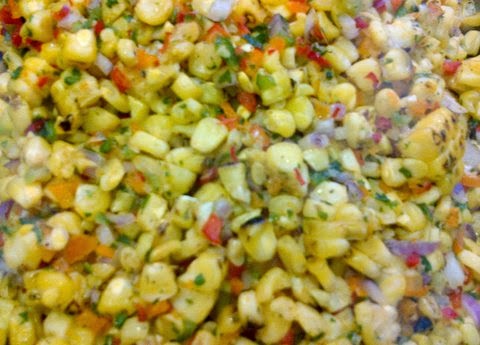


Enjoy! The salad is good warm, at room temperature or chilled. It's good as a relish or sneaked into sandwiches, green salads or soups.

Come wintertime, you could probably recreate the salad with frozen corn and imported peppers and herbs. (I would try to hold the line against the undentable pink tomatoes described so vividly in Barry Estabrook's book Tomatoland, but I might lack resolve by January.) But for now, this salad tastes like the juicy last harvest of summer.

Friday, June 21, 2013

Red vs. White

We all do it.

Despite our best efforts to appear fair, to be open to all, we all have favorites.

So, love ya, plum! You're fabulous, peach, simply fabby! I'll get back to you in a minute. Lemme just get past you.

The cherries are here.


Yay!


I wait all year for cherries. Occasionally cherries pop up out of season, presumably after a long haul from Chile or another country whose seasons complement our own, but I always end up giving them a pass after trying one. Some fruit don't do well out of their time.

When I think of cherries, I imagine deep crimson ones. When red cherries are identified, they're typically labeled Bing cherries, named after the Chinese-American horticulturalist Ah Bing, although other varieties, such as
Lambert cherries, also are widely sold. As you might guess from their deep color, Bing and Lambert cherries are chock full of anthocyanins, and so are are very healthful. (Even more healthful are tart cherry varieties such as Montmorency, which are typically canned or used for juice, but some of us love as is. Hmm, I sense a separate entry!)

But red cherries are not the only game in town. White cherries, aka golden cherries, also have their partisans. 


A becoming blush!


White cherries, typically Queen Anne or Rainier varieties (and few can tell the difference), are extremely delicate and bruise easily. Buy a pound, especially if you don't get to pick them yourself, and you'll likely end up with a lot of dinged and battered cherries, like the ones below They're also apparently more susceptible to growing problems, such as frost damage.


What to expect when you're expecting white cherries


Not surprisingly, white cherries are generally more expensive than red cherries - note the back-to-back signs at one of New York's gourmet supermarkets, showing red cherries for sale at $3.99/lb and white ones at $8.99/lb. 


Despite their premium cost, white cherries are very popular - especially in places like Japan, where delicacy is valued and a certain amount of fruit coddling is to be expected. As my friend Hiroko told me, "Rainiers, or "American Cherries," as we call them here, are quite popular in Japan. I remember my friend Aya complaining around this time of the year. She worked for an American semiconductor company in Tokyo, and she always had to make sure that semiconductor chips from the U.S. would secure their spot on air cargo in June. Otherwise Rainier cherries would take over the rides to Tokyo!"

If you look closely at the text in the supermarket's sign for Rainier cherries, you'll see it not only touts "firm skin that creates a satisfying crunch with every bite," (as if the cherries were tortilla chips), but also white cherries' lessened tartness.  This reminded me a bit of the recent trend to praise white chocolatewhich used to be scorned for its absence of cocoa solids/chocolate liquor and the attendant mixture of bitter/tart flavor with the sweetness. But as food activist Jo Robinson wrote in recent and fascinating New York Times article entitled, "Breeding the Nutrition Out of Our Food," produce's color and complexity of flavor has been seen as a disadvantage for a while:  

In 1836, Noyes Darling, a onetime mayor of New Haven, and a gentleman farmer, was the first to use scientific methods to breed a new variety of corn. His goal was to create a sweet, all-white variety that was “fit for boiling” by mid-July. He succeeded, noting with pride that he had rid sweet corn of “the disadvantage of being yellow.”
The disadvantage of being yellow, we now know, had been an advantage to human health. Corn with deep yellow kernels, including the yellow corn available in our grocery stores, has nearly 60 times more beta-carotene than white corn, valuable because it turns to Vitamin A in the body, which helps vision and the immune system.

And yet I'm happy both red and white cherries are around. For me, white cherries never scale the heights of magnificence that red cherries do, but they are much more consistent. There are points in June and at the end of July when red cherries are available but not worth buying. To me, they taste like mud. I have found (undamaged) white cherries to be pretty consistent in taste whenever they're available. 

The season is too short for me to spurn either contender. Which to choose? I say, Both.

There's a reason why it's a metaphor for a happy, easy life!