Showing posts with label plums. Show all posts

Friday, September 4, 2015

How to Pick a Good Cantaloupe

Yes, once again I'm taking a break from showcasing the oddball and  curious side of produce to offer, as my friend Karen said, "something useful, for a change." My only regret, of course, is that I can't offer this particular blog post in Odorama.


You might recall Odorama from the John Water's film Polyester.  The movie was enhanced by Smell-o-Vision cards that audience members were supposed to sniff at various times in story, to give them a deeper understanding of the movie. (This being a John Waters movie, unlike later family-friendly copycats like Spy Kids, which used "Aromavision," the scents included dirty sneakers and airplane glue.)

A Smell-0-Vision card would be useful to demonstrate the most important criterion in selecting a good cantaloupe: aroma.

A sweet, ripe cantaloupe will have a very pleasant, tropical, floral scent. Your nose can help you weed out cantaloupes with rot and mold - distinctive and unpleasant smells.

In the absence of Odorama, I suggest that you get into the habit of smelling cantaloupes that were sweet and luscious, and committing the smell to memory. Likewise, remember the smell of melon mold and remember it when you next hold your cantaloupe auditions.

You can also find visual clues to the cantaloupe's taste.

First, avoid cantaloupes with signs of withering, moldy patches or rot.


Next, look at the cantaloupe's underlying color below its netting. A creamy or orange color is good; greenish casts, especially if they are dark green, suggest underripeness.

Finally, check out the melon's stem end. An "innie" indentation means that the cantaloupe was ripe enough at the time of harvest to be pulled off its vine.


If the melon still has a bit of stem attached, it means that it had to be cut off before it was fully ripened.


As always, a fruit that is heavy for its side is likely to be ripe and juicy.

Choose a cantaloupe that is heavy for its size and has a floral aroma, creamy color, and an innie stem end, and you're likely to nab a good one!


After dealing with the mystery of the plum, my status as the Produce Savant needs this reassurance.

Saturday, August 22, 2015

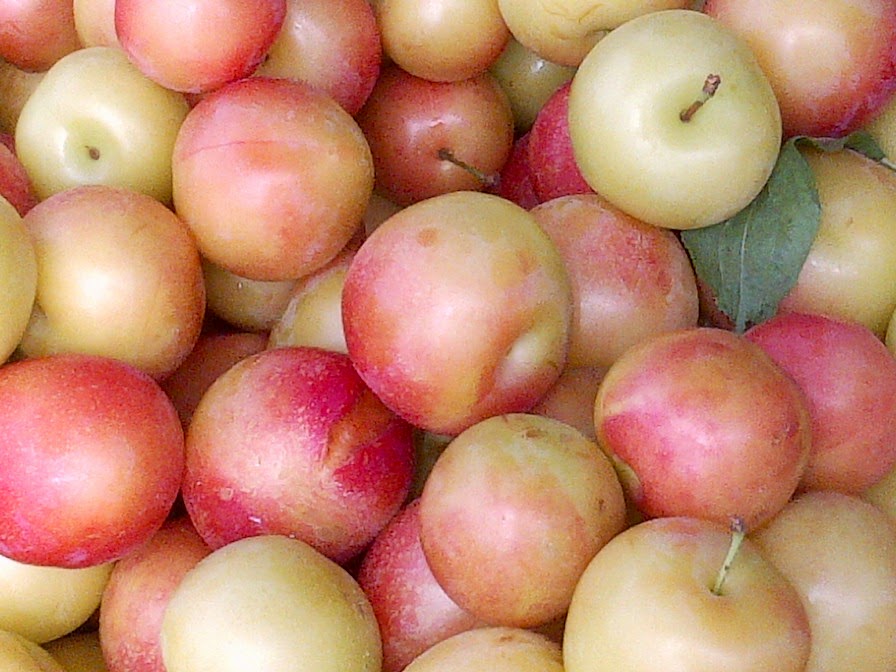
The Mystery of a Plum

Sure, many kinds of fruits and vegetables come in an array of colors, shapes and sizes. It's hard to go to the Greenmarket and not marvel at the variety of peppers, for example. But I think I know what to expect with peppers: small peppers are generally hot (how hot, of course can vary enormously) and green peppers taste more vegetal than red ones.

Plums, on the other hand, continue to stump me.


I understand a few varieties, especially the Empress and Prune - the oval ones with purple skins and greenish-brown flesh. When I was young, the sightings of prune plums always made me sad, since they signified the end of summer and the imminent return to school. Nowadays they appear in July, breaking the poignant end-of-summer-freedom association. I'm not a big fan of these plums, but I appreciate their intelligible code: hard plums will be tart, soft ones sweeter, and their flesh predictable along the green-brown spectrum.

But "black" or "red" plums are another story. Will their flesh be pink-red -- or beige? Plums with similar purple-black skin can look nothing alike when cut.


Markets that meticulously describe their produce often still use these crude color terms to identify their plums.


I turned to the International Federation for Produce Standards PLU (Produce Look Up) Codes on the plums' stickers for salvation.


Not much help! The code 4040, for example, just signifies "Large Black Plum."
This "includes Ambra, Black Beaut, Prima Black, Blackamber, Black Torch, Catalina, Challenger, Black Diamond, Friar, Royal Diamond, Black Knight, Freedom, Black Flame, Howard Sun and Angeleno." This range means that the plums labeled #4040, the most common number I've seen, can vary from squat to heart-shaped and can have interior flesh of pretty much any possible plum color: dark magenta, beige, pale pink. More importantly, #4040 plums can have any degree of flavor. Likewise, Code 4042 indicates "Large Red Plum," with another wide range of varieties (including ones I actually am familiar with, like Santa Rosa and Fortune).

Three of the stickers featured a cute dinosaur, which is a trademark of Dinosaur Brand pluots. A few years ago NPR claimed that pluots, the plum-apricot hybrids, "now make up a majority of the plum market. In fact, you might be eating a pluot or an aprium [another plum-apricot hybrid] and not even know it." Based upon my sticker survey, with many more #4040s than any other number, that isn't true. Using the International Federation for Produce Standards PLU website tells you about as little about the pluots as it does for plums: PLU 3278 is "Mottled Pluot" whereas 3609 is "CA Red Pluot." But since pluots and plumcots, pluots' plummier cousins, are relatively recent hybrids, breeders are interested in their distinctions. I wouldn't mind a chart for plums as comprehensive as this handy-dandy one for pluots!

Of course, many markets sell farm fresh plums, free from any PLU sticker adornment. The Union Square Greenmarket leans heavily toward plums round and small, like Shiro and Methley, which they sometimes call Sugar Plums. Of course, "sugar plums" usually refers to a confection of dried fruit, ground almonds and lots of sugar -- adding to the confusion that surrounds plums.

So what to do with the mystery of the plum? I'd say relax and enjoy its unpredictability. And with that, I'll salute the plum, in all of its diverse beauty and mystery.


Friday, July 31, 2015

Black Velvet

Give that person a raise! 

Whoever came up with the name "Black Velvet apricots" is a marketing genius. 

The name alone makes me never want to eat a humdrum regular ol' apricot again.


Even the more mundane shortened name of "black apricot" can work some marketing magic on me --  but then again, I am a New Yorker, with the black wardrobe to prove it. "Black velvet apricot" sets the stage for the velvety smooth skin, and a smooth jazz vibe from the fruit, a very different vibe from the sunshiney, "Have a nice day" orange-yellow of regular apricots. Granted BV apricots aren't actually black, but red cabbage isn't red, either. 

It turns out - perhaps even more impressively - black velvet apricots are also not actually apricots. They're a hybrid of apricots and plums. See what I mean about marketing?

Apricots and plums have a long and complicated history of crossing. Luther Burbank, the great 19th century botanist who, like Helen Keller and Florence Nightingale, was a regular star of 5th grade book reports back in my day, developed a 50/50 plum/apricot hybrid, later known as a plumcot.  Plumcots, in turn, have been crossed with plums to give birth to the pluot. (Pluots have become so ubiquitous that according to one account, "Pluots make up the majority of the plum market." And the pluot's place in the national consciousness has been certified with this New Yorker cartoon, which declared the pluot to be "an apricot that self-identifies as a plum.")

But unlike these half-plum and mostly-plum hybrids, black velvet apricots are apriums, an apricot/plum offspring that is mostly apricot.


As we saw with apple hybrids, the goal of breeding programs is to harness the best qualities of each parent - especially those qualities that yielded the holy trinity of a sweeter, juicier and hardier fruit. BV apricots are definitely juicier and sweeter. From what I've experienced, they're also less likely than standard apricots to be mushy or mealy.  I liked these traits, and I could see why shippers and vendors would like them too. I did notice that the the regular apricot had a pit that released much more easily, whereas the black velvet apricot's flesh clung to the pit, just like a plum. 


Not a big deal, but I'm sure a breeder is working on this "problem" right now.


But I'm not ready to write apricots off entirely. A day after buying a bunch of BV apricots, my head was turned by this display of the old-fashioned kind.


Look at that blush, I thought. The apricots were practically glowing with health. We don't need fancy tinkering, they seemed to say. We're fine the way we are.

I bought a couple. The apricot was firm and tasted both sweet and tangy. It wasn't as juicy as the black velvet apricot, but neither are a lot of fruits I enjoy. I enjoyed the indentation left behind when the pit easily slipped away. Liking one fruit doesn't mean forsaking all others, I thought. Sometimes a tweak gives you an appreciation of both the new thing and the original.

Besides, soon enough busy breeding programs will make the pluot old hat. Personally, I'm waiting for a cherry-plum hybrid.