Showing posts with label PLU codes. Show all posts

Wednesday, February 22, 2017

What the heck is that? Charentais melon

There's nothing like a wrong name to make a mysterious fruit even more mysterious.


I was delighted by the pile of diminutive striped mystery melons I recently found at a favorite produce shop. The melons looked a bit like a cross between a cantaloupe and a carnival squash.  Their sign bore a very cheap price and a name that was entirely unfamiliar to me.


Sharantain? I never heard of it. Neither had Google. "Did you mean Sharlyn?" Google asked not-so helpfully. 

I knew I needn't stay ignorant for long. The melons were adorned with pesky stickers. PLU codes to the rescue!


PLU, or "Product Look Up" Codes, are assigned by the International Federation for Produce Standards, an international body that should really recruit me to join. These are the codes that cashiers type in at supermarket registers, but curious consumers and fruit fetishists are also welcome to type a number into the PLU Code database to figure out What the heck is that? Number 3033, the number on the melon's stickers, corresponded to "Charentais, small." 

Also appearing on the sticker, albeit in tiny letters, written on an angle: the word Charentais. Oh yeah!

Charentais melons are also known as French cantaloupes. Their origins - and their name - come from the Poitou-Charentes region of France, where they were bred for refinement, "free of natural and highly occurring warts of its parent varieties." I hazily recalled a few past specimens from pricey gourmet stores, fragrant and expensive. These humbler cousins, (who, according to the PLU stickers, hailed from Guatemala) lacked an enticing scent, but also lacked the stiff price tag. Many fruit enthusiasts rhapsodize about the charentais: "Considered by many to be the most divine and flavorful melon in the world...sweet, juicy orange flesh with a heavenly fragrance," said this seed catalogue. And an exotic fruit vendor composed this tribute:
Charentais melons are said to be the finest melons in both taste and texture...They have an orange flesh and a luscious, flowery aroma. Popular in Europe, Charentais are especially prized in France for their rich, honeyed finish.
Both sources described the melon's diminutive size with the gauzy phrase of "perfect for two people," making a shortfall of tasty fruit into a romantic opportunity to share the luscious, honeyed fruit with just that special someone.

So how to the charentais stack up against the mundane, everyday cantaloupe?


The ones I tried - and when paying just 99 cents for each melon, I could be a scientist, with a quasi-statistically significant sample - were very nice, sweet and juicy though not noteworthily fragrant. 


But it's February, for godsakes, and there is no inalienable right to great summer fruit in February. By this standard, the charentais hit a home run.

I'll be buying more, if I can. Charentais is a great cantaloupe -- by whatever name it's known.


Saturday, August 22, 2015

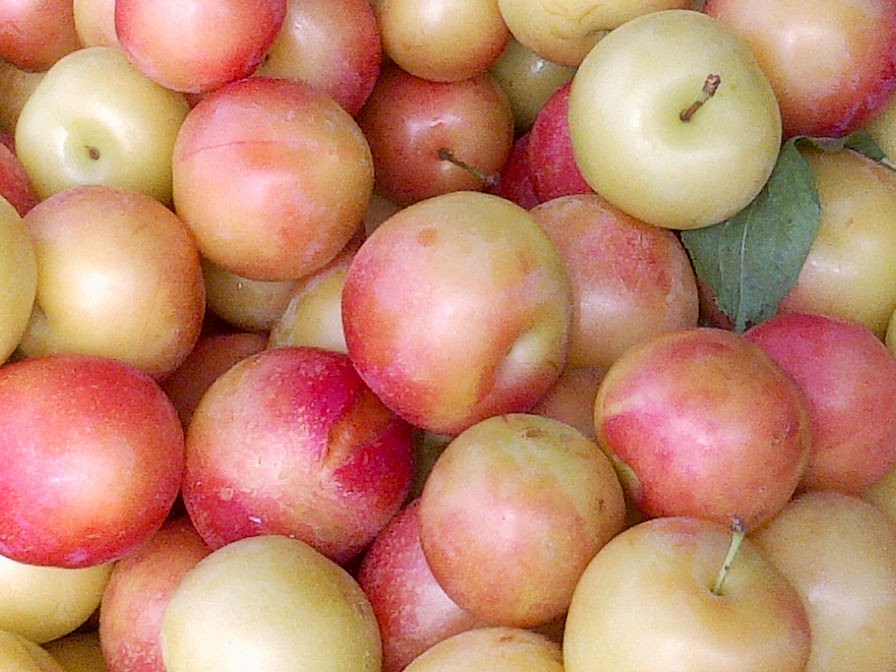
The Mystery of a Plum

Sure, many kinds of fruits and vegetables come in an array of colors, shapes and sizes. It's hard to go to the Greenmarket and not marvel at the variety of peppers, for example. But I think I know what to expect with peppers: small peppers are generally hot (how hot, of course can vary enormously) and green peppers taste more vegetal than red ones.

Plums, on the other hand, continue to stump me.


I understand a few varieties, especially the Empress and Prune - the oval ones with purple skins and greenish-brown flesh. When I was young, the sightings of prune plums always made me sad, since they signified the end of summer and the imminent return to school. Nowadays they appear in July, breaking the poignant end-of-summer-freedom association. I'm not a big fan of these plums, but I appreciate their intelligible code: hard plums will be tart, soft ones sweeter, and their flesh predictable along the green-brown spectrum.

But "black" or "red" plums are another story. Will their flesh be pink-red -- or beige? Plums with similar purple-black skin can look nothing alike when cut.


Markets that meticulously describe their produce often still use these crude color terms to identify their plums.


I turned to the International Federation for Produce Standards PLU (Produce Look Up) Codes on the plums' stickers for salvation.


Not much help! The code 4040, for example, just signifies "Large Black Plum."
This "includes Ambra, Black Beaut, Prima Black, Blackamber, Black Torch, Catalina, Challenger, Black Diamond, Friar, Royal Diamond, Black Knight, Freedom, Black Flame, Howard Sun and Angeleno." This range means that the plums labeled #4040, the most common number I've seen, can vary from squat to heart-shaped and can have interior flesh of pretty much any possible plum color: dark magenta, beige, pale pink. More importantly, #4040 plums can have any degree of flavor. Likewise, Code 4042 indicates "Large Red Plum," with another wide range of varieties (including ones I actually am familiar with, like Santa Rosa and Fortune).

Three of the stickers featured a cute dinosaur, which is a trademark of Dinosaur Brand pluots. A few years ago NPR claimed that pluots, the plum-apricot hybrids, "now make up a majority of the plum market. In fact, you might be eating a pluot or an aprium [another plum-apricot hybrid] and not even know it." Based upon my sticker survey, with many more #4040s than any other number, that isn't true. Using the International Federation for Produce Standards PLU website tells you about as little about the pluots as it does for plums: PLU 3278 is "Mottled Pluot" whereas 3609 is "CA Red Pluot." But since pluots and plumcots, pluots' plummier cousins, are relatively recent hybrids, breeders are interested in their distinctions. I wouldn't mind a chart for plums as comprehensive as this handy-dandy one for pluots!

Of course, many markets sell farm fresh plums, free from any PLU sticker adornment. The Union Square Greenmarket leans heavily toward plums round and small, like Shiro and Methley, which they sometimes call Sugar Plums. Of course, "sugar plums" usually refers to a confection of dried fruit, ground almonds and lots of sugar -- adding to the confusion that surrounds plums.

So what to do with the mystery of the plum? I'd say relax and enjoy its unpredictability. And with that, I'll salute the plum, in all of its diverse beauty and mystery.