Sunday, July 28, 2013

The Perfect Summer Snack


Lychees aren't my favorite summer fruit, but they might just be my favorite summer travel snack.


A bag of lychees is a virtual cure-all for many summer travel grumbles. 


  • I'm hungry! (They're food, and will slake your hunger.)
  • I'm thirsty and I don't have water! (Lychees are virtually bags of fruity water, and are so refreshing.)
  • My beautiful peaches/plums/name your fragile fruit got bruised and now are disgusting! (It's hard to damage lychees; they're in the junior division of [link]armored fruit)
  • I want some refreshing fruit but I don't have access to a refrigerator! (No problem. Lychees don't need refrigeration for a good long while.)
  • I'm bored! (The process of peeling them, popping them in your mouth and spitting out the seed is better-than-middling entertainment.)
  • Are we there yet? Are we there yet? (Ah, you got me on this one.) 


I have long enjoyed lychees' cousins, rambutans and longans. Lychees are generally more widely available. I remember when you would need to go to Chinatown to buy lychees (as you still need to do for longans and rambutans), but lychees have made it as crossover hits. Not only can you buy lychee flavored liqueurs, coconut water and frozen yogurts, you can buy fresh lychees from non-Chinese vendors.

Some vendors emphasize the jungly look.


What hides beneath lychees' armor? A pearly white fruit with a shiny dark pit. To discover it, just use your fingernail to make a hole in the thin shell at its stem end, then peel off the shell entirely.  


Posted by Picasa


Typically my lychees end up as a bag of shells and pits, but they're versatile fruits and they dress up well. No reason not to invite them to the party! Here they are in good company (pineapple, grapes, melon, plums and berries) on a summer fruit platter.


Without their shells, lychees are excellent homebodies - and just as refreshing at home as they are on the road.

Saturday, July 13, 2013

Mango mania


Hurrah! Mangoes are around - and abundant!


Now, I admit that it's not hard to find some kind of mango most of the year. The trouble is, most of the year that mango is a Tommy Atkins, sometimes called a blush mango because of its deceptively rosy glow. Tommy Atkins mangoes generally have pale, insipid flesh, acidic flavor and none of the lushness of great tropical fruit. They hint at great flavor but rarely deliver. Unfortunately, they're the de facto mango for most people in the US because they're the supermarket standard.


If this was the only mango I knew, I wouldn't love mangoes!


Fortunately, there are alternatives.


Check out this fruit stand in a place where people are connoisseurs of tropical fruit - the Bronx! This us Mango Central: nestled among the pineapple, papayas, avocados and quanepas (in the center square), it's all mango, all the time. Just note the numerous varieties! On the left side, Haitian (aka Francis) mangoes; on the bottom, Tommy Atkins; next to Tommy Atkins, tiny Dominican; above the quanepas, Ataulfo (aka Champagne or Manila) mangoes; and above the papayas, either Keitt or Kent mangoes (yes, I admit that I can't tell the difference).


We expect to see varieties of apples and grapes, so why not some choice of mangoes?

My favorites are the Ataulfo and Kent/Keitt varieties.


You might recall Ataulfo as my friend Thom's go-to variety in her Mango Agar Dessert recipe. Good choice! Ataulfos are smooth, not at all stringy and have a great, light taste.


The Champagne gang

Ataulfo pits are extremely flat, so you get a lot of mango for the size.


The weird, whiskery remains

I took this picture for perspective.


Of course, what really matters is flavor. Ataulfos have a light and delicious sweetness. One caution: Ataulfos peel, though smooth and thin, is very astringent.  I have seen folks chomping into these mangoes then spitting out the skin, but removing it before eating is a much pleasanter option.

Cut the mango in long "cheeks" (aim for as close to half as you can without hitting the pit) then remove the peel from the cheeks. Or use a spoon or melon baller to scoop out mango balls.


Next up are Kents/Keitts. Both are large fruit that can be ripe even when their skins are dark green. The big difference, in the US, anyway, is that Keitts are often grown in the US (and Mexico) with a peak season in later summer and early fall. Keitts are generally imported from Mexico and South America and are available January - March and again in the summer. Keitts especially can stay quite dark while attaining full ripeness.

I first became acquainted with K/K mangoes when a fruit vendor gave me a sample of what looked like a particularly robust - and unusually tasty - dark green Tommy Atkins. Huh? This mango was better than the ripest dark blushing Tommy I had ever had! It all made sense when I learned that I was eating an entirely different variety. 


The key I have found with K/K is to make sure the mango is soft and feels ripe, however dark the peel may be. (Many tropical countries have traditions of using under-ripe fruit for salads, pickles, or cooked condiments, but I'm going to leave this area unexplored for now.) A ripe Kent or Keitt mango is lusciousness itself.


You may be thinking, Huh! I think I've had a Tommy Atkins mango and it was delicious!  This could certainly be true. Or, more likely, especially if the mangowasn't fibrous, the Tommy mango could have been another variety entirely called a Haden. The Mango Maven, an expert on all things, upgraded her rating of Hadens (from "3rd runner up"). Her antipathy to Tommy Atkins remains in place, by the way: as As she writes in "The Trouble With Tommy Atkins," "Leave the Tommy Atkins mangoes on the shelves. When the Kents or Keitts or Manilas [Ataulfos] come in, get them while you can!! Eventually, produce buyers will get the message."

Of course, there's another school of thought entirely, one in which the best mango is the mango in front of you that someone else has peeled and trimmed. To these "Love the one you're with, baby" adherents, Manhattan - far away from the California and Florida growing fields - offers a unique welcome. The street vendor/fruit stand culture here includes many mango vendors who sell mango "roses" (mangoes on a stick with a half-dozen vertical cuts that turn the mango flesh into "petals") and cut, bagged mango slices. Some vendors include the pit with some surrounding flesh as if it were a particularly thick slice and some toss the pits away and just sell true slices. Salt and hot sauce are optional additions. Bon appetit!


Monday, July 1, 2013

Talking Turkey

My friend Lol recently paid a visit to Turkey, and very graciously took some pictures of fruit stands in Istanbul. (Note to readers: I'd love to get your pictures too - the farther afield from New York the better. That means you, audience member in Mauritius. And you, in Kuwait and Kazakhstan! And you too, Luc of the Jacaranda Primary and Secondary School in Malawi. Just email me your interesting photos - odd fruit, mystery veggies, only-natives-love-it produce, local markets - at theproducesavant@gmail.com. Thanks!)

The first photos howcases some very attractive melons (with more of a vine/leaf presence that melons generally do in the US); squash; beans; potatoes; and onions.


When I visited Turkey about 15 years ago, I went in March - a particularly cold March. I was a little startled that there was snow on the ground. I hadn't expected Istanbul to be colder than New York.

In those days Turkey did not import produce - that's probably no longer the case - so the produce selection was a bit limited. I recall that carrots were ever-present, along with grapes, specifically the most wonderful muscat grapes I've ever had.

Turkey has changed a lot since then, but I hope the muscat grapes are as good as ever.

Lol also snapped a picture of cherries, always of interest to me, sold alongside small green plums that were unfamiliar to her. As she wrote,  "There was a fruit in Istanbul I hadn't had before - a kind of green plum that isn't sweet. It's not exactly sour, but it wasn't sweet."


By some cosmic coincidence, while Lol was in Istanbul checking out the strange green plums, I was at Kalustyan's, New York's premier spice bazaar - I also checking out the strange green plums they had on display. 


Fortunately a sign explained it all:


Erik! Not just a man's name, it was a global phenomenon. I bought some plums, took them home and cut them up, and tried them with the requisite salt.


As I snacked, I googled "goje sabz" and found this heartfelt ode on the blog My Persian Kitchen:


Do you have any fond childhood memories that involve food? I do. Many.  I always get that fuzzy feeling inside any time I see or taste something that I loved in my childhood. Everyone looked forward to when [gojeh sabz] were in season because every loves Gojeh Sabz. If you are Persian and you don’t like them, then there is something wrong with you. Can I be any more judgemental???!! Seriously….
 Gojeh Sabz is actually sour plums which have not fully riped. They are sour and delicious! During this time of the year I buy them from our local Persian Grocery store. Much to my delight while I was at the Farmers Market in Torrance yesterday there was a vendor who was selling them. How awesome is that?I just stood in front of the tables and had a moment of happiness with me myself and I.The way we eat them is with a little pinch of salt.  The combination of sour and salty is just out of this world good! It will make you giggle!!! All you have to do is take a little bite, then sprinkle a little salt, take another bite, another sprinkle of salt and another bite….next thing you know you have gone through a whole bunch of them, because they are just like potato chips.

I certainly understand how powerful food memories are. And yes, even produce inspires longing in the homesick. But are erik/gojeh sabz/janareng as addictive as potato chips?

Nope.

They were okay, but not more than the sum of their parts. "Gee, this tastes like a salty, unripe plum," I thought. Since I had a little pile of salt remaining from Operation Appreciate Gojeh Sabz, I thought I'd experiment with another plum - a ripe one. Whaddaya know? I liked it better. 

And it was even better without the salt. 


Friday, June 21, 2013

Red vs. White

We all do it.

Despite our best efforts to appear fair, to be open to all, we all have favorites.

So, love ya, plum! You're fabulous, peach, simply fabby! I'll get back to you in a minute. Lemme just get past you.

The cherries are here.


Yay!


I wait all year for cherries. Occasionally cherries pop up out of season, presumably after a long haul from Chile or another country whose seasons complement our own, but I always end up giving them a pass after trying one. Some fruit don't do well out of their time.

When I think of cherries, I imagine deep crimson ones. When red cherries are identified, they're typically labeled Bing cherries, named after the Chinese-American horticulturalist Ah Bing, although other varieties, such as
Lambert cherries, also are widely sold. As you might guess from their deep color, Bing and Lambert cherries are chock full of anthocyanins, and so are are very healthful. (Even more healthful are tart cherry varieties such as Montmorency, which are typically canned or used for juice, but some of us love as is. Hmm, I sense a separate entry!)

But red cherries are not the only game in town. White cherries, aka golden cherries, also have their partisans. 


A becoming blush!


White cherries, typically Queen Anne or Rainier varieties (and few can tell the difference), are extremely delicate and bruise easily. Buy a pound, especially if you don't get to pick them yourself, and you'll likely end up with a lot of dinged and battered cherries, like the ones below They're also apparently more susceptible to growing problems, such as frost damage.


What to expect when you're expecting white cherries


Not surprisingly, white cherries are generally more expensive than red cherries - note the back-to-back signs at one of New York's gourmet supermarkets, showing red cherries for sale at $3.99/lb and white ones at $8.99/lb. 


Despite their premium cost, white cherries are very popular - especially in places like Japan, where delicacy is valued and a certain amount of fruit coddling is to be expected. As my friend Hiroko told me, "Rainiers, or "American Cherries," as we call them here, are quite popular in Japan. I remember my friend Aya complaining around this time of the year. She worked for an American semiconductor company in Tokyo, and she always had to make sure that semiconductor chips from the U.S. would secure their spot on air cargo in June. Otherwise Rainier cherries would take over the rides to Tokyo!"

If you look closely at the text in the supermarket's sign for Rainier cherries, you'll see it not only touts "firm skin that creates a satisfying crunch with every bite," (as if the cherries were tortilla chips), but also white cherries' lessened tartness.  This reminded me a bit of the recent trend to praise white chocolate, which used to be scorned for its absence of cocoa solids/chocolate liquor and the attendant mixture of bitter/tart flavor with the sweetness. But as food activist Jo Robinson wrote in recent and fascinating New York Times article entitled, "Breeding the Nutrition Out of Our Food," produce's color and complexity of flavor has been seen as a disadvantage for a while:  

In 1836, Noyes Darling, a onetime mayor of New Haven, and a gentleman farmer, was the first to use scientific methods to breed a new variety of corn. His goal was to create a sweet, all-white variety that was “fit for boiling” by mid-July. He succeeded, noting with pride that he had rid sweet corn of “the disadvantage of being yellow.”
The disadvantage of being yellow, we now know, had been an advantage to human health. Corn with deep yellow kernels, including the yellow corn available in our grocery stores, has nearly 60 times more beta-carotene than white corn, valuable because it turns to Vitamin A in the body, which helps vision and the immune system.

And yet I'm happy both red and white cherries are around. For me, white cherries never scale the heights of magnificence that red cherries do, but they are much more consistent. There are points in June and at the end of July when red cherries are available but not worth buying. To me, they taste like mud. I have found (undamaged) white cherries to be pretty consistent in taste whenever they're available. 

The season is too short for me to spurn either contender. Which to choose? I say, Both.

There's a reason why it's a metaphor for a happy, easy life!

Wednesday, June 19, 2013

What the heck is that? Quanepas


People like eating food from their childhoods.

That explains a lot. Like quanepas.


Quanepas are strange little tropical fruit that grow in the Caribbean. In the Bronx, Harlem and other areas with many residents from the Carribbean, fruit stands sell quanepa branches in the summer. Lord knows my produce trend-spotting record is poor, but I feel reasonably confident in predicting that quanepas will not be a breakout hit. 


Quanepas are attractive enough from the outside - they have a certain Nature Walk charm. The problem is the actual fruit, and especially its problematic ration of Perceived Labor to Fruity Pleasure. To enjoy a quanepa, you use your fingernail to split and remove its green shell. So far so good - not too much work. 

But unlike rambutan or longans - other tropical fruits with easily removed shells - the fruit inside isn't luscious.


It's mostly pit, with a bit of pulp with the consistency of a wet cotton ball clinging tenaciously. Imagine what you could achieve if you clung as tenaciously to your dreams as the quanepa's pulp clings to its pit!

If the fruit is actually ripe - a tough call without picking and squishing each one, something you might be able to do with a tree in your backyard but probably not at a fruit stand - the pulp has a pleasant enough sweet-tart taste. You have to use your teeth to scrape at the pulp and don't get much for your efforts, just a somewhat less fuzzy pit. If the fruit isn't ripe enough, suddenly you recall a long list of things to your really need to get done, so why exactly are you wasting your energy on Operation Fuzz Removal? 

Verdict: I'd be a fan if I were from the Caribbean and and feeling homesick, or if I were enjoying one on a balmy evening in my own Caribbean backyard. Otherwise I'd feel free to pass them by.

Wednesday, June 12, 2013

Not Everything is Better at the Farmers' Market

Last Saturday I saw these beauties at the Union Square Green Market. Not only were the strawberries very attractive, they were substantially discounted in an end-of-day sale.


Good from far, but far from good

Great, right? The one hitch: the strawberries had very little flavor. (Sorry, Hiroko.)

I couldn't help but contrast them with some strawberries I had purchased earlier in the day, the kind of big, mass market agri-business strawberry that we usually assume are bred for easy packing and shipment around the country.


I actually taste good!

They were succulent.

I love the Green Market. But I would never assume that just because a Union Square farmer sells something I'm obliged to buy it.

One of my favorite vendors offered this ready-for-compost kabocha for sale. 


Choose the kabocha - but not one of these


On several occasions I've sucker-bought grainy, sudsy, and flavorless watermelons because of the farmer's sworn attestation about their deliciousness. (Memo to self: No whole watermelons! No whole watermelons!) Eventually the lesson sunk in.

After learning the hard way, I don't buy corn for the first few weeks it's for sale at the Market -- despite the frenzied crowds at the Market stands. Let those folks elbow each other out of the way to get at the immature, under-ripe goods. I guess it's hard to leave the produce on the vine or on the stalk when the incentive to bring it to market (Market) is so great. I'm doing my part by not encouraging this practice.

Likewise, I suggest that customers ignore the apples being sold in the summer. You know that these apples are about 8 months old, right? And it's not as if there aren't alluring alternatives in the summer.


We are not apples (photo taken last year)

Too wordy for an embroidery sampler but true all the same: 

Just because something is being sold - even under the umbrella of virtue that is the Green Market - does not mean you have to buy it.

So try a blueberry before you buy a pint; buy one peach before you buy a peck. And understand that while there may be many compelling reasons to buy directly from a farmer - good stewardship of the land; better labor conditions for workers; a human connection with the grower and seller; support of the local economy; minimization of wasteful travel; better variety of produce; typically low or no dependence upon chemical fertilizers and herbicides; etc. -- taste isn't always one of them.


Monday, June 3, 2013

Hot Weather Treat: Filipino Avocado Milkshake


Kids exult in knowing more than grown-ups, and it's not unusual for a kid to come out of a science lesson about plants to crow to his or her parents, "Tomato isn't a vegetable; it's a fruit. Eggplants are fruits, not vegetables. Pumpkin is a fruit, too. Nyeh nyeh nyeh."


And yet - pumpkin pie notwithstanding - it seems so wrong. We generally think fruits are part of sweet dishes and vegetables of savory dishes, and that's that.

Or is it?

Think of avocados: Guacamole. Salads. Dusted with salt and black pepper or hot sauce.


Not necessarily waiting for the savory treatment...


But such treatment is not inevitable.

A recent mini-heatwave in New York was the perfect opportunity for my friend Bea, who hails from the Philippines (a country that understands the kind of hot, humid weather that always surprises New Yorkers despite its predictability), to showcase her sweet and refreshing avocado milkshake.

Here are her instructions:


1) Remove the pit and the peel from two - three ripe avocados.


2) Put the avocados and several ice cubes in a blender.


3) Add 8 oz of milk. Back home in the Philippines I would use condensed milk, which we use for everything - coffee and tea, rice, soups - but here I use plain milk and add some sugar to taste, maybe about 3 teaspoons. You could use any kind of dairy milk - whole, skim, 2% - or almond or soy milk. My avocado shakes are only a little sweet, so add more sugar to taste if you like a sweeter milkshake.


4) Turn on the blender and let it run until all the ingredients are nicely mixed and frothy. Pour the mixture into 2 -3 glasses.

5) Enjoy this refreshing treat!


Tuesday, May 28, 2013

What the heck is that? Cherimoya


Beneath the tough, scaly, lizardy exterior lies a tender interior. A smooth, sweet and creamy interior, to be exact. I'm writing, of course, of armored tropical fruits.

I'm thinking of guanabana, which I passed up in Brooklyn when I had empty pockets and some sticker shock. I'm thinking also of Brazilian beauties like the pinha that I am determined to see in person. Ah, someday.

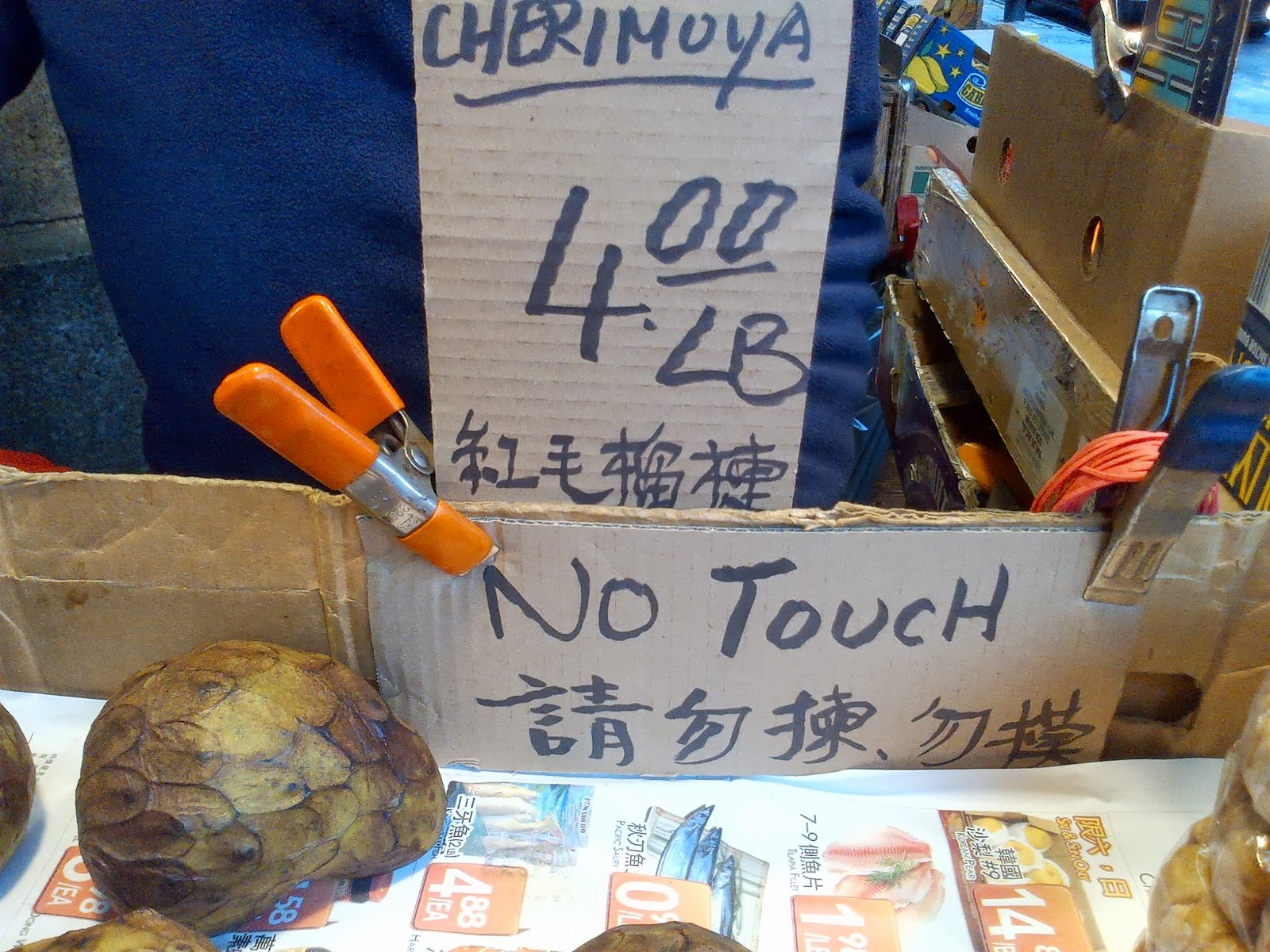
So when I encountered these scaly, lumpy fruits in Chinatown over this past weekend, I was powerfully motivated to buy them. My old pal, the cherimoya.


My interest in what you could call the lizardy fruits basically began with the cherimoya I first had at the fabled La Marqueta, a market built under the elevated Metro-North Railroad tracks in East Harlem. I had specifically gone to La Marqueta to discover unknown, delicious produce. I was not disappointed. The cherimoyas I purchased were magically custardy, as befitted another name by which they are known, custard apple. They tasted like a combination of several tropical fruits - banana + pineapple, most prominently, with hints of other fruits (maybe a very ripe Comice pear?) rounding out the flavor.

It's been years since I've had one. It was time.

The cherimoya in Chinatown looked considerably further along the ripeness continuum than, say, the photo in the Wikipedia entry.


Photo courtesy of Hannes Grobe, Wikipedia

Still, I was game. The Chinatown cherimoyas were a little riper than I would have liked, but I asked for one "for tomorrow, not today," and got one of the firmer ones. (Cherimoya can be a little grainy if not ripe and even a little astringent if far from ripe. I've been told to aim for the feeling of a banana at the degree of ripeness you like.)

I knew I needed to treat the cherimoya, especially if it was very ripe, extremely gently. This fruit stand wasn't going to provide padded sleeves for their high-strung fruit as some gourmet stores do. That was fine with me - I love the range, immediacy and price of the Chinatown produce experience, so  I am willing to forego some niceties. I wrapped my new cherimoya in a T shirt. 


When I got home, I dumped my bags and practically ran into the kitchen.

Here's what the Wikipedia photo of a cut cherimoya looks like: 


Photo courtesy Hannes Grobe, Wikipedia


And here's what mine looked like:


That is, until it looked like this:


Wow, that was good. 

Friday, May 24, 2013

The Rules of Attraction

On a recent walk through the Union Square Green Market, I saw several items of produce that I suspected I would dislike. Despite my misgivings, I ended up giving them a try. Why? They were so pretty! My head was turned by their beauty. Was my mind changed as well? Let's take a look.

Head Turner #1: Kale Flowers


Spring has sprung!


Selling point: Beautiful, bountiful and just $3 for a huge bunch. And they must be extremely nutritious - we are, after all, talking about kale here.

Voice in my head says: "Edible flowers" usually taste like sodden tissues. (Slight exception: I do like nasturtium well enough in small doses.)

Verdict: A great purchase for a caterer! The kale flowers would look great on a spring salad at a ritzy event, and one of these big bunches could to a whole lot of salad duty (especially considering the portion size at most ritzy, edible flower type events). As for the taste, well, the flowering kale tasted a bit better than sodden tissues but not enough to inspire me to compose a prissy salad. 


Head Turner #2: Red Mustard


Mustard greens are like escarole and chicory. Okay enough, but why would I buy or eat them when I had better options, such as collard, kale or broccoli rabe?  So I've mostly ignored ignored them. These bunches, however, were real lookers.


I feel a rosy glow!

Selling points: I loved the color! They'd be easy to prepare - just saute with some diced onion. Besides, I needed a vegetable for dinner. 

Voice in my head says: Yeah, it's worth making - once.

I made an all red (purple) dish: I sauteed some finely diced red onion until they became translucent and added the mustard greens.

First some onions


I love my cast iron skillet

I stirred the greens and allowed them for a few minutes. I plated them and added a dash of (red/purple) balsamic vinegar.


I know I've seen these mats before


The red mustard greens lost their reddish color in the cooking, as often happens with red/purple vegetables, but overall the dish retained enough Purple Majesty to please even Prince.

Verdict: Quick and easy to make. The greens retained a bit of their bite.Still, I probably won't rush to make the dish again - I sincerely like a lot of leafy green vegetables more than I enjoyed this one. 


Head turner #3: Radishes


When I was growing up, paprika was a kind of tasteless red dust you used to add some color to beige food and radishes were a food garnish, typically in the form of a radish rose, that wouldn't cause harm if eaten. My husband's family, on the other hand, uses zesty Hungarian paprika as an essential spice, and considers radishes a necessary component of any salad. I no longer push radish slices uneaten around my plate, but I don't typically think of purchasing them either. But could I really say no to these beauties?


Wow


Selling points: Gorgeous. Inexpensive. If I didn't eat them, maybe I could use them as some kind of centerpiece.

Voice in my head says: Youtube probably has some how-to videos about garnishes if the actually-eating-them plan doesn't work out. 

I made a quick salad by thin-slicing the radishes with a mandoline, adding some salt and a handful of chopped dill and garlic chives that I had on hand. 


Verdict: Finally! A dish I thoroughly enjoyed and would make again. In fact, I already have. The radish salad would be a great addition to a sandwich, too.

Overarching conclusion: Well, beauty may lure me in, but it's not enough for a lasting relationship.  But as the song nearly says, One out of Three Ain't Bad.