Sunday, August 25, 2013

A Day at the Beach

What does a beach have to do with produce? Everything - if the beach is Brighton Beach!

Brighton Beach is a Brooklyn neighborhood adjacent to the more famous Coney Island. In addition to its lovely and gorgeous mosaic beach (yes, the same South Shore of Long Island beaches that celebrities enjoy in The Hamptons), Brighton offers what New York Magazine called "arguably the most fascinating ethnic enclave in New York," an area in which several waves of Russian immigrants, initially Russian Jews in the 1970s and more recently a mix of Russian Jews and gentiles after the collapse of the Soviet Union, call home.

These are some of New York's most produce-loving people, as a stroll down the neighborhood's main drag, Brighton Beach Avenue, will reveal.


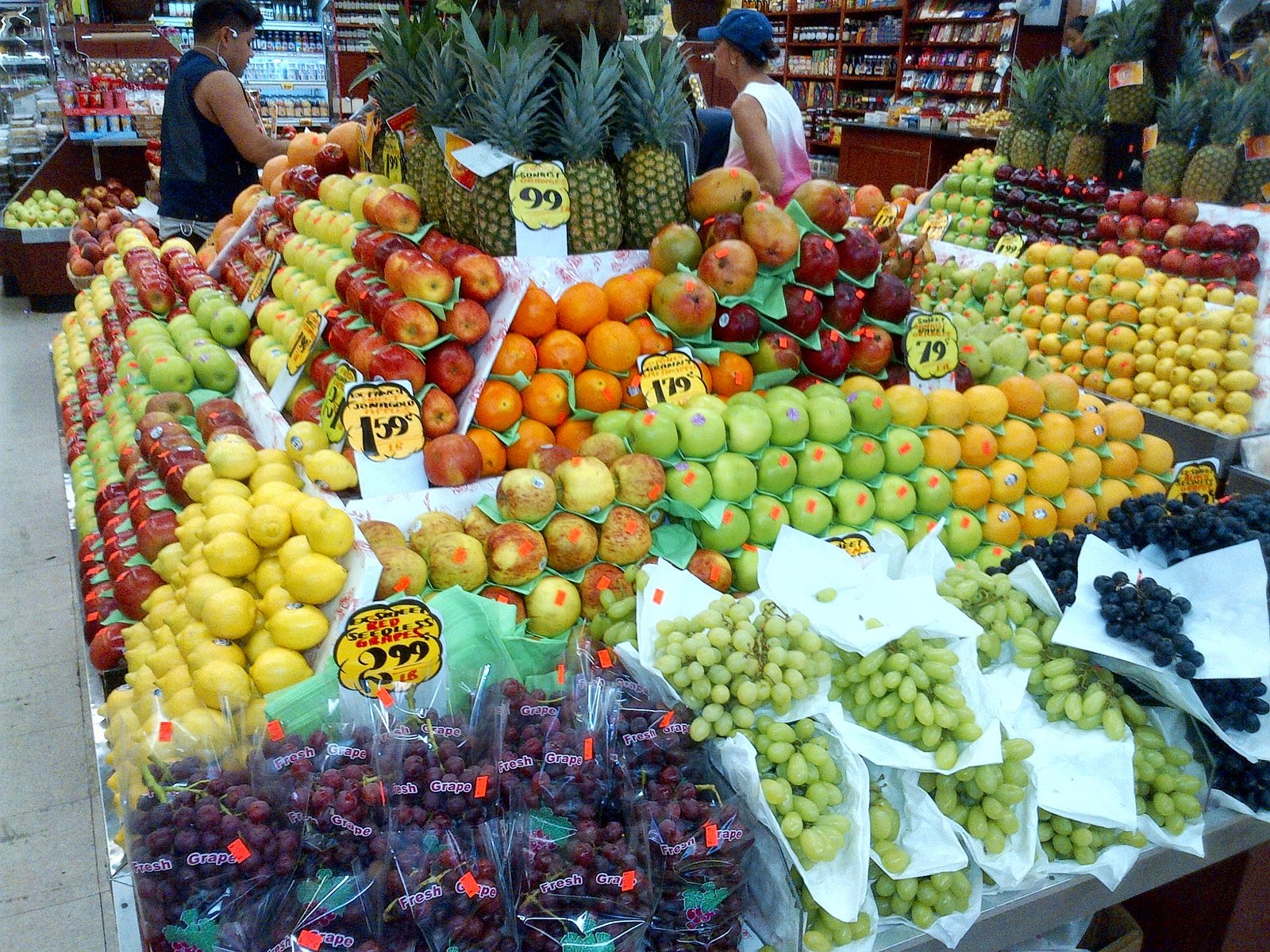
Some fruit vendors, particularly Fancy Farm (across the street from the Brighton Beach branch of the Brooklyn Public Library) are as fancy and beautifully arranged as any gourmet store.


Don't be surprised to see a sea of options, especially for produce items particularly beloved in the Russian community - three kinds of sour cherries, for example.


Does the number 99 contain mystical properties? Nah, these demanding shoppers just enjoy a good value.


Of course, the long Russian winter gives an appreciation for the need to preserve that bounty. Or maybe it's just that pickles are so tasty! Expect your vendor to carry a selection - pickled cucumbers, cabbage, tomatoes, etc.


Every now and then you'll see a sign that shows an appreciation for other produce items that wouldn't necessarily get as much love in another community.


Of course, Brighton Beach is still a beach! Not everyone is focusing on the produce. (And to be honest, once I'm on the beach, neither am I.)


Amazingly, this journey is readily accessible via the same subway lines that might take you to Central Park or Rockefeller Center. Or, in my case, home.


Monday, August 19, 2013

What the heck is that? Garlic scapes

Here’s another way to love garlic.


I first saw garlic scapes a few years ago. I was in Chinatown, and they were crowded among a whole heap of unknown and intriguing items. I was a little intimidated, so I kept to my shopping list and left them untouched. 

Flash forward a year or two, and I noticed them at the Union Square Greenmarket. This time the scapes were surrounded by familiar herbs, making them much more approachable. I decided to buy a bunch.

And so it began.  I was soon hooked.

What are garlic scapes? How do they fit into the scheme of what we typically consider "garlic"?

Garlic scapes are the leafless stems of hardneck garlic. From what I've been told, farmers traditionally cut back the stems in order to get the garlic plants to focus their energy on the garlic bulbs. One enterprising (or hungry) farmer must have grabbed some scapes off the compost pile and decided to cook with them. Viola! A cult was born. 

Or more likely, folks in the US noted that in Garlic Central, aka China, the world's leading producer and exporter of garlic, pretty much every bit of garlic is used. The blog Red Cook, which focuses on Chinese home cooking, tried to help out a reader confused by garlic scape nomenclature, since garlic scapes are sometimes called "garlic sprouts" or "garlic greens," noting,

There are many different parts of garlic available in Chinatown and they should all be labeled accordingly. Even in Chinese there are many different names. In northern China the name suan tai (蒜薹) is used most commonly for garlic scapes. But in the south suan xin (蒜芯) is used. But sometime suan miao (蒜苗) also refers to garlic scapes in spite of the fact that suan miao often refers to garlic greens, or the leaves. So I’m as confused as you are. I’m afraid you’ll have to look at the item itself. Garlic scapes are round solid stalks and usually have flower buds attached. Garlic greens are usually just the leaves with white parts at the bottom.

I hasten to add: Don't get discouraged! Work your way past the confusion! There are many great aspects to garlic scapes that will justify your investment of brain power and derring-do. Here are a few:


1) They are are beautiful singly and a little crazy looking when bunched into a bouquet, a Medusa-head, roller-coaster ride of flower bud and stalk. 

2) They taste like garlic, only a subtle and even herbal version of garlic. This makes them appealing to both garlic fanciers and more reticent fans.

3) They're really versatile! One idea: I've used my scapes, diced finely, in a cucumber salads, mixed green salads and bean salads - anywhere I might use scallions. But wait, there's more!


4) The number one use among shoppers at the Union Square Greenmarket (and not just because of the suggestion below): garlic scape pesto. One shopper said she freezes several containers' worth.


5) Scapes are a nice addition to stir fries.

6) Soups, dips, sandwich enhancers - just let your imagination run wild.

7)  My favorite way: pop a few on a skillet and grill for a few minutes. Sprinkle lightly with salt. Totally addictive. 


But do not tarry! The season is short. Before too long your request for scapes will get you only a sorrowful look and a tip to try again next year.

Tuesday, August 13, 2013

What the heck is that? Donut peaches

Could donut peaches bridge the donut - produce divide?


I am a strong believer in Produce Proselytizing - showing folks how delicious and delightful produce can be. But I know that it's hard to convince people who are accustomed to eating donuts (or other members of the notorious Salt-Sugar-Fat trinity) that they might like some fresh fruit as well. Produce Proselytizing faces a couple of widely acknowledged challenges - access, cost, habit, etc. - and one that isn't discussed as frequently: most junk food has a consistent taste but agricultural products are much more variable in quality.


"I know I can count on an Oreo," a friend's husband told me recently. "An Oreo is always good! Cantaloupe is another story. Sure, I've had some good cantaloupe, but can you guarantee that the next cantaloupe will be just as good? I didn't think so." 


Of course I've had some bad produce. So much, in fact, I've tried to formulate solutions in those circumstances When Bad Produce Happens to Good People. Those experiences haven't broken my stride much, but I do sometimes wish for a consistently wonderful fruit for those a bit more wobbly in their faith.

Enter the donut peach, one of the surest things in the produce world I've experienced thus far.

Donut peaches, aka Saturn peaches, aka Galaxy peaches, aka UFO peaches, aka bagel peaches, are white-flesh peaches with flattened shapes. This unusual profile is said to resemble a donut, the rings of Saturn, a bagel or a UFO. Ya gotta have a gimmick! 


We mean no harm to your Galaxi 


Beyond the amusing names, what I have found intriguing about donut peaches is how consistently great they are. They're very sweet and lower in acid than other peaches. I can't recall ever having a mealy one. 

Donut peaches are a supermarket's dream (flat = stackable) but the variety isn't a recent lab development. They've been grown in China since the 19th century. 

Donut peaches are on the small side (very appealing for kids) and they have a tiny pit that sidesteps one of regular peaches' potentially annoying attributes: the problematic pit. Clingstone peach pits do just what their name implies - cling to the flesh that irritates some people. Freestone pits avoid those separation issues, but sometimes the pit halves separate from each other as well, leaving bits of hard shell amid the peach flesh, or exposing the interstices of the seed and seed debris in a way that repulses some eaters. Donut peaches' pits stay tightly closed but don't cling to the flesh: the best of both worlds.


Little donut peach pits vs. big peach pit


After buying several donut peaches at the farmers' market (and then going back and buying more), I did a bit of research and discovered that donut peaches are wonderful to grow, too.  Mother Earth News noted that donut peaches are easier to grow than many varieties (highly pest resistant and producers of unusually abundant harvests) and have particularly beautiful blossoms.  This seed catalog describes "small, fast-growing trees so attractive they'd be valuable even without the fruit." 

Hmmm, sounds like an opportunity for some garden proselytizing...

Monday, August 5, 2013

Watermelon Tourism (Guest blog post from Korea and Hong Kong)

Summer vacations! The time to hit the road and check out far away lands, reunite with family and friends and visit tourist attractions. And the time for me to engage in some vicarious produce tourism.

My friend Thom has been visiting Hong Kong and Korea this summer, and - of course - our email exchanges have a certain focus to them: the food.

And even within our niche topic I've noticed a little sub-niche: watermelon. 


Large & in charge!


Back in New York Thom and I debated the relative merits of seedless (so convenient) versus seeded (usually more flavorful) watermelon. While I mulled over my weekend purchase of a disappointing whole seedless watermelon, Thom continued her exploration of this topic from Hong Kong and Korea.

Here are some of her comments:

We're in Korea! We went to an ocean park today, and I thought it was interesting one of the snacks that was offered was mini watermelon.  They cut it open and served both halves with a with a spoon! It was very refreshing! I normally hate small mini watermelon, but this one was was surprisingly sweet - and seedless too! 


(Here's Thom's daughter Heidi enjoying some of the mini-watermelon.)


Why are you taking my picture, Mom?


Thom's watermelon commentary continued in Hong Kong. 


The photo of the giant watermelon [photo at the beginning of this post]  was taken inside a Japanese supermarket in Hong Kong that sells a lot of beautiful greenhouse fruit. They sold a pretty looking cantaloupe for $240 HK -- about $35 US! There was also a pretty peach -- for $20!

This long, mini-melon [photo immediately above] is known as a "Blacklady," maybe because of the seeds. You can see the name on the price label.


These Malaysian Melon are about half-way between our typical watermelons' size and that of the super mini-melon size. (Mini stuff is big: they have mini-pineapple too.)

In Hong Kong, people still prefer to go shop in the market in they have household help, a stay-at-home mom, etc. old style. People still prefer to hand pick their produce, but the best quality stuff gets picked early in the AM well before lunch. Unless you get there early, by the time you get to the market, the most popular stalls are usually closed since they are sold out. Working people usually go to the supermarket, which will sell everything. I noticed the market is getting smaller and smaller as Hong Kong land is getting more and more expensive, and it's more regulated since the initial outbreaks of SARS and bird flu.

In Hong Kong, people definitely eat very seasonally. In a restaurant, for example, instead of ordering a plate of broccoli, you would ask the waiter, "What vegetables do you have today?" Now in the summer there is something called "yean choi," that is available. It's like spinach except with more texture and less of a minerally taste - like a big, crunchy watercress. You might get that. Once you select your vegetable, you tell the waiter exactly the way you want it done. [Editor's note: Cover your eyes, vegetarians!] Poached in fish stock, steamed with chicken broth, stir fried with shrimp paste with chili, etc. The vegetable dish is more of a main dish than a side dish; it's the same size as an entree.

Thom sent another interesting picture, this time from Korea. (With nary a watermelon in sight! See, we are complex people with many varied interests - vegetables, for example.)


It's alive!

The Lotte Mart is a 3 story supermarket in Seoul that sells everything from shampoo to stationery to pots to frozen, fresh and preserved vegetables. They also sell lettuces that are still growing - here they are in their little nursery.

Given that Korea is kimchi world, they have a whole section, easily a 2000 square foot space, just for preserved and pickled vegetables, fish, etc. Every customer seems to buy leeks and scallions in this market.

The weather has been rainy, otherwise I'd be visiting the market we passed on a taxi ride. It's huge - Vietnamese, Hong Kong style. The vendors sell stuff from woven baskets, just grabbing and weighing. Like Chinatown but on a massive scale. Sorry to miss out on those pictures.

Sunday, July 28, 2013

The Perfect Summer Snack


Lychees aren't my favorite summer fruit, but they might just be my favorite summer travel snack.


A bag of lychees is a virtual cure-all for many summer travel grumbles. 


  • I'm hungry! (They're food, and will slake your hunger.)
  • I'm thirsty and I don't have water! (Lychees are virtually bags of fruity water, and are so refreshing.)
  • My beautiful peaches/plums/name your fragile fruit got bruised and now are disgusting! (It's hard to damage lychees; they're in the junior division of [link]armored fruit)
  • I want some refreshing fruit but I don't have access to a refrigerator! (No problem. Lychees don't need refrigeration for a good long while.)
  • I'm bored! (The process of peeling them, popping them in your mouth and spitting out the seed is better-than-middling entertainment.)
  • Are we there yet? Are we there yet? (Ah, you got me on this one.) 


I have long enjoyed lychees' cousins, rambutans and longans. Lychees are generally more widely available. I remember when you would need to go to Chinatown to buy lychees (as you still need to do for longans and rambutans), but lychees have made it as crossover hits. Not only can you buy lychee flavored liqueurs, coconut water and frozen yogurts, you can buy fresh lychees from non-Chinese vendors.

Some vendors emphasize the jungly look.


What hides beneath lychees' armor? A pearly white fruit with a shiny dark pit. To discover it, just use your fingernail to make a hole in the thin shell at its stem end, then peel off the shell entirely.  


Posted by Picasa


Typically my lychees end up as a bag of shells and pits, but they're versatile fruits and they dress up well. No reason not to invite them to the party! Here they are in good company (pineapple, grapes, melon, plums and berries) on a summer fruit platter.


Without their shells, lychees are excellent homebodies - and just as refreshing at home as they are on the road.

Saturday, July 13, 2013

Mango mania


Hurrah! Mangoes are around - and abundant!


Now, I admit that it's not hard to find some kind of mango most of the year. The trouble is, most of the year that mango is a Tommy Atkins, sometimes called a blush mango because of its deceptively rosy glow. Tommy Atkins mangoes generally have pale, insipid flesh, acidic flavor and none of the lushness of great tropical fruit. They hint at great flavor but rarely deliver. Unfortunately, they're the de facto mango for most people in the US because they're the supermarket standard.


If this was the only mango I knew, I wouldn't love mangoes!


Fortunately, there are alternatives.


Check out this fruit stand in a place where people are connoisseurs of tropical fruit - the Bronx! This us Mango Central: nestled among the pineapple, papayas, avocados and quanepas (in the center square), it's all mango, all the time. Just note the numerous varieties! On the left side, Haitian (aka Francis) mangoes; on the bottom, Tommy Atkins; next to Tommy Atkins, tiny Dominican; above the quanepas, Ataulfo (aka Champagne or Manila) mangoes; and above the papayas, either Keitt or Kent mangoes (yes, I admit that I can't tell the difference).


We expect to see varieties of apples and grapes, so why not some choice of mangoes?

My favorites are the Ataulfo and Kent/Keitt varieties.


You might recall Ataulfo as my friend Thom's go-to variety in her Mango Agar Dessert recipe. Good choice! Ataulfos are smooth, not at all stringy and have a great, light taste.


The Champagne gang

Ataulfo pits are extremely flat, so you get a lot of mango for the size.


The weird, whiskery remains

I took this picture for perspective.


Of course, what really matters is flavor. Ataulfos have a light and delicious sweetness. One caution: Ataulfos peel, though smooth and thin, is very astringent.  I have seen folks chomping into these mangoes then spitting out the skin, but removing it before eating is a much pleasanter option.

Cut the mango in long "cheeks" (aim for as close to half as you can without hitting the pit) then remove the peel from the cheeks. Or use a spoon or melon baller to scoop out mango balls.


Next up are Kents/Keitts. Both are large fruit that can be ripe even when their skins are dark green. The big difference, in the US, anyway, is that Keitts are often grown in the US (and Mexico) with a peak season in later summer and early fall. Keitts are generally imported from Mexico and South America and are available January - March and again in the summer. Keitts especially can stay quite dark while attaining full ripeness.

I first became acquainted with K/K mangoes when a fruit vendor gave me a sample of what looked like a particularly robust - and unusually tasty - dark green Tommy Atkins. Huh? This mango was better than the ripest dark blushing Tommy I had ever had! It all made sense when I learned that I was eating an entirely different variety. 


The key I have found with K/K is to make sure the mango is soft and feels ripe, however dark the peel may be. (Many tropical countries have traditions of using under-ripe fruit for salads, pickles, or cooked condiments, but I'm going to leave this area unexplored for now.) A ripe Kent or Keitt mango is lusciousness itself.


You may be thinking, Huh! I think I've had a Tommy Atkins mango and it was delicious!  This could certainly be true. Or, more likely, especially if the mangowasn't fibrous, the Tommy mango could have been another variety entirely called a Haden. The Mango Maven, an expert on all things, upgraded her rating of Hadens (from "3rd runner up"). Her antipathy to Tommy Atkins remains in place, by the way: as As she writes in "The Trouble With Tommy Atkins," "Leave the Tommy Atkins mangoes on the shelves. When the Kents or Keitts or Manilas [Ataulfos] come in, get them while you can!! Eventually, produce buyers will get the message."

Of course, there's another school of thought entirely, one in which the best mango is the mango in front of you that someone else has peeled and trimmed. To these "Love the one you're with, baby" adherents, Manhattan - far away from the California and Florida growing fields - offers a unique welcome. The street vendor/fruit stand culture here includes many mango vendors who sell mango "roses" (mangoes on a stick with a half-dozen vertical cuts that turn the mango flesh into "petals") and cut, bagged mango slices. Some vendors include the pit with some surrounding flesh as if it were a particularly thick slice and some toss the pits away and just sell true slices. Salt and hot sauce are optional additions. Bon appetit!


Monday, July 1, 2013

Talking Turkey

My friend Lol recently paid a visit to Turkey, and very graciously took some pictures of fruit stands in Istanbul. (Note to readers: I'd love to get your pictures too - the farther afield from New York the better. That means you, audience member in Mauritius. And you, in Kuwait and Kazakhstan! And you too, Luc of the Jacaranda Primary and Secondary School in Malawi. Just email me your interesting photos - odd fruit, mystery veggies, only-natives-love-it produce, local markets - at theproducesavant@gmail.com. Thanks!)

The first photos howcases some very attractive melons (with more of a vine/leaf presence that melons generally do in the US); squash; beans; potatoes; and onions.


When I visited Turkey about 15 years ago, I went in March - a particularly cold March. I was a little startled that there was snow on the ground. I hadn't expected Istanbul to be colder than New York.

In those days Turkey did not import produce - that's probably no longer the case - so the produce selection was a bit limited. I recall that carrots were ever-present, along with grapes, specifically the most wonderful muscat grapes I've ever had.

Turkey has changed a lot since then, but I hope the muscat grapes are as good as ever.

Lol also snapped a picture of cherries, always of interest to me, sold alongside small green plums that were unfamiliar to her. As she wrote,  "There was a fruit in Istanbul I hadn't had before - a kind of green plum that isn't sweet. It's not exactly sour, but it wasn't sweet."


By some cosmic coincidence, while Lol was in Istanbul checking out the strange green plums, I was at Kalustyan's, New York's premier spice bazaar - I also checking out the strange green plums they had on display. 


Fortunately a sign explained it all:


Erik! Not just a man's name, it was a global phenomenon. I bought some plums, took them home and cut them up, and tried them with the requisite salt.


As I snacked, I googled "goje sabz" and found this heartfelt ode on the blog My Persian Kitchen:


Do you have any fond childhood memories that involve food? I do. Many.  I always get that fuzzy feeling inside any time I see or taste something that I loved in my childhood. Everyone looked forward to when [gojeh sabz] were in season because every loves Gojeh Sabz. If you are Persian and you don’t like them, then there is something wrong with you. Can I be any more judgemental???!! Seriously….
 Gojeh Sabz is actually sour plums which have not fully riped. They are sour and delicious! During this time of the year I buy them from our local Persian Grocery store. Much to my delight while I was at the Farmers Market in Torrance yesterday there was a vendor who was selling them. How awesome is that?I just stood in front of the tables and had a moment of happiness with me myself and I.The way we eat them is with a little pinch of salt.  The combination of sour and salty is just out of this world good! It will make you giggle!!! All you have to do is take a little bite, then sprinkle a little salt, take another bite, another sprinkle of salt and another bite….next thing you know you have gone through a whole bunch of them, because they are just like potato chips.

I certainly understand how powerful food memories are. And yes, even produce inspires longing in the homesick. But are erik/gojeh sabz/janareng as addictive as potato chips?

Nope.

They were okay, but not more than the sum of their parts. "Gee, this tastes like a salty, unripe plum," I thought. Since I had a little pile of salt remaining from Operation Appreciate Gojeh Sabz, I thought I'd experiment with another plum - a ripe one. Whaddaya know? I liked it better. 

And it was even better without the salt.