Tuesday, November 19, 2013

Washington DC Markets

The Lincoln Memorial.

The Air and Space Museum.

The Dupont Circle Farmers' Market.

Yes, it's a Produce Savant trip to Washington DC!

I hadn't been to DC for many years. On my last visit, I was so produce-starved I ended up buying a banana from an ice cream parlor. But things have changed since then.


I was delighted to find that farmers' markets have become popular and readily accessible since my last visit. When I asked the staff at our hotel about farmers' markets, I received some helpful and straightforward ideas, mercifully free of any good-thing-I'm-paid-to-deal-with-members-of-fringe-communities response.

But we found our first market serendipitously, while walking downtown. This market was held at the U.S. Department of Agriculture. 


The USDA market offered a two-fer: vendors plus the opportunity to see produce growing in the surrounding gardens. 
The selection of farm stands was small, but offset by the friendly vibe and the extreme convenience of finding the market without going out of our way. 


The market's modest size showcased the courtly manners of the vendors. These manners, coupled with the prominence of certain vegetables like lima beans and okra - while our markets in New York do have them, they occupy less actual and mental real estate - gave the market a semi-Southern vibe, not inappropriate for this semi-Southern city.   


Would it be snarky to note that the USDA farm stand that attracted the longest lines featured King Corn? Yes, skip over the fairy eggplant, tomatoes and okra to get to the market's real attraction, kettle corn.


Of course, like all travelers, we had to keep it moving.

Our next destination was the Eastern Market, a public market in the Capitol Hill neighborhood that first opened in 1873 - about 20 years earlier than Philadelphia's wonderful Reading Terminal Market.  Its 19th century building was gutted in a fire in 2007 but renovated and re-opened in 2009. My carnivorous friends were very impressed by the market's butcher stand. For us herbivores, the market was a little small. We were ready for some destination produce markets.


Next stop: the market at 14th and U Streets


I enjoy exploring urban neighborhoods like U Street, which added to the fun. This market had a nice selection of farm stands.


Although the prices seemed a bit high by New York standards - more on this later - the vendors did have a more formal system of discounting small and bruised produce than is common in New York.


I have to admit my favorite vendor was not a farm stand but rather No 1 Sons, produce picklers. As a connoisseur not only of farmers' markets but also their signs, I was doubly wowed.


Our final market: the huge Dupont Circle farmers market. 


This one is operated by FreshFarm, which also runs conveniently located markets in neighborhoods such as Foggy Bottom, Union Market, downtown Silver Spring (Maryland) and "by the White House." 


FreshFarm restricts participation to "farmers/producers who sell what they grow, raise or produce on their own farm or facility." All farmers must hail from the Chesapeake Bay Watershed region, which by FreshFarm's reckoning includes a 200 mile radius of Washington DC and the states of Maryland, Delaware, Pennsylvania, West Virginia, and Virginia.


I enjoyed the extensive samples and some C-SPAN policy wonk celebrity sighting. I can't wait for the Us Magazine spread: "Celebrities are just like us - they shop at farmers' markets!" I'm just not sure that pundits count as celebrities.


I couldn't help but notice that the prices at the market - Dupont Circle especially - were steep, noticeably steeper than NYC's Union Square Greenmarket. I mentioned this to a FreshFarm staffer, and she responded matter-of-factly, "Oh, DC is much more expensive than New York in general." 

Huh!  This was news to me (and various chart-makers) - NYC's real estate costs are especially ridiculous - but we're happy to step aside. 

Lest you think the Produce Savant is a philistine with limited interests, I should add that I did visit many of Washington's great museums. Here are some highlights from the National Gallery of Art


·         

Tuesday, November 5, 2013

What the heck is that? Romanesco

When I've seen romanesco, typically at farmers' markets, it's often been displayed next to the lovely purple and peach colored cauliflower, so I’ve assumed that this groovy-looking vegetable is just another cauliflower variation. But the truth is more complicated.


But before we look into romanesco's DNA, let’s first focus for a moment on its appearance. Romanesco looks like it should inspire a thousand architectural acid trips.


Its color is a lovely lime green. Its shape has been described as "spires and minarets" and "a natural approximation of a fractal." Fractals are shapes or patterns that look basically the same over a wide range of scales. Think of snowflakes. Or think of romanesco, whose little spiral buds join together to make up a kind of giant spiral bud. Romanesco is the the subject of this article by John Walker, called, “Fractal Food: Self-Similarity on the Supermarket Shelf,” which notes,

Nearly exact self-similar fractal forms occur do in nature, but I'd never seen such a beautiful and perfect example until, sometime after moving to Switzerland, I came across a chou Romanesco in a grocery store. This is so visually stunning an object that on first encounter it's hard to imagine you're looking at a garden vegetable rather than an alien artefact created with molecular nanotechnology. But of course, then you realise that vegetables are created with molecular nanotechnology, albeit the product of earthly evolution, not extraterrestrial engineering.

My informal survey about the romanesco's appearance elicited these comparisons and comments: coral reef; space ship; "definitely some kind of stone," "a vegetable pagoda," and "Did Gaudi eat this when he was designing some of his buildings?" 

Back to romanesco's DNA. As Walker notes, in some countries romanesco is called "chou," or cabbage; elsewhere it's romanesco broccoli or romanesco cauliflower. Broccoli, cauliflower and other members of the brassica oleracea family have cross-bred for centuries; cavolo broccolo romanesco (as it is known in Italy) apparently dates back to the time of Julius Caesar.

Which side of the family does romanesco favor? Botanical testing says cauliflower is its closest kin.

My own taste test agrees. Romanesco has its own flavor, reminiscent of cauliflower but sweeter. It keeps its shape well when steamed - you could break it up into florets later - and would make a fine addition to a crudite platter. Sauteing with garlic and red pepper flakes or a squeeze of lemon, as you might with broccoli rabe, is another good option. 


Here it is steamed and coupled simply with some sriracha sauce; other good options would be a garlicky dip or something zesty-Mediterranean, with capers and olives.  They'll play nicely off the romanesco's sweet vegetable flavor, but there's no real competition for its striking looks.


Friday, October 18, 2013

Pawpaw at the Union Square Greenmarket


What the heck is pawpaw? And what the heck was it doing at the Union Square Greenmarket?

At Wednesday's market, I saw the expected apples and winter squash, all looking lovely. But at one table I saw something really unexpected.


Pawpaw and kiwi berries at a farm stand!


As you can see from the close-up below, pawpaw is a fruit with creamy flesh and big shiny seeds. 


You can't see, so you'll have to take my word for it, that this aforementioned creamy flesh is really sweet and luscious. This makes sense when you realize that pawpaw is part of the same family as guanabana and cherimoya, creamy tropical fruits that typically show up in New York only in "ethnic" neighborhoods with large immigrant communities. Chinatown, for example.

What was wild to me was that a fruit I would have described as tropical was grown locally - in New Paltz, New York, north of New York City. What was wild was the pawpaw itself! It's native to the New York, and grows in a wide swath of the US, as far west as Nebraska and as far south as northern Florida. 

The pawpaw's fruit looks like a small under-ripe mango. A newspaper article with the appealing headline, "Don't Pooh-pooh the Pawpaw," notes that pawpaw has a long history in the US, first as a Native American staple. Pawpaw fans included George Washington and hungry foragers over the centuries.  Of course, bringing wild "free" fruit to the commercial marketplace isn't cheap. Pawpaws ripen quickly and move quickly to a stinky fermented state.

The particular farmer who was selling the pawpaws is a horticulturalist and gardening author named Lee Reich. He was selling an interesting looking book called Uncommon Fruits for Every Garden, which promised to "offer delectable rewards to the gardener willing to go only slightly off the beaten path at local nurseries" for fruits such as maypop and shipova

He attracted a small crowd by offering samples of pawpaw and kiwi berries, a tiny kiwi variety also known as "grape kiwis." (I'm still waiting for samples of the maypop and shipova.) Unlike regular kiwi fruit, which have fuzzy skin the color of brown paper bags, kiwi berries have smooth, edible, green skin. They look a bit like quanepas, a fruit I'm assuming is still off-limits for New York gardens, but maybe Lee should confirm this.

Kiwi berries are quite a bit sweeter than regular green kiwi fruits, more like yellow kiwis than green in taste. I've purchased grape kiwis in Brighton Beach a couple of times, but those were already packaged and imported from somewhere else, I think New Zealand. I had no idea that kiwis in any variety could be grown north of New York.

While I was at the stand another gentleman came by to chat with Lee about their shared interest in growing wild persimmon in their metropolitan NYC gardens. Take that, commercial agriculture!  

I asked Lee where folks who were interested in growing these exotic fruits should go for more information, and he mentioned his book and Kentucky State University's land grant program.

Just another day at the Greenmarket! But Lee, what the heck is aki-guni?


Saturday, October 12, 2013

Waste Not, Want Not

I hate waste, but I have my limits.

I pickled watermelon rinds - once - before I concluded that it was fine to toss them into the compost pile. I think soy sauce makes a better vegetarian soup base than a dubious collection of peels, so my enormous pile of scraps generally go to the compost pile as well, not the stock-in-progress pile.

But if root-to-frond eating, the vegetarian equivalent of snout-to tail -  makes sense, I'm all for it.

My new chum (if not best friend), radish, offers such a package deal.  


The radish's roots are what we think of as "radish," but typically they come attached to some greens. Often those greens look as appealing as as any garden lettuce. And there they are, convenient attached to the vegetable you're already purchasing! 

So if your produce seller asks, "Want me to cut off the tops?" don't absent-mindedly nod yes. It might even be worthwhile to inquire about the greens that your fellow customers requesting be chopped off and discarded. 

But what can you do with the green part of your package deal?

While you ponder your options, give the greens a good clean-up soak. Root vegetables and their attached greens live in soil, and often bring the soil with them wherever they go. Fill a large bowl with water, cut the radish tops off and give them a good soak. Dump out the mud and do it again. Drain and hose them down when you're through. You might be astonished by how much mud is left behind.

Yes, feel free to waste the soil

After you spin or pat the radish greens dry, consider some possibilities:

1) The simplest: Use the greens as you would watercress or arugula. Add them to a salad; bring some brightness to a sandwich; toss them into a soup; or place them as a base underneath a hot, protein-rich food.

2) Be inspired by namul, the marinated vegetable dishes that are part of the banchan often served as appetizers at Korean restaurants. Coat the greens with one or two teaspoons of toasted sesame oil and one tablespoon of soy sauce (feel free to dribble the liquids from their respective bottles and use your well-scrubbed hands to mix). When the marinade is evenly distributed, add one teaspoon of toasted sesame seeds, and if you like, a splash of mirin.

3) Wilt the greens in a very lightly oiled skillet for few minutes. If you're like me, you think a splash of soy sauce makes everything better, so go ahead and add that splash. This is a great use of vegetarian ponzu (citrus) soy sauce.


And what about the radish "bottoms" - you know, radishes?

Start out by making sure the radishes are rid of soil. 

I like to give radishes a haircut - I cut off their rat-tail roots.


Then give them a nice pat-down.


Of course you could use the radish for salads or for lovely garnishes, as I used to do. Lately I've been enjoying the caramelized, salty snack goodness of sauteed radishes. Sauteing the radishes brings out their sweetness - great if you've avoided radishes because you find their raw taste too harsh. I cut the radishes in half and cook them, cut side down, for a relatively long time - 20 minutes or even more - in my trusty cast-iron skillet.


I cover the skillet and keep the flame medium-low. After a while the radishes turn a rosy pink. Keep them there 20 minutes or so and they'll get brown. 


I like to sprinkle them with sea salt right in the pan. There have been times when a friend and I have eaten them directly from the pan, with no pesky, needs-to-be-washed plates getting in the way. Yes, "salty snack goodness" is no misnomer.

Of course, the combo platter - radish tops and bottoms - is another option, a tasty and attractive option.


Radishes are not only dirty, but dirt cheap. A bunch goes for about $1.50 at the Union Square Greenmarket. Many vendors charge just $1 - and with good timing and the slightest interest, you typically can get extra radish greens for free. Pretty astounding.

Yes, I am indeed thinking about the radish.


Sunday, October 6, 2013

What the heck is that? Husk cherries


Move over, tomatillo. You're not the only papery husked, kinda odd, kinda cool nightshade fruit in town.


Husk cherries, aka ground cherries, are little yellow fruit that are covered by what looks like a loose-fitting brown paper wrapper. They have a family resemblance not only to tomatillos, but also to Chinese Lanterns, the vividly orange flowers that are sometimes seen in dried arrangements.


I've heard that members of the Physalis family grow pretty easily, but I've never heard of casual gardeners growing husky cherries. If they cross your path, you're probably at your local farmers' market.

I was at Union Square when one stand decided to engage in some outreach efforts, handing out samples to shoppers lured by their heirloom tomatoes.


Once you remove or pull back their papery husks, husk cherries look like yellow cherry tomatoes. Their texture is the same, too.


Their taste is a little mysterious. My first impression was pineapple, albeit a weird kind of pineapple. The blog Catertots,  on the other hand, describes the husk cherry has having a "taste [that] is sweet and complex with hints of melon, tomato and strawberry," adding, "We kept on eating them trying to put a finger on what they reminded us of, and before we knew it we had burned though half of our stash."


What to do with these little gems? They'd be a welcome addition to any salad and a fine garnish. Catertots suggests salsa, a logical extension of the tomato-tomatillo connection.

That is, of course, assuming you have any husk cherries left in the container after you've fully explored the mystery of their odd but beguiling taste.


Tuesday, October 1, 2013

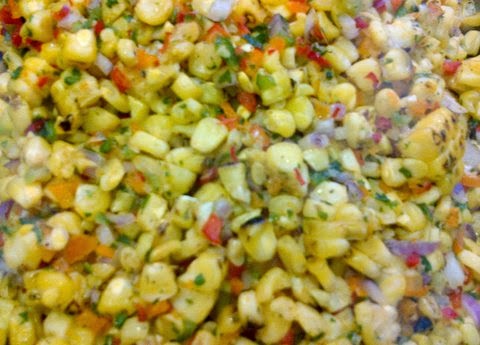
Grilled Corn Salad

Let me be clear from the get-go: corn salad isn't meant to solve an "excess corn" problem. There is no excess corn problem.


This time of year it's common to find ideas and recipes for extra tomatoes, eggplant, squash, etc. I wish I had an excessively fertile garden and over-productive vines! Instead, I had the need for a good picnic salad - the kind that doesn't need refrigeration; has no delicate components to bruise or wilt; and benefits from some knocking around in transit to mix up the ingredients.

I could have made a grain or bean salad, but I had loaded up on ears of corn earlier in the day. When I moved several ears to make way for my salad, I had an epiphany: they could be the basis of my salad!

I quickly assembled the fixings: corn, red pepper, tomatoes, wild scallion from my sister-in-law's garden and some red onion (I had both on hand, but either one would have been fine) and a little parsley from our own windowsill garden. 

Here's the quick-and-dirty recipe:

1) Cook two ears of corn. I stovetop-grilled them in my beloved cast iron skillet for about 7 minutes (turning regularly), but you could steam the corn or even microwave them (2 squares of paper towels to absorb moisture + 2 ears of corn (husks kept in place) + 5-7 minutes = cooked corn.) The grilling gives a nice smoky effect, but any method will work. Once the corn is cooked, set it aside to cool off. 

2) Chop everything else. I used approximately one small beefsteak tomato, 1/4 of a red pepper, one scallion, a leftover bit of red onion and a handful of parsley. I chopped everything finely.

3) Using a sharp knife, cut the corn kernels from the cob, making sure not to cut into the cob itself. Kernels are tasty in a salad but bits of cob are not. (If you're determined to use the cob, save them for soup stock or corn cob jelly.)

3) Make the dressing: mostly vinaigrette  with a splash or two of soy sauce and a splash or two of hot sauce (or a pinch of ground chipotle or one finely chopped chipotle pepper). Mix thoroughly.

4) Dump everything in a large bowl and mix thoroughly.


Enjoy! The salad is good warm, at room temperature or chilled. It's good as a relish or sneaked into sandwiches, green salads or soups.

Come wintertime, you could probably recreate the salad with frozen corn and imported peppers and herbs. (I would try to hold the line against the undentable pink tomatoes described so vividly in Barry Estabrook's book Tomatoland, but I might lack resolve by January.) But for now, this salad tastes like the juicy last harvest of summer.

Thursday, September 19, 2013

What the heck is that? Purslane


One of the fun things you can do in the Union Square Greenmarket is snoop in chef’s shopping carts. Today I snooped in this cart. Sure enough - this seems like the norm this time of year - there was some purslane on top.


Let's go for the close-up:


Purslane is a chef’s darling, but to many folks it’s a weed. As horticulturalist Sandra Mason  writes, "Purslane, Portulaca oleracea, is probably in your garden right now, but not because you invited it to dinner."

Once you know what to look for, you'll find it, as I did, in a green patch around an urban traffic light and in a mall parking lot.


And don't think these purslane patches aren't here to stay! Purslane has made its way all over the world - not surprising, given purslane's legendary hardiness. As Mason notes,

Seeds of purslane have been known to stay viable for 40 years in the soil. You may find that fact either depressing or exciting... Purslane grows just about anywhere from fertile garden soil to the poorest arid soils. A rock driveway is nirvana to purslane... Again depressing or exciting. Running a tiller through purslane is called purslane multiplication.


I first encountered purslane as a desirable vegetable in Turkey, where it is prized in a variety of dishes - stews meze appetizers, and salads. In New York, I frequently see it sold in the East Harlem vegetable stalls that cater to Mexican shoppers. And it's sold at many farmers' markets, where it is snapped up by chefs and a small but cultish following of laypeople. (And, occasionally, curious shoppers who interact with both groups.) This stand at a farmers' market is hoping to entice the uninitiated. 


So what's purslane's appeal? Of course, if you have a lot of it growing in your garden, by all means forage away. Purslane is extremely nutritious - in addition to being a good source of fiber, Vitamins A, B and C and several minerals and anti-oxidants, purslane has more Omega 3 fatty acids than any other leafy plant source. Chefs like it because it is a juicy succulent with an unusual tangy, almost lemony taste. Whenever I've seen someone buying purslane, I've asked them what they planned to do with it. Here are some of the responses: 

  • Mixed green salad
  • "Hide it in a sandwich for extra nutrition"
  • Chopped salad with tomatoes, cucumbers and onions
  • Salad with watermelon
  • Wilted, like spinach or other greens, underneath a hunk of protein
  • In a soup
  • "I'm Turkish, so with yogurt or with lamb"

Purslane does indeed go well with tomatoes - juiciness meets juiciness - and I was intrigued by the watermelon suggestion. Another juicy idea!


This combination was a winner! As it happened, this particular watermelon wasn't that impressive on its own, but as a salad ingredient it was aces. (As an aside, I'm always on the lookout for ideas for disappointing produce (check out some entries in the When Bad Produce Happens to Good People series on this blog), and treating a fruit as a salad vegetable often lowers the bar satisfactorily.)  A good addition to this salad would be something salty - olives, capers - or just some salt itself. 


The other idea that appealed to me was wilting the purslane. Purslane can get a little slimy if it's overcooked, so a light hand and quick cooking time are in order. You could saute some chopped garlic in oil first or proceed without it.


Sometimes I like to eat the tangled web of purslane with chopsticks.


One final tip: Purslane stems may be sold without their roots or with them.


If the roots are intact, expect clumps of sod too.


Give the purslane a soak and thorough hosing.

Give them a haircut too - no need for rat-tails here!


A couple of times I've pinched tip of what I assume is a purslane stem's seed head and planted it in one of my flower pots. The success of this plant plan is by no means guaranteed: I've killed a few "weeds" in my time - this year, a lovely pot of spearmint - so I don't know if this ever-propagating plant will visit me next year. If not, no big deal. That's what farmers' markets are for.