Sunday, October 30, 2016

Happy Halloween!

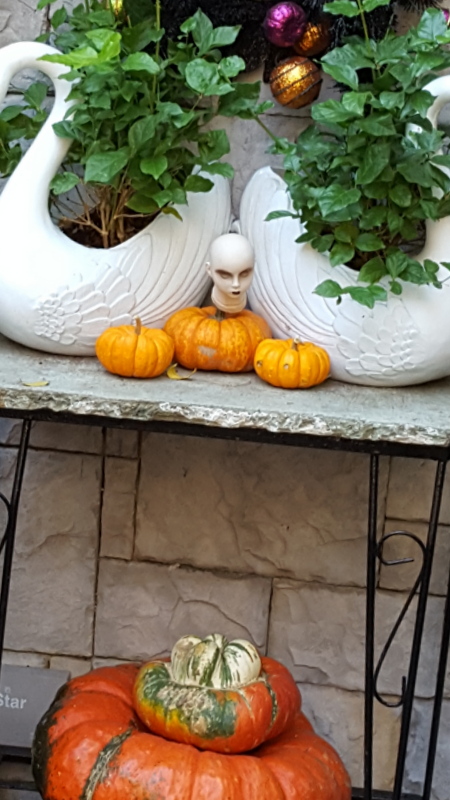
Here is this year's selection of Halloween produce art! 

I can't help but notice some trends. Spooky non-pumpkin squashes are getting in on the action as snakes and goblins.  Some artists seem less inspired by Halloween than by the novel medium of pumpkin. And it turns out carving isn't even essential if the setting is eerie enough.

Boo!


Saturday, October 22, 2016

Long live the new fig tree

I have seldom been accused of excess optimism, but how else could you explain my purchase of another fig tree?


To recap: when I was a lass growing up in the Rockaways, my next-door neighbors had a lush fig tree whose bounty spread to our side of the fence. They were happy -- and we were even happier -- to share. As an adult with an apartment and a balcony, I succumbed to a somewhat improbable hope to grow a fig tree on my balcony. I bought a sapling from the Union Square Greenmarket, kept my hopes up and watched the tree grow taller and sprout more leaves. My little tree didn't bear fruit, but that was fine. I still harbored hope. At the end of the season, I carefully wrapped it in the loving manner of New York's Italian and Greek immigrants who tended to their fig trees in Williamsburg and Astoria circa 1920.

But no matter, Fig Tree I bit the dust, a victim of a frost that massacred many other tender young fig trees. My little guy seemed more vulnerable as a balcony baby, but my sister's fig trees, one a native Brooklynite and the other a companion to mine from the Greenmarket. both planted in in an actual garden, also died.


In a recent column that featured fig recipes, the New York Times food writer Melissa Clark wrote that her figs were store-bought, because her own fig tree had been felled by frost. Oh no! I remember an earlier description of an enviably hardy and fecund tree, which she had raised from its beginnings as a scrawny specimen.


And if the legendary Clark fig tree had succumbed, shouldn't I pull the plug on my own fig tree dreams?

Despite my misgivings, a small fig tree caught my eye in the Greenmarket this summer. It had two small figlets growing at its base. "I'm guaranteed at least two figs even if this tree dies too," I thought, justifying the purchase. Once relocated in a nice big planter, the fruit promptly dried up and fell off the tree. 

The tree itself, however, continue to grow. It's now double the height and triple the width it was at the time of purchase.  I'm already planning its super-duper winter wardrobe to guard against murderous frost.

There are no signs of fruit, but I am vowing to take the long-term perspective. Once fig trees start producing fruit, they can bear fruit for decades.

Besides, succulent fruit aren't fig trees only offerings. It turns out that the leaves, with their "fruity flavor and distinct coconut aroma" have many fans too. You can find recipes for hunks of protein grilled and baked in fig leaves and Tuscan potato torta baked on fig leaves. Fig leaf ice cream. (And fig leaf ice cream, Hungarian style.) Fig leaves used as a seasoning ingredient for preserves or liqueurs. Fig leaf dolmas and koubebia (the dolma's Cypriot counterpart) made with fig leaves. Rice simmered with a fig leaf on top won this accolade:
Brilliant. It was one of those things that had never occurred to me. Added to a pot of simmering grains, the fig leaf imparts a subtle flavor and perfume to the entire pot. The best way I can describe it - a bit green, and a bit nutty. But more like raw pepitas than walnuts. And coconut, but green coconut. There are some of those notes as well.

And if none of these ideas inspire, Halloween is around the corner. Maybe some of my friends would want to go as Adam and Eve.


Sunday, October 2, 2016

Greetings from a Parisian market!

Paris is a fantasy food destination, and its many markets are both a key source of fresh ingredients and a stamping ground for the country’s finest producers. Your shopping visit could be a lazy Sunday wander on your way to brunch, a dedicated food shopping expedition or a gastronomic tour – but no matter what, the sights and smells will make you hungry long before you’re back in the kitchen.
                               --- The Best Paris Food Markets, Time Out magazine


My lucky friend Bethanne has hit the road again, this time visiting her friends Marie and Diego in Paris. I was delighted to receive a large cache of market pictures from her. Amazingly, I didn’t even have to beseech her before her trip! (I probably have beseeched my friends enough to last several lifetimes, much less several trips, so they are now self-policing.)

Some of Paris’ markets originated over 1,000 years ago. The Saxe-Breteuil market, featured in Bethanne’s photos, offers "the city's most chic produce,” according to Time Out.  The market is held twice a week, Thursdays and Saturdays, from 7 am - 2:30 pm, on the Avenue de Saxe in the 7th arrondissement in the Left Bank. 


I chanced upon a website Paris Perfect (one of those glamorous apartment rental websites that makes you moan softly as you read about various lovely neighborhoods with cobbled streets and charming shops), which described the market in these appropriately drool-inducing terms:
Among the many markets in Paris, the Saxe-Breteuil market is often regarded as the most beautiful. There is no more lovely setting, as it is framed by the Eiffel Tower and the Invalides. Farmers and producers come from all over France to sell their specialties and this market is known for its high-quality organic foods.


I immediately searched for sales of the wonderful Charentais melon, which is sometimes known as "French melon" in gourmet stores. (Charentais melons are basically very fragrant and sweet cantaloupes, and apparently contain some super-duper antioxidant, superoxide dismutase, for those folks who prefer to ingest their produce in pill form.) No disappointments here! 


Also expected and found: tributes to luscious end-of-summer tomatoes.


A little more surprising: the inclusion of fruits that are obviously not locally grown – pineapples, kiwis, mangos, bananas - which wouldn’t fly at a typical US farmers’ market.


The Union Square Greenmarket, for example, touts its credentials as “producer-only market with rigorous “grow-your-own” standards… selling directly to customers means farmers, fishers and their children can keep doing what they love and feeding growing cities.” Farmers markets in Washington DC have similar rules. 

But upon further thought, I realized that the French covered market (marché couvert) isn’t like these Johnny-come-lately markets. The Union Square Greenmarket began in 1976, not the 10th century --- when many of the Parisian markets began. Consequently, the French markets are much more fully integrated into daily life and provide a wider range of essential range of essential foodstuffs to their customers.


And if, for whatever strange personal quirk, you’re not interested in the produce – well, it’s still Paris. Rumor has it there is other beauty to behold.


Saturday, April 30, 2016

What the heck is that? Cara cara oranges


Some of my favorite fruit stands are modest in their sales approach. They never display cut fruit, however beautiful or remarkable. Or they cut open only the most dinged up fruit, as if to say, "Ha! Not rotten after all!" Most use only the simplest terms, maybe grudgingly acknowledging the presence of seeds or some other feature that would engender buyer's remorse in the unwitting customer. Under this system, sweet, extraordinarily fragrant muscat grapes from Italy might be labeled "Grapes," or "Grapes (Seeds)."

So I take notice when a seemingly commonplace piece of fruit gets more attentive treatment. Cara Cara oranges have made this leap: they're labeled "Cara Cara orange" with pride.


Not that these oranges don't deserve the primo treatment.
 
Cara Cara oranges look like regular "orange" oranges on the outside, but inside, they're special. Their flesh is deeply red, comparable to the darkest pink grapefruits like Star Ruby (and much rubier than standard pink grapefruits). Unlike blood oranges, which have red speckles on their rinds, Cara Caras keep their ruby secret to themselves.


Cara Cara oranges are navel oranges of uncertain parentage (a term I associate mainly with Donald Duck's nephews Huey, Dewey and Louie) whose unusual features are considered a mutation. There is no scandalous liaison between orange and pink grapefruit, or at least nothing that has anything to do with Cara Caras.
Yup, that's a navel all right.
Their red color is caused by lycopene, the phytochemical and pigment that also gives tomatoes and pink grapefruits their lovely color. Lycopene is "temperature neutral," so Cara Cara oranges have a consistent color regardless of their growing temperature. (Blood oranges, another vividly colored citrus fruit, get their color from anthocyanin, and need cool weather conditions to become fully red-fleshed.) Cara Caras get their catchy name from the area in which they were first discovered, Hacienda Cara Cara in Venezuela. After their discovery, Cara Caras were brought by US citrus growers to groves in  Florida and California.

I enjoy lurking on botany websites, so I've learned that selecting the wrong bud to cultivate could result in a boring old orange-colored fruit and the wrong twig could produce fruit with striped rind. Ah, Nature! Always messing with our plans for uniformity and predictability.
Cara Caras are also getting a name for their good flavor and fragrance.  One enthusiast writes longingly of the oranges' "subtle rosewater scent." The produce-promoting website Fruits & Veggies - More Matters, promises, "You'll experience hints of cherry and notes of rose and blackberry."

These over-the-top descriptions remind me of the quickly mumbled descriptions I would offer customers when I worked at a coffee store - "Yes, undertones of chocolate and cinnamon, with hints of leather and bourbon." I hoped my mumbling would ensure that no one else, except possibly some credulous customers, would hear my stream-of-consciousness commentary. As the days progressed, my choices for hints and undertones grew ever more baroque and ridiculous.
Sadly, I detect no hints of cherry - my very favorite fruit - in Cara Caras. They taste like oranges, not berries. But that's okay. Cara Cara oranges are great on their own terms, alone or part of a rainbow of citrus. 

Friday, February 5, 2016

Today's Celebration of Fried Potatoes: Hash Browns

As my friend Karen has noted, I typically exhibit a penchant for celebrating the weird and bizarre of the produce world. But that doesn't mean in real life I neglect the world's most popular produce: potato, fried.
 
Yes, I have previously celebrated French fries and roasted potatoes with rosemary and garlic, the latter not technically fried, but bathed in so much oil it might as well be. But another tribute is certainly due. Today's honoree: hash browns.


Zillions of Americans love going to the Waffle House, a big restaurant chain based mainly in the South that is especially well known for its hash browns. The Waffle House has over 2,100 branches, but none in New York. The New Yorkers I know who hail from the South or have discovered the Waffle House while traveling mostly observe a "Don't ask, don't tell" or ""What happens in Georgia stays in Georgia"  stance in their enjoyment of the hash browns. Those who think too much about their pleasure at the Waffle House seem a bit afraid of what they might learn.

Take this question to the official Idaho potato website: 
Q. Dr. Potato, why do I love Waffle House-style hash browns more than ones I make at home? What do they do to the food service version that makes them so good? Are they partially dehydrated? Or maybe seasoned with some kind of chemical? I mean the shredded kind that come in boxes, not the deep-fried QSR formed hash brown.
Here's the answer:
A. Waffle House does use a dehydrated potato (very similar to what you can buy in the stores in the center of the aisle from Idahoan or Basic American) and they use a butter style oil. One of the tricks you can do at home is to lightly oil the surface of the pan, heat it up, and then place the re-hydrated potatoes into the pan, resist turning right away till they start to caramelize. Flip, wait for the potatoes to turn a golden color and then remove and serve.
The website provided a link to a supermarket "premium" hash brown mix that I checked out. Here are its ingredients: IDAHO® POTATOES, VEGETABLE OIL (CONTAINS ONE OR MORE OF THE FOLLOWING: CANOLA, SOYBEAN, COTTONSEED, SUNFLOWER), SALT, DEXTROSE, ONION POWDER, MONOGLYCERIDES, CALCIUM STEAROYL LACTYLATE, SODIUM ACID PYROPHOSPHATE (PRESERVE FRESHNESS) AND SODIUM BISULFITE (PRESERVE FRESHNESS). CONTAINS: SOY.

You know what I'm going to say next. You can do better. Here's how.

First, and most important: use actual potatoes. Russet potatoes are a good choice.


Wash them. I suggest not peeling the potatoes. (Of course I'd say that.) Oh, all right, you can peel them if you want to.


Spread a thin film of oil on a griddle or cast iron skillet. Turn on the flame to a moderate heat.


Take a clean white cloth (or in the alternative, a cloth that was once white, but then got stained from many rounds of potato juice) and spread it out over a clean counter or big cutting board. 


Using a box grater, grate the potatoes - one big potato makes a nice hash brown; two potatoes make two hash browns, even nicer.
 

I find grating by hand boring, so I recommend listening to some good music while you toil. Take care not to skin your knuckles. You can also use a food processor to grate the potatoes. Sprinkle a bit of salt on the pile of grated potato.


The next step is key: Squeeze out the potatoes' liquid. The goal is to dehydrate your potatoes so they get a chance to caramelize on the griddle. Roll up your white cloth and squeeze as hard as you can.


Yeah, wring it out some more.


I like to mix in some pepper and paprika in at this point. You can add whatever seasonings you like, just distribute them evenly.


Grab a pile of "dry" grated potatoes, dump them on the grill and flatten them into a patty. Use a double grill or a second skillet if you're doubling your portion.


Here's the hard bit. Don't touch the has browns for 15 minutes. Set the timer and mosey off to do something else.


When your timer rings, give the hash browns a flip and - you guessed it - leave them alone for another 15 minutes.


Your home should have a rich, potatoey aroma by now. And beautifully lacy, caramelized potato shreds for your other senses.


You'll just have to make do without the calcium stearoyl lactylate, sodium acid pyrophosphate and the sodium bisulfite.


Wednesday, January 6, 2016

Big Praise for a Little Pear

Is it cruel to recommend Seckel pears when they are can be so maddeningly hard to find?
 

Seckel pears aren't produce outliers - okay, weirdos - like wasong, for example. (This blog post isn't even a "What the heck is that?"  entry. Seckel pears are mainstream!) So why aren't vendors of Bosc, Bartlett, Comice and other pears selling them?

"It's still the season for them. It's just that we don't plant that many trees," one Union Square Greenmarket farmer told me. His stand had had a nice pile of Seckel pears the previous week. "That's why we don't have them now." He mused for a minute, then added, "They are good though. Huh."


Who knows - maybe I inspired him to consider planting a few more trees. If so, you'll thank me.
 
Seckels may be the only commercially grown pear that is native to the US - they're believed to be descended from a wild seedling (found near Philadelphia in the 19th century), unlike other pear varieties, which come from European cultivars.

There's also this more complicated version of Seckel pears' origin:
According to some sources, the first Seckel pear tree was discovered growing near the Delaware River in Pennsylvania around 1800. Unlike other varieties developed in the U.S. from a cross or bud spore of other European cultivars, Seckels are thought to have originated as a wild seedling near Philadelphia. This may or may not be true, it is possible/probable that German immigrants traveling westward through the area dropped fruit or left seeds behind. According to the book Industrial History of the United States, from the Earliest Settlements to the Present Time: Being a Complete Survey of American Industries, Embracing Agriculture and Horticulture by Albert Sidney Bolles, the Bishop White narrates a story from his boyhood, circa 1760, that a German cattle-dealer used to sell some small but particularly delicious pears around Philadelphia. Apparently he wouldn’t tell anyone where he got them from. Eventually the cattleman, “Dutch John,” raised the money to buy the parcel of land from which he was poaching the pears eventually selling the farm to a Mr. Seckel. Bolles claims that it is doubtless that the pear tree was a seedling raised by German settlers, but while the Seckel somewhat resembles certain known German varieties, it is distinct from them, and is a strictly American fruit. Another source claims the fruit to be a hybrid of European and Asian varieties. Helen, a volunteer at the soup kitchen told me that they are from Poland so clearly everyone has their own opinion.
I won't care if Seckel pears turns out not to be indigenous to the US. The Seckels' pedigree isn't what charms me.

Nor is it the Seckels' appearance. Yes, they are small - the smallest of the mainstream, commercially grown pears - and cute. Diminutive + round does =  kind of adorable.  They look like they could be these Bosc pears' kids.


But never mind that.

For me, the Seckels' charm is their flavor: honey with a tiny undercurrent of spice. I've only rarely encountered a Seckel with grainy or mealy flesh (perhaps a consequence of having a pool of mostly locally grown fruit.) Because of this, I consider Seckels the most consistently delicious pears.

I am realistic, though. Any produce marketer who sees the appeal of baby vegetables or "Cuties" clementines would be a fool to ignore Seckel pears' diminutive charms. Little hands are a perfect match for these little pears. Tire of fruit after a few bites? Seckels are ready for your Age of Distraction. Seckles' petite size makes them attractive for the cheese plate or the lunch box. I'm happy for any use that spreads the word to build the fan base for these wonderful pears.

Or should I say, almost any use. I draw the line at coating them in raw egg whites and rolling their bottoms in sugar. Blech! That's just culinary bullying - and these sweet little guys deserve much better than that.


Sunday, December 27, 2015

What the heck is that? Kumato tomatoes


Try this experiment at home: drop a supermarket tomato off the counter and see if it gets damaged. 

I inadvertently performed this experiment on some plum tomatoes I was using for a red lentil dish. Nope, they emerged unscathed. 

We all value resilience, of course, but this is a little ridiculous – and an echo of the description in the book Tomatoland of Florida-grown supermarket tomatoes falling off the truck and remaining dent-free. (And I don't mean to imply that this is the worst attribute of supermarket tomatoes, grown in nutrient-free sand, doused in eye-popping amounts of pesticide and harvested under slavery-like conditions. But, yes, there are times when I still buy them.)

I went ahead and used these tomato-bots – I pumped up the tomato flavor with tomato paste and enjoyed the texture and slight sourness the supermarket tomatoes contributed to the dish. 

But using tomatoes in a cooked lentil dish is one thing; a fresh salad is another. Are there viable tomato options for a salad in December?

Enter the kumato.


Kumatoes have a striking appearance - their color is reminiscent of autumn leaves, encompassing various hues of green and brown in addition to their basic red.


Typically when you see a tomato with an exotic appearance, it's hanging out at the farmers' market.


You might have mistaken the kumato for an heirloom variety, had you first seen it in a farmers' market rather than encased in plastic. Kumatoes are actually cultivated (but not genetically modified) tomato variety. They were first bred in Spain; now their patent is held by a Swiss company, Syngenta. Kumatoes have a higher sugar content than most tomatoes (yum) balanced out with some tang, and thicker skins, which make them hardier than regular tomatoes. To help kumatoes stand out even more in shoppers' minds, Sunset, the North American representative for the kumato brand, trademarked the phrase "Simply Unique Brown Tomato" and put the catchphrase on the kumato packaging. 

The kumato tomatoes were delicious in a chopped garden salad, and earned a lot of "How did you manage to pull off a decent salad with winter tomatoes?" compliments. The green and brown hues of the tomatoes got lost in the normal exuberance of a salad. I give the kumato high grades for taste.


But of course it's hard to be unique - even if you're trademarked as such.


Sacher tomatoes, seen here at a farmer's market, are probably mistaken for heirlooms by most shoppers, simply because of their context. But like kumato tomatoes, sachers are carefully cultivated hybrids. Even their name is carefully selected: "Sacher" is intended to connote the chocolately deliciousness of a sacher torte.  As we saw with apple breeding, taste is just one part of the package - the most successful products are also hardy and memorable in the marketplace.


Kumato tomatoes can cope with their farmers' market rivals (and so far, I haven't seen sachers make the leap out of the farmers' market). In fact, the better-because-they're-odd farmers' market varieties help give kumato tomatoes their street cred. But the success of one supermarket "European brown gourmet tomato" can't help but spawn imitators. 

Watch out kumato - brunetta's right behind you.