Showing posts with label What the heck is that?. Show all posts

Tuesday, December 31, 2019

What the heck is that? Thomcord grapes


Shouldn’t hybrid fruit have the best attributes of their parents?
That was my thought when I tried Thomcord table grapes, a hybrid developed in the 1980s by California grape breeders (and reportedly tinkered with over the next two decades).


This exotic hybrid is the offspring of two extremely common grapes. Thompson grapes are the world’s most popular snacking and raisin variety. Concord grapes, gorgeously purple, are the mainstay of PB&J grape jam, grape juice, cut-with-a-scissors cut-with-scissors sweet kosher wine, and “grape” in whatever candies and soda that choose natural alternatives to blue dye and synthetic flavorings.

Obviously missing on Concord’s honor roll: eating out of hand raw, aka snacking. Concord grapes are not only strikingly attractive, they’re fabulously fragrant and very flavorful. But Concords also have thick skins and pits. I’ve eaten them at farmer’s markets and in the backyards of New Yorkers who are lucky of them to have them growing “wild” (or more likely, planted by the person who lived in their house before them). They’re fragile and usually susceptible to blight and consequently expensive. 
The obvious goal: make the gorgeous but temperamental Concord as practical and saleable as the Thompson. Here's one account of the Thomcord's origin story:
What are Thomcords? The tastiest grapes you’ve never heard of. Like Concord grapes, they’re juicier and more intensely grape-flavored than the red or green grapes you can buy year-round. But Concords have small, crunchy seeds, which may explain why they often end up as grape juice or jelly. Enter USDA’s grape-breeding scientists. In 1983, they crossed Thompson (seedless green) grapes with Concords…then spent nearly two decades fine-tuning the hybrid. The result: the seedless sweetness of a green grape with the plump, grapey flesh of a Concord.
 The Thomcord were certainly gorgeous - as plump and grapey-fleshed as promised.


And they were indeed seedless as well. And their skin was not as tough as the Concord's. 

But -- and perhaps this could explain the nearly two decades of tinkering, though not its termination -- Thomcord grapes tasted terrible! 

It was as if flavor somehow got dropped from the breeder's checklist. 

The heady, winy complexity of the Concord grape - the attribute that caused my friend Jen to declare that "Concord grapes make your taste buds sing" - was flattened out, leaving only a random grape with a weird aftertaste. 

What a disappointment! This practical, shippable, saleable, affordable grape didn't even measure up to the simple, sweet joys of its other parent, the Thompson.

I had no reason to snack on the carton of Thomson grapes, so I sought redemption via my go-to method of bringing out the best in substandard fruit: roasting.

These Thomcord grapes might have been the best-looking fruit I have ever subjected to heat therapy: candidates for caramelization typically include the withered and blemished. But these guys needed something drastic to make eating them worthwhile.

Out came the pan.


But as it turns out, while roasting can smooth out a mealy texture and coax out sweetness from underripe specimens, even this miracle worker can't take away a developed, unprepossessing flavor.

Roasting gave me sticky, sweeter Thomcord grapes that were still saddled with a charmless aftertaste.


Performers who decide not to tamper with their quirky looks are sometimes derided as superstitious, but perhaps they are on to something: smoothing out inconvenient, non-conforming or unconventional traits doesn't always lead to success. 

Maybe we just need to appreciate the Concord in all its prima donna glory.

Wednesday, February 22, 2017

What the heck is that? Charentais melon

There's nothing like a wrong name to make a mysterious fruit even more mysterious.


I was delighted by the pile of diminutive striped mystery melons I recently found at a favorite produce shop. The melons looked a bit like a cross between a cantaloupe and a carnival squash.  Their sign bore a very cheap price and a name that was entirely unfamiliar to me.


Sharantain? I never heard of it. Neither had Google. "Did you mean Sharlyn?" Google asked not-so helpfully. 

I knew I needn't stay ignorant for long. The melons were adorned with pesky stickers. PLU codes to the rescue!


PLU, or "Product Look Up" Codes, are assigned by the International Federation for Produce Standards, an international body that should really recruit me to join. These are the codes that cashiers type in at supermarket registers, but curious consumers and fruit fetishists are also welcome to type a number into the PLU Code database to figure out What the heck is that? Number 3033, the number on the melon's stickers, corresponded to "Charentais, small." 

Also appearing on the sticker, albeit in tiny letters, written on an angle: the word Charentais. Oh yeah!

Charentais melons are also known as French cantaloupes. Their origins - and their name - come from the Poitou-Charentes region of France, where they were bred for refinement, "free of natural and highly occurring warts of its parent varieties." I hazily recalled a few past specimens from pricey gourmet stores, fragrant and expensive. These humbler cousins, (who, according to the PLU stickers, hailed from Guatemala) lacked an enticing scent, but also lacked the stiff price tag. Many fruit enthusiasts rhapsodize about the charentais: "Considered by many to be the most divine and flavorful melon in the world...sweet, juicy orange flesh with a heavenly fragrance," said this seed catalogue. And an exotic fruit vendor composed this tribute:
Charentais melons are said to be the finest melons in both taste and texture...They have an orange flesh and a luscious, flowery aroma. Popular in Europe, Charentais are especially prized in France for their rich, honeyed finish.
Both sources described the melon's diminutive size with the gauzy phrase of "perfect for two people," making a shortfall of tasty fruit into a romantic opportunity to share the luscious, honeyed fruit with just that special someone.

So how to the charentais stack up against the mundane, everyday cantaloupe?


The ones I tried - and when paying just 99 cents for each melon, I could be a scientist, with a quasi-statistically significant sample - were very nice, sweet and juicy though not noteworthily fragrant. 


But it's February, for godsakes, and there is no inalienable right to great summer fruit in February. By this standard, the charentais hit a home run.

I'll be buying more, if I can. Charentais is a great cantaloupe -- by whatever name it's known.


Friday, December 2, 2016

What the heck is that? Apple pear

Apple pears: the first step in a project to breed interesting hybrids of popular fruit? A project that could include the easy-peel, not-too-acidic banana pineapple (not to be confused with banana potatoes ) and one-step-ratatouille tomato eggplant?


The truth is a bit less exciting.

Apple pears are a type of pear, as some of the fruit's other names, Asian pear (and its geographic subsets, Chinese pear, Korean pear, Taiwanese pear, Japanese pear, etc.) and nashi (Japanese for "pear") indicate. Apple pears have been enjoyed in Asia for thousands of years and in California since the Gold Rush days, when Chinese immigrant miners planted trees. 

The "apple" part of "apple pear" refers to the fruit's appearance and texture - round and crisp like an apple. In other ways, the apple pear definitely tows the pear line. Apple pears ripen on the tree, not the kitchen counter. They are sweet, with a flavor in the pear family. Apple pears' skins can range from golden yellow to greenish yellow to paper bag brown, with a corresponding texture than can range from delicate to a bosc pear level of coarseness.


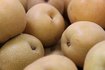
Here you can see the outward similarity of the two apple pears to the apple on the left. The apple pears' grainy texture, not quite revealed in the photo, differs from the apple's. Unlike a regular pear, the seed pod is dead center, rather than located in the lower portion of the fruit. 


The more delicate apple pears sometimes earn dog in a winter vest protective gear. 
th -- they're both members of the rose family, or pomes -- but the "apple pear," or Asian pear, blurs the line between the two fruits. Their flavor packs the unmistakeable honeyed sweetness of a pear, but Asian pears have the crisp texture, size and roundness of a superlative eating apple. To scientists they're unquestionably pears, but they're a distinctive and quirky branch of the family. You can use them in tarts, pies and other baked confections, but aficionados recommend eating them out of hand.


Distinctive Characteristics

  • Apple pears differ significantly from the familiar Eurasian varieties that fill your grocer's produce section. Ordinary pears don't ripen on the tree, but must be harvested while still hard and encouraged to ripen in storage. Asian pears, like apples, can be left on the tree and picked while ripe. Conventional pears have textures ranging from meltingly soft to grainy and sand-like, but always relatively dense. Apple pears have a distinctively crisp texture, apple-like but even lighter and juicier than most apples.

Pick a Good One

  • Asian pears are packaged carefully to minimize bruising, their major flaw from the retailer's perspective. Avoid fruit with visible bruising or other damage. Apple pears range from pale yellow to russet to green in color, but this is a question of cultivar rather than ripeness. Rather than color, use your nose to judge the ripest fruit. The best-tasting pears have the sweetest fragrance.


Read more : http://www.ehow.com/facts_5769226_apple-pear_.html?ref=Track2&utm_source=ask


But they are surprisingly hardy in other important ways: they don't turn brown or mealy when exposed to air, making them a good choice for salads and cheese platters, and their shelf life is noticeably longer than that of either apples or regular pears.                                                                                                          
My friend Thom sent me a picture from a Japanese supermarket in Hong Kong of this gift box of giant apple pears grown in a greenhouse in Japan. 


The price (using the conversion of Hong Kong dollars to U.S. dollars at the time of the picture) is over $22 per apple pear. Yes, $22 each! A box of six makes a nice gift for the right person. 

How can you do justice to a fruit this expensive? Chomping down wouldn't seem right. Perhaps you could only cut it thinly and curate on a platter with some equally fancy tidbit.

Fortunately, when I buy apple pears, whether at the Union Square Greenmarket, a fruit stand or in Chinatown, I don't have such constraints. At $1 each, and sometimes half that cost, apple pears are free to be simply enjoyed.

Saturday, April 30, 2016

What the heck is that? Cara cara oranges


Some of my favorite fruit stands are modest in their sales approach. They never display cut fruit, however beautiful or remarkable. Or they cut open only the most dinged up fruit, as if to say, "Ha! Not rotten after all!" Most use only the simplest terms, maybe grudgingly acknowledging the presence of seeds or some other feature that would engender buyer's remorse in the unwitting customer. Under this system, sweet, extraordinarily fragrant muscat grapes from Italy might be labeled "Grapes," or "Grapes (Seeds)."

So I take notice when a seemingly commonplace piece of fruit gets more attentive treatment. Cara Cara oranges have made this leap: they're labeled "Cara Cara orange" with pride.


Not that these oranges don't deserve the primo treatment.
 
Cara Cara oranges look like regular "orange" oranges on the outside, but inside, they're special. Their flesh is deeply red, comparable to the darkest pink grapefruits like Star Ruby (and much rubier than standard pink grapefruits). Unlike blood oranges, which have red speckles on their rinds, Cara Caras keep their ruby secret to themselves.


Cara Cara oranges are navel oranges of uncertain parentage (a term I associate mainly with Donald Duck's nephews Huey, Dewey and Louie) whose unusual features are considered a mutation. There is no scandalous liaison between orange and pink grapefruit, or at least nothing that has anything to do with Cara Caras.
Yup, that's a navel all right.
Their red color is caused by lycopene, the phytochemical and pigment that also gives tomatoes and pink grapefruits their lovely color. Lycopene is "temperature neutral," so Cara Cara oranges have a consistent color regardless of their growing temperature. (Blood oranges, another vividly colored citrus fruit, get their color from anthocyanin, and need cool weather conditions to become fully red-fleshed.) Cara Caras get their catchy name from the area in which they were first discovered, Hacienda Cara Cara in Venezuela. After their discovery, Cara Caras were brought by US citrus growers to groves in  Florida and California.

I enjoy lurking on botany websites, so I've learned that selecting the wrong bud to cultivate could result in a boring old orange-colored fruit and the wrong twig could produce fruit with striped rind. Ah, Nature! Always messing with our plans for uniformity and predictability.
Cara Caras are also getting a name for their good flavor and fragrance.  One enthusiast writes longingly of the oranges' "subtle rosewater scent." The produce-promoting website Fruits & Veggies - More Matters, promises, "You'll experience hints of cherry and notes of rose and blackberry."

These over-the-top descriptions remind me of the quickly mumbled descriptions I would offer customers when I worked at a coffee store - "Yes, undertones of chocolate and cinnamon, with hints of leather and bourbon." I hoped my mumbling would ensure that no one else, except possibly some credulous customers, would hear my stream-of-consciousness commentary. As the days progressed, my choices for hints and undertones grew ever more baroque and ridiculous.
Sadly, I detect no hints of cherry - my very favorite fruit - in Cara Caras. They taste like oranges, not berries. But that's okay. Cara Cara oranges are great on their own terms, alone or part of a rainbow of citrus. 

Thursday, November 5, 2015

Gettin' Figgy with It

Just because my fig tree failed doesn't mean I have to be deprived of figs.


I find figs delightful. I like their plush flesh and pleasingly round shape. When cut in half, figs reveal a secret, fertile world, akin to the interior of gemstones. The figs' crunchy seeds offer a dramatic contrast in texture to the fruit's soft flesh, making each bite more enjoyable. 

And softness is key: If your fig looks really firm, with a strong stem - beware! You want some droop in the stem, some looseness in the skin. Too much firmness may be the signs of an unripe fruit. Dark-skinned figs should be just that; too much green is also a key sign of unripeness, though of course this particular clue offers limited information for a green fig. Figs do not ripen after being harvested, though they may "soften" or "mature" or more likely, rot. You will probably not encounter seriously unripe figs unless you are lucky enough have access to a fig tree, but if you do, consider making these candied unripe figs or unripe fig jam. 

Until recently, I thought figs came in two basic varieties (even if there are reputedly nearly 200 fig types): green and "dark" (black/purple/brown).

Green: Kadota (good) and Calimyrna (better) varieties.


Dark:  Brown Turkey (good) and Black Mission (better) varieties. 


I like them all -- and I also enjoy the the chewy, crunchy seeds-in-the-teeth sugar bomb of dried figs of either color.


But recently I've had my fig consciousness expanded in most exciting way. Forget black and green, or any monochromatic color : how about stripes? Behold Panachée figs, aka Tiger Stripe figs, aka Candy Stripe figs, a yellowish fig with green stripes. I assumed that these figs were a recent hybrid, but the name ""panachée," French for "variegated," dates back to 1826, and fig fanciers have known about these striped figs since the 17th century.


Where have they been all my life? And why have they shown up now?

Apparently Tiger Stripe cultivation was considered, but rejected, a century ago by California fig farmers. The variety was fragile, not as productive and didn't dry very well. Improved shipping has translated into a growth in the fresh fig market - I know I've certainly seen more fresh figs at the fruit stands in the past couple of years. I'm guessing our appetite for exotic fruits has also made us more willing to pay extra for showstoppers (Tiger Stripe figs typically cost more than standard figs), which offsets the fragility and unproductivity costs.

I bought the Panachée figs for their exotic and glamorous outsides, but it turns out their insides are even more exciting: ruby-red and juicy instead of the pale, dusty-rose seed interiors. Their flavor is markedly sweeter and more berry jam-like.


You could absolutely scoop out the seed and spread it on toast, add it to Greek yogurt, or use it in any number of ways that you would use strawberry jam.

But why stop there? I cut off the stem end and peeled back the skin in segments to make these stars.


My work was not as clean as it might have been had I not worked impulsively, but no matter. I soon ate the evidence. Because however beautiful these fruits are from the outside, their beauty is more than skin-deep.

Wednesday, October 28, 2015

What the heck is that? Sooty blotch

My friend Robair recently commented, "Every time I read your blog, I learn something new about something I'd like to eat."

Not this time, baby.

I should be upfront with the news: Sooty Blotch is not actually an item of produce, though it's fun to imagine asking a vendor for 2 lbs. of it. Nor is "sooty blotch" a vivid insult, though it sounds like an entry in the Urban Dictionary.

Rather, sooty blotch is the first, and probably the last, non-produce entrant in the "What the heck is that?" category.

Sooty blotch is a fungus.


Sooty blotch isn't a tasty fungus like mushrooms or huitlacoche, the Mexican corn fungus that is also known, hilariously, as corn smut. Sooty blotch is the fungus that gives meaning to the term "no spray."


Sooty blotch is associated with wet summers, and can affect other fruit besides apples - pears, grapes and plums are also favorites of the fungus. Farmers can treat their crops with fungicides or simply prune the trees more aggressively during the winter, since better air circulation means better drying in the wet warm weather.   

Seeing unsprayed apples is like seeing one of those "Shocking and Unrecognizable: Stars Without Make-up!" articles that celebrity magazines love to publish. Wow, is that a blemish on Beyonce? You mean it takes work for Katy Perry to look glamorous?

You mean apples would like this without anti-fungal spray?


Listen to Iowa State University's plant pathologists discuss sooty blotch and hear the echoes of feminist deconstructions of the conventions of beauty. As one pathologist noted mournfully, "People know what a good apple looks like. They're used to the Disney World-looking apples."  Another pathologist added, "It's devastating if you're the grower," saddled with apples unfit for the consumer's gaze, suitable "only... for juice and in pies."

I notice that even organic apples sometimes feel the pressure to be beautiful, especially if they're jockeying for attention in a gourmet market.


 Meanwhile the dreaded fungus is by all accounts tasteless and harmless. "Give the skin a good scrubbing if it bothers you," one vendor at the Union Square Greenmarket told me. "Or scrape it off with your nail. That is, if it bothers you." He was right - there was no taste difference, and some of the discoloration did come off on my cloth when I gave a few wipes.


Learning about sooty blotch has made me a bit more accepting of apples' cosmetic imperfections. At the same time, it has also made me aware of the hard work - and probable chemical intervention - that goes into making an apple look naturally perfect.

Today I bought a perfect-looking apple. But lovely on the outside did not guarantee perfection on the inside. Nature often surprises.


 Hmmm...could this become a selling point?


Ya gotta have a gimmick!

Tuesday, September 29, 2015

What the heck is that? Muscadine

Suddenly they are everywhere.  Well, maybe not everywhere, but at a lot of places.  

Could muscadines, aka swamp grapes, be the Next Big Produce Thing?


Here are some muscadines at a produce stand in the South Bronx. 


Surrounded by fruit stand mainstays like bananas, strawberries and oranges, and Latino neighborhood mainstays like papayas, plantains and two kinds of avocados (one of which, the large tasteless green kind, labeled "Domin" for Dominican, perhaps a slander) were the muscadines: small purplish fruit, a bit smaller and rounder than Damson or Italian Prune plums in the primo real estate of the center square. 

I have also been seeing muscadines all over Chinatown. Here they are at one stand in Chinatown, next to longans, grapes and starfruit.


 And here they are at Sarah's Fruit Stand in Union Square.


I have a poor track record of produce prognostication - that is, guessing which obscure produce items will cross over. I wouldn't have plucked muscadines off the chorus line.

Muscadines are grapes that are native to the United States, specifically its hot, swampy South, where most grape varieties would plead uncle. They are a fruit with many nicknames, including "America's first grape." Sir Walter Raleigh described muscadines in glowing terms way back in 1584 when he encountered them growing along the Outer Banks in 1584. Southerners have been making jellies, sauces and - most importantly - wine, ever since.

Muscadines grow in clusters, but the clusters are much looser than the tight bunches of other grapes. 


They are harvested one by one, not in bunches. And they are big by grape standards, so it's easy to mistake them for small plums, as you would for the fruit in the opening photo.

Photo credit: grapeseedextract.com
Muscadines, like most deeply colored fruit, have impressive antioxidant levels, and are especially high in resveratrol and ellagic acid. M.D. Journals (special Carolinas edition, natch) says, "A single 1 cup serving of muscadine grapes would more than double the average person's antioxidant intake." This could explain some of the fruit's newfound popularity. In the South, there is also a certain folk celebration of the fruit in the South, especially for old-time muscadine hull pies and wine.

On the "con" side, however, are two inescapable attributes: seeds and thick skins. In this country, seeds are generally considered a nuisance by most fruit consumers (and the corporations that predict and shape consumers' behavior). When was the last time you saw watermelon with seeds, for example?

Thick skin is a different matter: even though I have no quarrel with baked potato and kabocha peels, I am annoyed by the muscadines' thick skins. (I'm pretty tolerant of seeds). But muscadine lovers work around the problem.

Ozzy of Sarah's fruit stand is one enthusiast. "I love them!" he said. His technique is to bite into the muscadine and suck out the pulp, which he then discards. He doesn't mind the seeds, but as he says, "I'm Turkish, so I don't think fruit shouldn't have seeds."


He throws out the skins, but as muscadines grow in popularity, I imagine a secondary market for the discarded skins. Added to smoothies for the nutritional power? Harnessed for agricultural disease resistance? Organic clothing dye? Touted addition to makeup and shampoos?

Or maybe it's just time to bake up some extra muscadine hull pie.

Sunday, August 16, 2015

What the heck is that? Pumpkin scapes

It was the word "scapes" that first lured me.


To me, the word "scapes" refers to garlic scapes, the stalks and flower buds of a
garlic plant. I have very positive feelings about these scapes.

Farmers used to cut off garlic scapes to direct the plant's energy toward its bulb. (Then one day a farmer realized that the scapes tasted good, really good, and a new vegetable was born.) These pumpkin greens probably had a different path - they were the edible vines of a pumpkin plant, so why not use them? After all, pumpkins are the vegetable equivalent of tail-to-snout pigs, with everything usable from fruit to seeds to decoration

Still, I had never heard of eating pumpkin scapes/greens, so I directed a few questions to the seller at the farmers' market.

"Why are these called scapes, and not pumpkin greens?" I asked. "Good question," he said.

"What do they taste like?" I asked. "Ha!" He replied. "Another good question! Someone told me they taste like pumpkins, like beet greens taste like beets. But I really don't know. You should buy them and tell me."

"What should I do with them?" I asked. He smiled and shook his head, then said, "I really don't know, but you can't go wrong-" I joined in here, "...by chopping them up sautéing them with garlic."


The seller might not have been a master salesman, but he had a point about the preparation. What the heck: I bought them.


The pumpkin scapes had something going for them besides their name. I'm a sucker for the tendrils that vines shoot out as friendship-feelers to anchor themselves. I'm always entertained when I see a vine plant lasso in another plant, a piece of patio furniture or anything else in its path - a gate, a broom handle - to support its own stability. Sometimes the shoots are long and aimless, the bid for "friendship" unsuccessful; other ones are kinked and doubled upon themselves for extra strength.


Won't you be my neighbor?

The bunch of pumpkin scapes had no shortage of charming shoots. Some reminded me of old style telephone cords.


It turns out that pumpkin greens are popular throughout Africa, South Asia and the South Pacific. In Kenya, a traditional mashed potato dish called mukimo can feature chopped pumpkin greens. The Malaysian dish masak lemak labu uses both pumpkin flesh and pumpkin greens cooked in coconut milk. Guam, Bangladesh, India, Zimbabwe - all have cuisines that make good use of pumpkin shoots, sometimes simply boiled with salt, but more often seasoned with locally celebrated ingredients such as peanut butter (Africa) or mustard seeds and turmeric (South Asia) - and, of course, onions and garlic. A test nibble on some leaves revealed why no one seemed to advocate for use in salads: many of the pumpkin scapes had a weird, prickly texture. Their taste was mild, unlike the bitterness of many greens, and I suspected I could get away with a quick cooking time.

I planned a garlic saute, but I decided to celebrate the full "scapeness" of these pumpkin greens by enlisting garlic scapes rather than garlic bulbs in the dish.


I gently sauteed some finely chopped garlic scapes in a large skillet, then added the pumpkin scapes, which I had chopped very coarsely.


The cooking time was indeed brief - 5 minutes or so. The resulting dish wasn't photogenic or fit for company - dig those long stems! - but it wasn't intended to be. This experience was a getting-to-know you, focused mainly on taste. 


And taste was in rather short supply. The pumpkin scapes had a vegetal, mild flavor. They lacked the bitterness of greens like broccoli rape and collards, which some might see as a plus, but they also lacked the oomph and personality of these greens. There was nothing to highlight or temper. I definitely did not discern any pumpkin flavor. 

The pumpkin scapes' flavor void was filled by the garlic scapes' ebullient personality. This was not at all an unhappy outcome, but I could have enjoyed the rich, garlicky flavor without the pumpkin scapes as well.

So by all means use the pumpkin greens if you have a pumpkin patch growing anyway. Add the greens to soups and stews for added nutrition and color. Just don't expect this supporting player to become a star.