"You should save the seeds. If I still had a garden, that's what I would do. Plant them and see what happens."

I'm not ambitious enough to attempt to raise dragon fruit, a heat-lover native to Southeast Asia, but his words inspired me to direct my attention to my herb garden.
This year's crop included basil, dill, cilantro, oregano, parsley and chives. The oregano, parsley and chives are still going strong; the dill and basil are a mix of viable plants and stalks with dried leaves and seed heads; and the cilantro has entirely gone to seed.
Time to harvest!
First, the dill. I enjoy the dill in its "firework" stage, when I use the leaves and pretty yellow seed head in pickles and salads, but that doesn't mean the party's
over when the fireworks subside.


I chopped off the dill heads, and then gave them a good shake.

What can you do with the ensuing bounty?

Dill seed was actually a mainstay spice in my rather spice-deprived home. My mother, who has an extraordinarily keen sense of smell, used salt and pepper very sparingly and adventured to the use of garlic only after a late-adulthood trip to Italy. But she used dill seed very frequently in soups. You can also use dill seed in pickles, salads and anywhere you might use caraway seeds - in rye breads or dishes like sauerkraut or braised red cabbage.
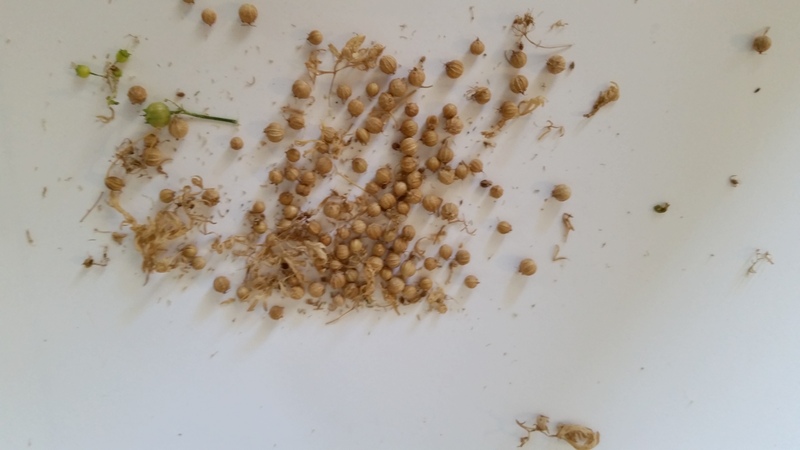
Next was the cilantro, which mysteriously crosses over and becomes "coriander" when I think of the seeds rather than the leaves and stems. Oh, you're supposed to use those terms.

We use coriander seeds all the time when cooking Indian dishes. But maybe I don't have to buy the seeds in bulk, when I have a coriander-seed-tree right at home?
Once again, it's snip and shake.

If shaking doesn't do the trick, give each little seed a pinch off the branch.
Finally, the basil seed.

Unlike the dill and coriander seeds, basil seeds aren't a mainstream grocery spice rack item. I had grown the basil from seed, and I mainly intended to save the basil seeds for next year's planting.

But a brief google search revealed the limits of my imagination.
Thai basil seed ice cream!
Trendy salad ingredient! ("Inexplicably, the chefs also spurted a gray dribble of soaked basil seeds on the plate,"wrote the less-than-thrilled New York Times restaurant critic.)
Tapioca pearl alternative, perfect for bubble teas, smoothies, and other beverages!
Weight loss aid! (A skeptical comment from the Livestrong website: "Basil seeds, also called tukmaria seeds, are touted as a weight-loss aid because of their ability to swell in water and, therefore, improve satiety. While there's no harm in including basil seeds as part of a healthy weight-loss diet, no studies support these claims.")
Medicinal powerhouse, fighting respiratory, digestive and skin ailments!
Once again, the basic method of harvest was snip and shake. The basil seed heads were stickier than the others, so I pushed the whole mess through a sieve to get my seed yield.

Since most uses mentioned basil seeds' ability to become gelatinous tadpoles with soaking, I decided to soak the seeds and try them out. (No, the photo below is not a grubbier version of the dragon fruit photo at the start of this blog post.)

The resulting concoction was as gelatinous and tasteless as promised. What the heck, if you're in the habit of adding chia seeds for a nutrition boost to your smoothie, I suppose you could try this alternative. I'm going to save the basil seeds for the more mundane task of planting next year's crop.
But this whole exercise has changed my perspective. I'm looking at all of this year's crops with next year's in mind.

Cherry tomato seeds, anyone?


