The fruit vendor's sign read: "Warning! These are quince, not apples. Ask us about the difference."
I could only guess the sign was prompted by the ire of customers who had bought some of the fragrant, pear-resembling fruit and nearly lost teeth biting through the thick peel and almost impenetrable flesh, only to be rewarded by the astringent taste of raw quince. Such are the rewards of mistaking quince for apples or pears, fellow members of the botanical Rosaceae family.
Then there are people like me, who recognize quince as a delight of its own.
I was ready to roll up my sleeves, grab a peeler and a sharp knife and dust off my father-in-law's recipe for candied quince. (He hails from the area of Vynohradiv in Eastern Europe, an apple/pear/quince stronghold.)
When I first learned of quince, my first discovery was their enticing scent. The second thing I learned was to never eat them raw. Like hachiya persimmons, quinces are sufficiently astringent to feel as if they are ripping out the inside of your cheeks when you nibble on them.
I recently learned a new word that is used in connection with astringent fruit like quince and hachiya persimmons: bletting. Bletting is a process of decay or frost that renders intensely tart fruit softer and sweeter. I've let hachiyas soften (now I'll use this great new word) but I haven't bletted any quince. Yet.
Instead, I've cooked them. In Europe, the pectin-rich quince has a long and glorious history of being used for jams and preserves; in fact, the word "marmalade" stems from the Portugese word for quince jam, marmalda. From the Wikipedia entry on Marmalade:
The Romans learned from the Greeks that quinces slowly cooked with honey would "set" when cool (though they did not know about fruit pectin). Greek μελίμηλον (melimēlon, "honey fruit") transformed into Portuguese "marmelo"— from the Greek μῆλον (mēlon, "apple") stood for all globular fruits, and most quinces are too astringent to be used without honey. A Roman cookbook attributed to Apicius gives a recipe for preserving whole quinces, stems and leaves attached, in a bath of honey diluted with defrutum—Roman marmalade. Preserves of quince and lemon appear—along with rose, apple, plum and pear—in the Book of ceremonies of the Byzantine Emperor Constantine VII Porphyrogennetos, "a book that is not only a treatise on the etiquette of imperial banquetting in the ninth century, but a catalogue of the foods available and dishes made from them."
Medieval quince preserves, which went by the French name cotignac, produced in a clear version and a fruit pulp version, began to lose their medieval seasoning of spices in the 16th century. In the 17th century, La Varenne provided recipes for both thick and clear cotignac.
In 1524, Henry VIII received a "box of marmalade" from Mr Hull of Exeter. As it was in a box, this was probably marmelada, a solid quince paste from Portugal, still made and sold in southern Europe. Its Portuguese origins can be detected in the remarks in letters to Lord Lisle, from William Grett, 12 May 1534, "I have sent to your lordship a box of marmaladoo, and another unto my good lady your wife" and from Richard Lee, 14 December 1536, "He most heartily thanketh her Ladyship for her marmalado."
If you're used to cooking with apples or pears, you should be prepared: quince is a tough customer. No scooping out the seed pod with a demistasse spoon: you'll need a sharp paring knife to cut and yank the seeds out. But the results are worth it.
Candied Quince Compote
8 cups quince, peeled, cored and sliced lengthwise into 1/2" slices
4 cups water
1 1/2 cup sugar
1/2 lemon, sliced thinly
12 cloves
2 sticks cinnamon, optional
Combine all ingredients into a 4 quart stockpot. Bring to a boil then reduce to a simmer. Cook until the fruit is fork tender and rosy in color, about 30 minutes.

Once cooked, the tough quince slices become silken. I also enjoy the syrupy lemon slices. And the fragrance the quince emits while cooking is a pleasure of its own. A dish of candied quince compote is well worth the hassle.
So you'll be glad to get acquainted with quince -- despite its occasional identity confusion.
When I recently served my father-in-law some dragon fruit, he said the same thing he always says when I serve him a new and intriguing fruit, especially a fruit whose seeds are prominent or themselves intriguing:
"You should save the seeds. If I still had a garden, that's what I would do. Plant them and see what happens."
Well, I am nowhere near the
accomplished gardener he is, but I am finally taking his advice.
I'm not ambitious enough to
attempt to raise dragon fruit, a heat-lover native to Southeast Asia,
but his words inspired me to direct my attention to my herb garden.
This year's crop included
basil, dill, cilantro, oregano, parsley and chives. The oregano,
parsley and chives are still going strong; the dill and basil are a
mix of viable plants and stalks with dried leaves and seed heads; and
the cilantro has entirely gone to seed.
Time to harvest!
First, the dill. I enjoy the dill
in its "firework" stage, when I use the leaves and pretty
yellow seed head in pickles and salads, but that doesn't mean the
party's
over when the fireworks subside.
There's still some utility
in the pale, dried-out skeleton.
I chopped off the dill heads,
and then gave them a good shake.
What can you do with the ensuing
bounty?
Dill seed was actually a mainstay
spice in my rather spice-deprived home. My mother, who has an
extraordinarily keen sense of smell, used salt and pepper very
sparingly and adventured to the use of garlic only after a
late-adulthood trip to Italy. But she used dill seed very frequently
in soups. You can also use dill seed in pickles, salads and anywhere
you might use caraway seeds - in rye breads or dishes like sauerkraut or braised red cabbage.
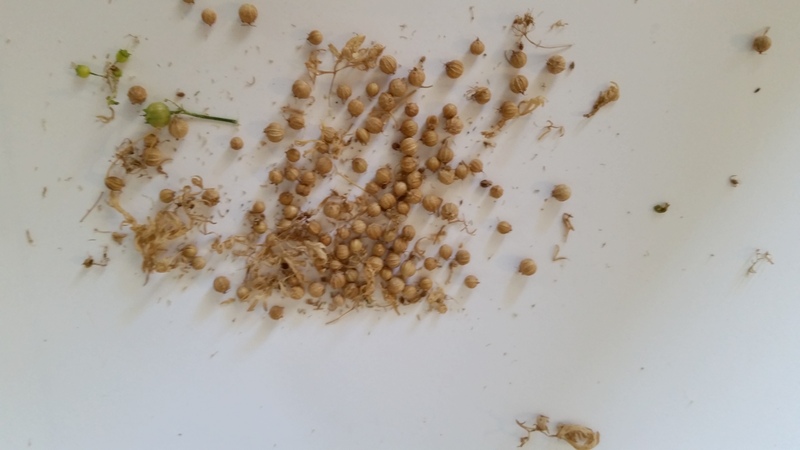
Next was the cilantro, which
mysteriously crosses over and becomes "coriander" when I
think of the seeds rather than the leaves and stems. Oh, you're
supposed to use
those terms.
We use coriander seeds all the
time when cooking Indian dishes. But maybe I don't have to buy the
seeds in bulk, when I have a coriander-seed-tree right at home?
Once again, it's snip and shake.
If shaking doesn't do the trick,
give each little seed a pinch off the branch.
My husband suggested a freshness
taste test, but I couldn't really tell the difference between the
purchased and the homegrown, other than the bits of tiny debris in
the homegrown.
Finally, the basil seed.
Unlike the dill and coriander seeds, basil seeds aren't a mainstream
grocery spice rack item. I had grown the basil from seed, and I mainly
intended to save the basil seeds for next year's planting.
But a brief
google search revealed the limits of my imagination.
Thai basil seed ice cream!
Trendy salad ingredient! ("Inexplicably, the chefs also spurted a gray dribble of soaked basil seeds on the plate,"wrote the less-than-thrilled New York Times restaurant critic.)
Tapioca pearl alternative, perfect for bubble teas, smoothies, and other beverages!
Weight loss aid! (A skeptical comment from the Livestrong website: "Basil seeds, also called tukmaria seeds, are touted as a weight-loss aid
because of their ability to swell in water and, therefore, improve
satiety. While there's no harm in including basil seeds as part of a
healthy weight-loss diet, no studies support these claims.")
Medicinal powerhouse, fighting respiratory, digestive and skin ailments!
Once again, the basic method of harvest was snip and shake. The basil seed heads were stickier than the others, so I pushed the whole mess through a sieve to get my seed yield.
Since most uses mentioned basil seeds' ability to become gelatinous tadpoles with soaking, I decided to soak the seeds and try them out. (No, the photo below is not a grubbier version of the dragon fruit photo at the start of this blog post.)
The resulting concoction was as gelatinous and tasteless as promised. What the heck, if you're in the habit of adding chia seeds for a nutrition boost to your smoothie, I suppose you could try this alternative. I'm going to save the basil seeds for the more mundane task of planting next year's crop.
But this whole exercise has changed my perspective. I'm looking at all of this year's crops with next year's in mind.
Cherry tomato seeds, anyone?