Wednesday, October 28, 2015

What the heck is that? Sooty blotch

My friend Robair recently commented, "Every time I read your blog, I learn something new about something I'd like to eat."

Not this time, baby.

I should be upfront with the news: Sooty Blotch is not actually an item of produce, though it's fun to imagine asking a vendor for 2 lbs. of it. Nor is "sooty blotch" a vivid insult, though it sounds like an entry in the Urban Dictionary.

Rather, sooty blotch is the first, and probably the last, non-produce entrant in the "What the heck is that?" category.

Sooty blotch is a fungus.


Sooty blotch isn't a tasty fungus like mushrooms or huitlacoche, the Mexican corn fungus that is also known, hilariously, as corn smut. Sooty blotch is the fungus that gives meaning to the term "no spray."


Sooty blotch is associated with wet summers, and can affect other fruit besides apples - pears, grapes and plums are also favorites of the fungus. Farmers can treat their crops with fungicides or simply prune the trees more aggressively during the winter, since better air circulation means better drying in the wet warm weather.   

Seeing unsprayed apples is like seeing one of those "Shocking and Unrecognizable: Stars Without Make-up!" articles that celebrity magazines love to publish. Wow, is that a blemish on Beyonce? You mean it takes work for Katy Perry to look glamorous?

You mean apples would like this without anti-fungal spray?


Listen to Iowa State University's plant pathologists discuss sooty blotch and hear the echoes of feminist deconstructions of the conventions of beauty. As one pathologist noted mournfully, "People know what a good apple looks like. They're used to the Disney World-looking apples."  Another pathologist added, "It's devastating if you're the grower," saddled with apples unfit for the consumer's gaze, suitable "only... for juice and in pies."

I notice that even organic apples sometimes feel the pressure to be beautiful, especially if they're jockeying for attention in a gourmet market.


 Meanwhile the dreaded fungus is by all accounts tasteless and harmless. "Give the skin a good scrubbing if it bothers you," one vendor at the Union Square Greenmarket told me. "Or scrape it off with your nail. That is, if it bothers you." He was right - there was no taste difference, and some of the discoloration did come off on my cloth when I gave a few wipes.


Learning about sooty blotch has made me a bit more accepting of apples' cosmetic imperfections. At the same time, it has also made me aware of the hard work - and probable chemical intervention - that goes into making an apple look naturally perfect.

Today I bought a perfect-looking apple. But lovely on the outside did not guarantee perfection on the inside. Nature often surprises.


 Hmmm...could this become a selling point?


Ya gotta have a gimmick!

Friday, October 23, 2015

Save the seeds

When I recently served my father-in-law some dragon fruit, he said the same thing he always says when I serve him a new and intriguing fruit, especially a fruit whose seeds are prominent or themselves intriguing:

"You should save the seeds. If I still had a garden, that's what I would do. Plant them and see what happens."


Well, I am nowhere near the accomplished gardener he is, but I am finally taking his advice. 

I'm not ambitious enough to attempt to raise dragon fruit, a heat-lover native to Southeast Asia, but his words inspired me to direct my attention to my herb garden.

This year's crop included basil, dill, cilantro, oregano, parsley and chives. The oregano, parsley and chives are still going strong; the dill and basil are a mix of viable plants and stalks with dried leaves and seed heads; and the cilantro has entirely gone to seed.


Time to harvest!

First, the dill. I enjoy the dill in its "firework" stage, when I use the leaves and pretty yellow seed head in pickles and salads, but that doesn't mean the party's 
over when the fireworks subside.
 

  There's still some utility in the pale, dried-out skeleton.


 I chopped off the dill heads, and then gave them a good shake.


What can you do with the ensuing bounty?


Dill seed was actually a mainstay spice in my rather spice-deprived home. My mother, who has an extraordinarily keen sense of smell, used salt and pepper very sparingly and adventured to the use of garlic only after a late-adulthood trip to Italy. But she used dill seed very frequently in soups. You can also use dill seed in pickles, salads and anywhere you might use caraway seeds - in rye breads or dishes like sauerkraut or braised red cabbage. 

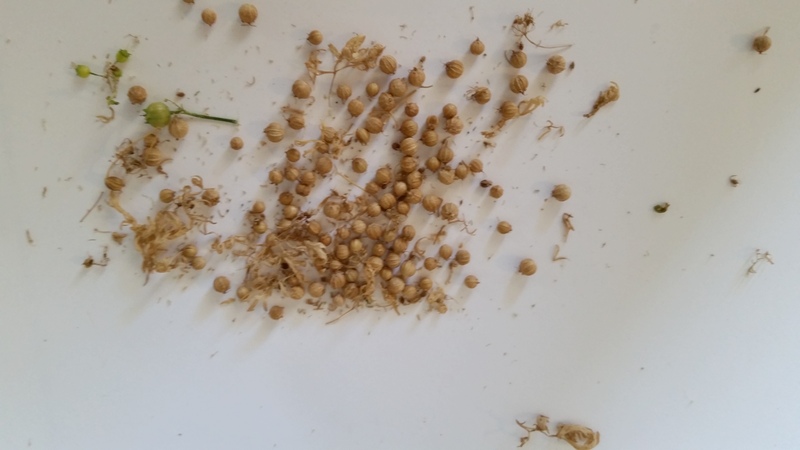
Next was the cilantro, which mysteriously crosses over and becomes "coriander" when I think of the seeds rather than the leaves and stems. Oh, you're supposed to use those terms. 


We use coriander seeds all the time when cooking Indian dishes. But maybe I don't have to buy the seeds in bulk, when I have a coriander-seed-tree right at home?

Once again, it's snip and shake.


If shaking doesn't do the trick, give each little seed a pinch off the branch.


My husband suggested a freshness taste test, but I couldn't really tell the difference between the purchased and the homegrown, other than the bits of tiny debris in the homegrown.


Finally, the basil seed.


Unlike the dill and coriander seeds, basil seeds aren't a mainstream grocery spice rack item. I had grown the basil from seed, and I mainly intended to save the basil seeds for next year's planting.


But a brief google search revealed the limits of my imagination.  

Thai basil seed ice cream!

Trendy salad ingredient! ("Inexplicably, the chefs also spurted a gray dribble of soaked basil seeds on the plate,"wrote the less-than-thrilled New York Times restaurant critic.) 

Tapioca pearl alternative, perfect for bubble teas, smoothies, and other beverages! 

Weight loss aid! (A skeptical comment from the Livestrong website: "Basil seeds, also called tukmaria seeds, are touted as a weight-loss aid because of their ability to swell in water and, therefore, improve satiety. While there's no harm in including basil seeds as part of a healthy weight-loss diet, no studies support these claims.")

Medicinal powerhouse, fighting respiratory, digestive and skin ailments!

Once again, the basic method of harvest was snip and shake. The basil seed heads were stickier than the others, so I pushed the whole mess through a sieve to get my seed yield.


Since most uses mentioned basil seeds' ability to become gelatinous tadpoles with soaking, I decided to soak the seeds and try them out. (No, the photo below is not a grubbier version of the dragon fruit photo at the start of this blog post.)


The resulting concoction was as gelatinous and tasteless as promised. What the heck, if you're in the habit of adding chia seeds for a nutrition boost to your smoothie, I suppose you could try this alternative. I'm going to save the basil seeds for the more mundane task of planting next year's crop.

But this whole exercise has changed my perspective. I'm looking at all of this year's crops with next year's in mind.


Cherry tomato seeds, anyone?

Tuesday, October 13, 2015

Apple picking in friends' backyard

Apples! The pride of the Union Square Greenmarket, where you can buy over 60 varieties (and counting).

But what the heck are they doing growing in my friends' backyard?


I surprised myself by acting like an urban hayseed. It's not like I don't grow produce myself. I covet the sour cherry tree on 19th Street near 2nd Avenue! And I fondly recall the crab apple trees that were common in my childhood home in Queens. But I betray my urban sensibilities when I encounter real apple trees in a backyard, full of fruit ripe for the picking.

My friends Joan and Frank have a house in Stony Brook, a college town on Long Island. They planted two apple trees in honor of their young grandsons, Tyler and Cameron.


Joan and Frank described the apple trees as McIntosh and Red Delicious, probably the two most popular varieties in New York. The McIntosh tree, bearing round red fruit, was indeed a McIntosh, but I had my doubts about the Red Delicious. "They're not ripe yet," Joan said of the still-green fruit. But they looked full-sized and ripe to me, despite its green color.

Feeling curious, I picked one of the green apples - you can do that with a tree in your backyard - examined it. The apple looked like it was as big as it was going to be; all of the apples on the tree did. I washed the mystery apple and cut it up. This was not a Red Delicious at all, but rather some variety of green, semi-tart apple. 

I reviewed the inventory of greenish apples I had in my head. Too small and tart for Mutsu. Too sweet for Rhode Island Greening. Didn't really look nor taste like Granny Smith. What was this apple?

I took a couple of apples, thinking I would ask one of the Union Square apple farmers. I ended up eating them instead. That happens a lot with fruit and me.
So I described the green apples to some farmers, and we played the "Who Am I?" game. The most compelling guesses were two heirloom varieties I had never heard of: Briggs Auburn, a variety so obscure it doesn't even get a mention on the comprehensive fruit fetish site Orange Pippin, and Chehalis. Could this simple Red Delicious apple tree really be an obscure heirloom variety instead? Apple trees grown from seed can cross-pollinate to become a different variety than expected. Maybe that's what happened here.

I decided not to get too hung up on the green apple's mysterious identity, which left plenty of room to mull over the pleasure of having an apple tree in the first place. There were apples to eat and apples to squish and throw into the brook behind the house.


There were apples to observe as science experiments, as in this one, Bugs Like Apples.


And of course humans, ants and worms aren't the only animals to admire apple trees. Deer and rabbits love them too, as Joan noted ruefully. But there is enough to share, and enough to continue to engage Tyler and Cameron for years to come - hanging out in the shade of the trees, playing with the fruit, and sustained by its flavor and nutrition.


Tuesday, September 29, 2015

What the heck is that? Muscadine

Suddenly they are everywhere.  Well, maybe not everywhere, but at a lot of places.  

Could muscadines, aka swamp grapes, be the Next Big Produce Thing?


Here are some muscadines at a produce stand in the South Bronx. 


Surrounded by fruit stand mainstays like bananas, strawberries and oranges, and Latino neighborhood mainstays like papayas, plantains and two kinds of avocados (one of which, the large tasteless green kind, labeled "Domin" for Dominican, perhaps a slander) were the muscadines: small purplish fruit, a bit smaller and rounder than Damson or Italian Prune plums in the primo real estate of the center square. 

I have also been seeing muscadines all over Chinatown. Here they are at one stand in Chinatown, next to longans, grapes and starfruit.


 And here they are at Sarah's Fruit Stand in Union Square.


I have a poor track record of produce prognostication - that is, guessing which obscure produce items will cross over. I wouldn't have plucked muscadines off the chorus line.

Muscadines are grapes that are native to the United States, specifically its hot, swampy South, where most grape varieties would plead uncle. They are a fruit with many nicknames, including "America's first grape." Sir Walter Raleigh described muscadines in glowing terms way back in 1584 when he encountered them growing along the Outer Banks in 1584. Southerners have been making jellies, sauces and - most importantly - wine, ever since.

Muscadines grow in clusters, but the clusters are much looser than the tight bunches of other grapes. 


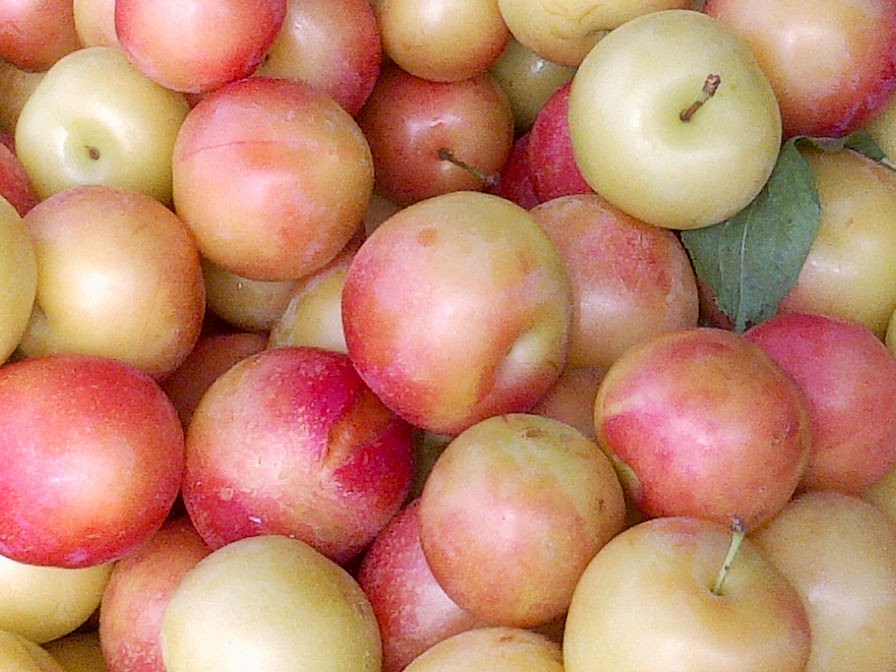
They are harvested one by one, not in bunches. And they are big by grape standards, so it's easy to mistake them for small plums, as you would for the fruit in the opening photo.

Photo credit: grapeseedextract.com
Muscadines, like most deeply colored fruit, have impressive antioxidant levels, and are especially high in resveratrol and ellagic acid. M.D. Journals (special Carolinas edition, natch) says, "A single 1 cup serving of muscadine grapes would more than double the average person's antioxidant intake." This could explain some of the fruit's newfound popularity. In the South, there is also a certain folk celebration of the fruit in the South, especially for old-time muscadine hull pies and wine.

On the "con" side, however, are two inescapable attributes: seeds and thick skins. In this country, seeds are generally considered a nuisance by most fruit consumers (and the corporations that predict and shape consumers' behavior). When was the last time you saw watermelon with seeds, for example?

Thick skin is a different matter: even though I have no quarrel with baked potato and kabocha peels, I am annoyed by the muscadines' thick skins. (I'm pretty tolerant of seeds). But muscadine lovers work around the problem.

Ozzy of Sarah's fruit stand is one enthusiast. "I love them!" he said. His technique is to bite into the muscadine and suck out the pulp, which he then discards. He doesn't mind the seeds, but as he says, "I'm Turkish, so I don't think fruit shouldn't have seeds."


He throws out the skins, but as muscadines grow in popularity, I imagine a secondary market for the discarded skins. Added to smoothies for the nutritional power? Harnessed for agricultural disease resistance? Organic clothing dye? Touted addition to makeup and shampoos?

Or maybe it's just time to bake up some extra muscadine hull pie.

Saturday, September 19, 2015

Saudações de Portugal (Greetings from Portugal)


When my jetsetting friend Bethanne told me she was planning a trip to Portugal, I naturally demanded some photos of the markets.

"What are you looking for?" she asked. "What if they don't have anything that interesting, just the familiar things we have here?"

"I still want to know what they have and how they sell it," I replied. "Maybe they have huge displays of olives, or something that expresses the essence of the Portuguese way of life.

"I love produce markets!" I added enthusiastically, maybe too enthusiastically. I hoped I wasn't spitting as I talked, though even if I had been, it was a phone call and she would have been unscathed.

Whatever her misgivings, Bethanne is a good friend and she took some photos for me. Actually she took more than photos -- she took a hit for me (and the noble cause of produce nosiness), since the supermarket, a Pingo Doce supermarket in Campo Grande, told her to stop photographing.

This photos below show a nice assortment of melons, plums, regular and donut peaches, grapes, etc. There are also some interesting curiosities above the fruit, like the inflatable banana in the above the fresh fruit in the upper part of the photographs.


I wanted to learn more about Pingo Doce, which looks like a large Portuguese supermarket chain. I enjoyed checking out the stores' weekly circular - something your can't do with a roadside fruit stand or even a central market, however wonderful they are in other ways. From what I could see, fruits and vegetables seem to play a supporting role, as they would in a US circular; I was most struck by the centrality of fish (another supporting player in the circulars I'm most familiar with), and wine, which in NYC is mostly sold in wine stores. In NYC, probably the most famous Portuguese food is very tasty Portuguese bread, originating in Newark's Ironbound neighborhood and delivered all over the metropolitan area. Bread gets a lot of love in the motherland too, judging by the respectful amount of real estate devoted to in the circular.

I also enjoyed reading about the fruta e legumes in Portuguese, which is amusingly similar-but-different than Spanish. Carrots, "zanahoria" in Spanish, are "cenoura" in Portuguese. Onions, "cebolla" in Spanish, are "cebola" in Portuguese.  Oranges, "naranja" in Spanish, are "laranja" in Portuguese. And so on. I notice too that the word "importada" (imported) shows up in a few listings, suggesting that most of the stuff isn't imported, and that the names of maçãs (apples) are in English - Gala, Royal Gala, Starking and Golden. The "translate this page" button helped me learn Pingo Doce's philosophy regarding its produce: 
We are committed to flavor and sweetness. Meaning that define levels of minimum sugar content for each variety of fruit we put on sale.Here you will not find fruit that is not sweet. Do not forget: flavor and sweetness.
Bethanne basically agreed with this sentiment. She wrote, "I found the fruit to be sweeter than in the US. Some of the homegrown stuff gets very big - melons, lettuce and oranges, larger-sized that what you see sold in the US."

Thanks, Bethanne, for the photos and reporting. And thanks Pingo Doce for a new, tattoo-worthy creed for all fruits, fruit vendors and fruit customers:
Do not forget: flavor and sweetness.

Thursday, September 10, 2015

What's a nice farmers market like you doing in a place like this?

The farmers market had some good stuff. 


Wonderful peaches, both yellow and white. Nectarines. Concord grapes. Apples. Tomatoes. Berries.


The vendors spoke Russian, not that surprising, given that Brighton Beach, New York's most Russian neighborhood, was only about a mile away. But the market's wares were less noteworthy than its location: near the boardwalk of Coney Island, an area more celebrated for freaks than leeks.


(And certainly the food item most emblematic of Coney Island - especially because Coney Island Whitefish isn't actually a food item - is a Nathan's Famous hot dog, still going strong after nearly 100 years.)


I came to Coney Island to watch Minor League baseball: the Brooklyn Cyclones, an affiliate of the NY Mets, were battling their cross-Narrows rivals, the Staten Island Yankees. Wholesome, carefully arranged produce was just about the last thing I expected to encounter in front of the Cyclones' MCU Stadium.


Despite the typical stadium rules against bringing in food, the guard let me bring in my newly purchased produce. "We say no snacks, but I gotta admit you're not going to find fruit in there," he said, jerking a thumb toward the concession stands. Hot dogs and fries were as popular inside the stadium as they were just outside of it.
After the Cyclones lost to the Staten Island Yankees, we took in some of Coney Island's other attractions.


When I last went on the Cyclone. I felt lucky to have my teeth still in my head at the ride's end. But this old-school (circa 1927) rollercoaster has been joined by newer rides like the Thunderbolt, Sling Shot, Zenobie, and Soarin' Eagle, variations on the theme of dropping you from a high point really fast and probably shaking you upside down a couple of times for good measure. While we were watching the game we could see the Thunderbolt car making its way up on the track (and if you go to the game picture above, you can see the ant-like car beginning its vertical path upwards in the upper right-hand corner; the track's super-sharp descent immediately follows). More tellingly, we could follow its path by the passengers' screams, which we had no trouble hearing over the din of the game. (To get a sense of these rides, just click on the respective link for a virtual front row seat on each ride.) 

 
There were no shortage of screams as we strolled around the park, contemplating the long lines and dithering about whether to join them (maybe next time). I was impressed by the sighting of a White Castle tucked in among the rides. Who thought that the experience of being catapulted 150 feet in the air at 90 miles/hour, then twisted into a couple of somersaults, would be enhanced by a greasy burger? 

But to be fair even the lovely farmers market peaches wouldn't be very appealing then either. 


Friday, September 4, 2015

How to Pick a Good Cantaloupe

Yes, once again I'm taking a break from showcasing the oddball and  curious side of produce to offer, as my friend Karen said, "something useful, for a change." My only regret, of course, is that I can't offer this particular blog post in Odorama.


You might recall Odorama from the John Water's film Polyester.  The movie was enhanced by Smell-o-Vision cards that audience members were supposed to sniff at various times in story, to give them a deeper understanding of the movie. (This being a John Waters movie, unlike later family-friendly copycats like Spy Kids, which used "Aromavision," the scents included dirty sneakers and airplane glue.)

A Smell-0-Vision card would be useful to demonstrate the most important criterion in selecting a good cantaloupe: aroma.

A sweet, ripe cantaloupe will have a very pleasant, tropical, floral scent. Your nose can help you weed out cantaloupes with rot and mold - distinctive and unpleasant smells.

In the absence of Odorama, I suggest that you get into the habit of smelling cantaloupes that were sweet and luscious, and committing the smell to memory. Likewise, remember the smell of melon mold and remember it when you next hold your cantaloupe auditions.

You can also find visual clues to the cantaloupe's taste.

First, avoid cantaloupes with signs of withering, moldy patches or rot.


Next, look at the cantaloupe's underlying color below its netting. A creamy or orange color is good; greenish casts, especially if they are dark green, suggest underripeness.

Finally, check out the melon's stem end. An "innie" indentation means that the cantaloupe was ripe enough at the time of harvest to be pulled off its vine.


If the melon still has a bit of stem attached, it means that it had to be cut off before it was fully ripened.


As always, a fruit that is heavy for its side is likely to be ripe and juicy.

Choose a cantaloupe that is heavy for its size and has a floral aroma, creamy color, and an innie stem end, and you're likely to nab a good one!


After dealing with the mystery of the plum, my status as the Produce Savant needs this reassurance.

Saturday, August 22, 2015

The Mystery of a Plum

Sure, many kinds of fruits and vegetables come in an array of colors, shapes and sizes. It's hard to go to the Greenmarket and not marvel at the variety of peppers, for example. But I think I know what to expect with peppers: small peppers are generally hot (how hot, of course can vary enormously) and green peppers taste more vegetal than red ones.

Plums, on the other hand, continue to stump me.


I understand a few varieties, especially the Empress and Prune - the oval ones with purple skins and greenish-brown flesh. When I was young, the sightings of prune plums always made me sad, since they signified the end of summer and the imminent return to school. Nowadays they appear in July, breaking the poignant end-of-summer-freedom association. I'm not a big fan of these plums, but I appreciate their intelligible code: hard plums will be tart, soft ones sweeter, and their flesh predictable along the green-brown spectrum.

But "black" or "red" plums are another story. Will their flesh be pink-red -- or beige? Plums with similar purple-black skin can look nothing alike when cut.


Markets that meticulously describe their produce often still use these crude color terms to identify their plums.


I turned to the International Federation for Produce Standards PLU (Produce Look Up) Codes on the plums' stickers for salvation.


Not much help! The code 4040, for example, just signifies "Large Black Plum."
This "includes Ambra, Black Beaut, Prima Black, Blackamber, Black Torch, Catalina, Challenger, Black Diamond, Friar, Royal Diamond, Black Knight, Freedom, Black Flame, Howard Sun and Angeleno." This range means that the plums labeled #4040, the most common number I've seen, can vary from squat to heart-shaped and can have interior flesh of pretty much any possible plum color: dark magenta, beige, pale pink. More importantly, #4040 plums can have any degree of flavor. Likewise, Code 4042 indicates "Large Red Plum," with another wide range of varieties (including ones I actually am familiar with, like Santa Rosa and Fortune).

Three of the stickers featured a cute dinosaur, which is a trademark of Dinosaur Brand pluots. A few years ago NPR claimed that pluots, the plum-apricot hybrids, "now make up a majority of the plum market. In fact, you might be eating a pluot or an aprium [another plum-apricot hybrid] and not even know it." Based upon my sticker survey, with many more #4040s than any other number, that isn't true. Using the International Federation for Produce Standards PLU website tells you about as little about the pluots as it does for plums: PLU 3278 is "Mottled Pluot" whereas 3609 is "CA Red Pluot." But since pluots and plumcots, pluots' plummier cousins, are relatively recent hybrids, breeders are interested in their distinctions. I wouldn't mind a chart for plums as comprehensive as this handy-dandy one for pluots!

Of course, many markets sell farm fresh plums, free from any PLU sticker adornment. The Union Square Greenmarket leans heavily toward plums round and small, like Shiro and Methley, which they sometimes call Sugar Plums. Of course, "sugar plums" usually refers to a confection of dried fruit, ground almonds and lots of sugar -- adding to the confusion that surrounds plums.

So what to do with the mystery of the plum? I'd say relax and enjoy its unpredictability. And with that, I'll salute the plum, in all of its diverse beauty and mystery.